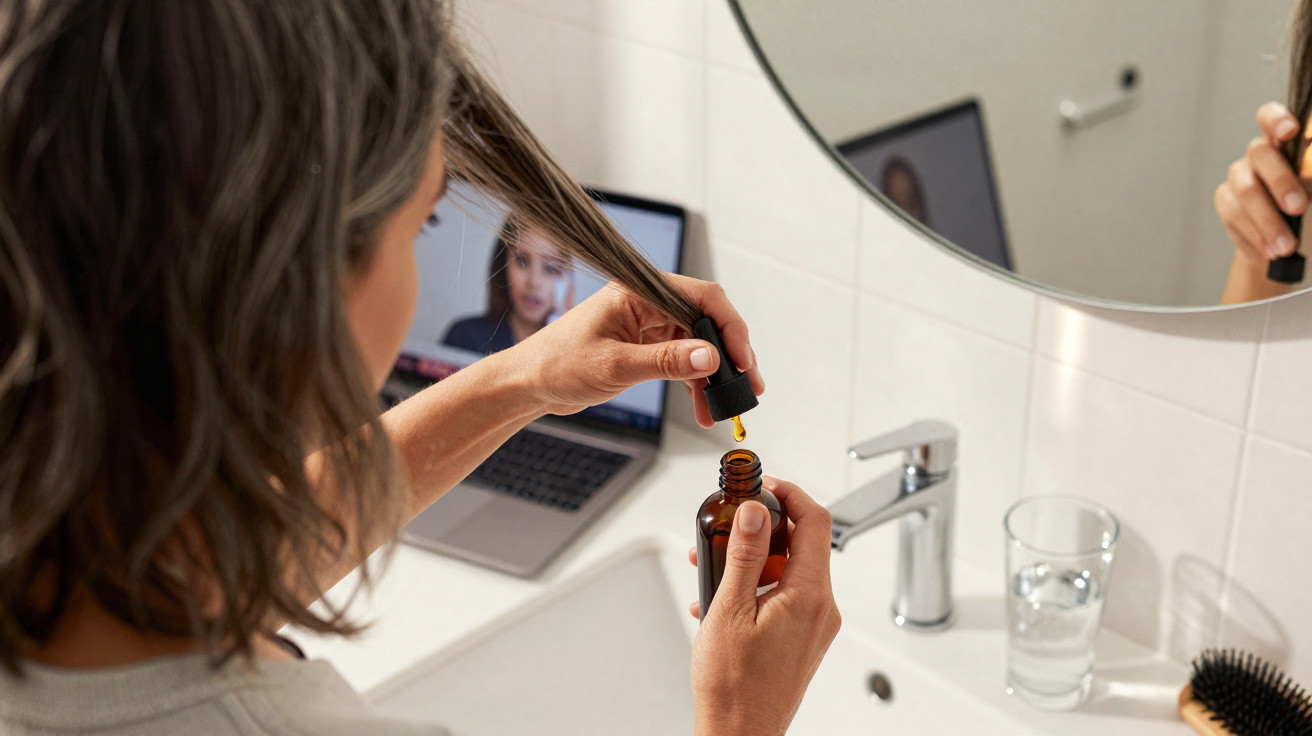
You tend to spot it in the bathroom mirror first, or in an unflattering lift selfie. Your hair no longer seems as rich as it once did: perhaps it is paler at the roots, slightly transparent at the temples, particularly when somebody tags you in a photo you never asked for. Then a friend mentions a magical shampoo add-in that makes hair appear darker, thicker and more “alive”, and you pay attention. It sounds like effortless sorcery: add a drop to your regular shampoo, work up a lather, rinse, and emerge with fuller-looking hair in a deeper shade. No intimidating box dye or two-hour salon expense, just a discreet adjustment to your usual routine that nobody has to know about. Yet the familiar question behind every bathroom-shelf claim remains: what genuinely works, and what is simply hopeful thinking in an expensive bottle?
The quiet rise of “shampoo boosters” for darker hair
Visit any high-street chemist and you will find shelves increasingly packed with little bottles and sachets promising to “deepen”, “tint” or “shade-enhance” hair. These products are sold as add-ins or boosters to blend with your usual shampoo, supposedly making brunette hair seem richer or making grey strands less noticeable. Some are presented as natural botanical concentrates, others resemble hair dye in a smaller tube, while some are effectively tinted conditioners under another name. Their wording is deliberately gentle and imprecise: “revives tone”, “buildable depth”, “washes out gradually”. In other words, do not expect an overnight shift from mousey brown to espresso.
There is a clear reason these small extras have become popular. Conventional permanent colour can feel like a major commitment, involving potent chemicals, patch tests, stained towels and worries that your hair might break in the shower. A shampoo add-in sounds mild, temporary and almost skincare-like for your hair colour. It appeals to a hope many people share: perhaps there is an option between fully accepting grey hair and signing up to a complete dyeing routine. Something manageable in the three minutes it takes for the kettle to boil.
We’ve all had that “zoom call lighting” moment
If you have ever looked at yourself on a laptop screen and thought, “When did my hair start blending into my scalp?”, you are far from alone. Harsh office lighting, brightly lit supermarket aisles and unforgiving mid-morning sunlight on the bus all make grey hairs and lighter patches far more visible. Noticing it is not vanity. Hair frames your face, and when it appears patchy or flat, you can feel slightly unlike yourself.
So when a colleague mentions that they “just add a bit of this stuff to my shampoo, makes my hair look less see-through”, the thought can stick. It sounds like a hidden tip that every other adult has known for years while you have been scrutinising yourself in bathroom mirrors. The appeal is not necessarily about appearing younger, but about looking closer to the person you imagine yourself to be. There is something unexpectedly reassuring in believing the solution could be a teaspoon of liquid sitting in your hand.
What’s actually inside these darkening add-ins?
Once the branding is stripped away, only a few ingredients can make hair seem darker when mixed into shampoo. First, there is real dye: diluted semi-permanent colour. Next come pigments and colour-depositing ingredients, like those found in tinted conditioners. There are also herbal and plant extracts that can lightly stain hair over time, including henna and black tea. Finally, there are powders such as coffee and cocoa, which are often championed on social media, although people rarely mention the state of their towels afterwards.
Where a product uses phrases such as “colour deposit”, “tone corrector” or “pigment booster”, it will usually contain genuine colour. This clings to the hair’s outer layer, particularly lighter hairs and grey strands, then fades slowly with washing. These are the add-ins that really can make hair look darker, even if the difference is only half a shade. Plant-based tinctures can sound appealingly romantic - walnut shell, indigo leaf and sage - but they generally produce a very subtle result unless left on for a long time. They may add warmth to a shade rather than truly deepen it.
The truth moment: you’re not doing lab tests in your shower
In reality, nobody is carefully measuring shampoo in millilitres or timing their lather to the second. You are likely half awake, surrounded by steam and shower gel, simply trying to get clean before the school run or your first Teams meeting. Anything requiring careful mixing and the accuracy of a laboratory experiment will probably be used once or twice before being relegated to the back of the cupboard. An add-in that works only when you follow a five-step ritual on every wash day is unlikely to last.
That is why straightforward formulas tend to succeed in daily life. A few pigment drops that turn your ordinary clear shampoo light brown are easy enough to use. A sachet that must be poured out, stirred, left on for twelve minutes and rinsed in cold water is another matter entirely. There is a reason such routines appear on TikTok rather than in your friend’s actual bathroom. Products that work with your laziness, not against it, are the ones that quietly change how your hair looks.
What really makes hair look darker: more than just colour
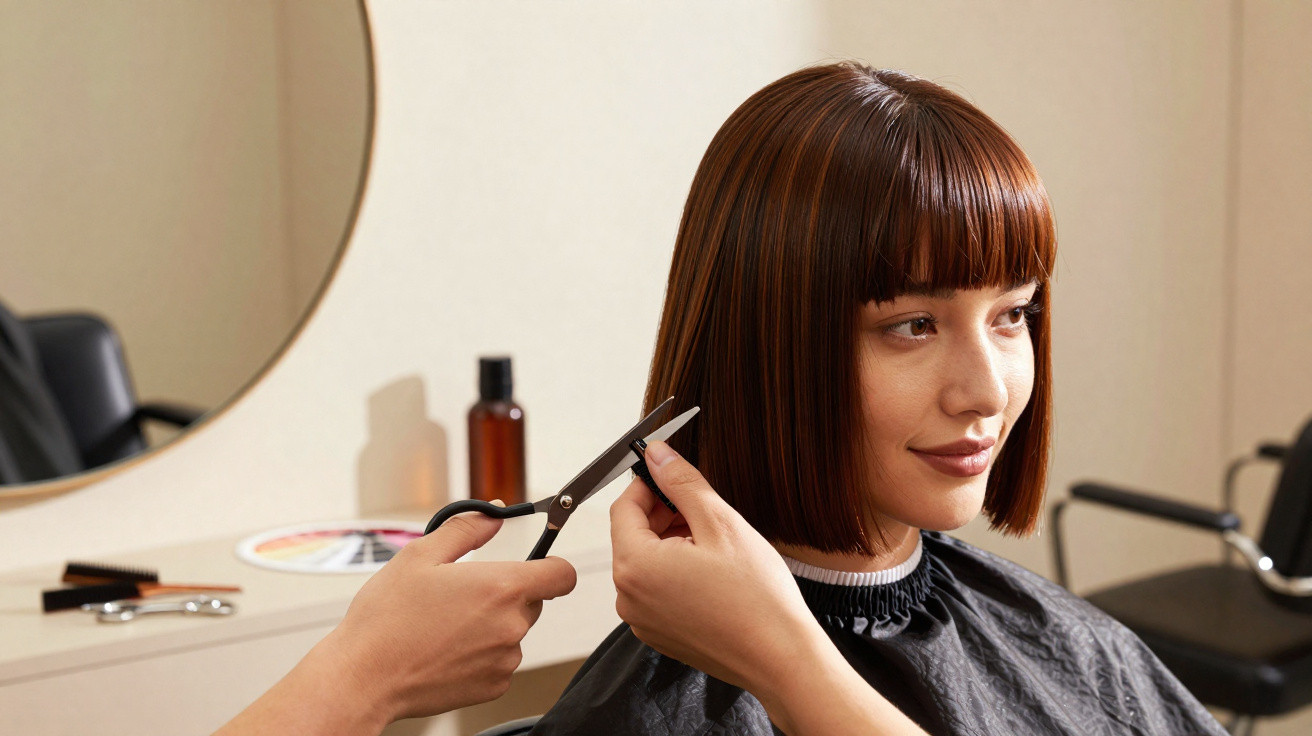
Here is the detail that packaging rarely highlights: hair can appear darker without becoming significantly darker in colour. Its shine, smoothness and the way individual strands sit together all affect how light meets your head. Rough, fluffy or frizzy hair scatters light and can look paler, almost dusty. Hair that is smoothed, lightly grouped together and covered with a glossy layer reflects less light and appears richer in tone.
This is why certain supposed “darkening boosters” focus more on conditioning and coating than strong pigment. Silicone-based add-ins, selected oils and proteins can help hair lie flatter and alter the way it catches the light. Consequently, your natural shade can look deeper, less scalp may show through, and grey hairs can blend in slightly more. The grey has not disappeared; everything around it is simply shinier and more even.
Thickness, density, and the illusion of depth
There is a psychological element as well. We often interpret slightly fuller hair as darker hair. A shampoo add-in that makes the hair shaft swell even a little, through ingredients such as panthenol or polymers, can make each strand occupy more room. There are then fewer spaces through which the scalp can show like a pale backdrop. Your brain reads this as stronger, deeper colour, even where the pigment itself has barely changed.
This explains why some people say their volumising shampoo “deepens” their hair even when it contains no dye whatsoever. They are not completely mistaken. If you want darker-looking hair around your parting or temples, a product that improves density and reduces flatness may help as much as a tint. The strongest darkening boosters usually combine both approaches: a hint of colour alongside clever work on texture.
The stuff that’s mostly hype
Naturally, as soon as people recognise a new beauty concern - “my hair looks washed out” - brands and influencers are eager to capitalise on it. This is when products begin making confident claims while doing very little. You may see clear liquids said to “react with your natural melanin” despite listing no colourants, or shampoos claiming to “remember your youthful shade” without explaining the mechanism. Such language is designed to sound mysterious so that you do not probe too closely.
Social media adds to the problem. Watch a viral clip of someone massaging coffee grounds into their scalp before revealing glossy raven waves, and you may be ready to put the kettle on yourself. Coffee, cocoa and black tea can stain hair slightly, especially if it is very light or porous, but they are untidy, unreliable and can dry hair out when overused. Many dramatic before-and-after images are shot under different lighting or after a proper colouring treatment. What you are seeing is editing, not a miraculous roast blend.
“Natural” doesn’t automatically mean safer or better
“Chemical-free” darkening boosters are also wrapped in a great deal of emotional marketing. The description is meaningless - everything is chemicals - yet it strongly appeals to contemporary worries about harsh ingredients. Botanical colourants such as henna, indigo and walnut can work brilliantly in suitable circumstances, and some cultures have used them for centuries. However, they can also cause allergic reactions, interfere with later salon colouring or cling unevenly to hair if used carelessly.
Natural options are not inherently the problem. The issue is that “natural” is often used as a comforting label for products that are still essentially dyes, only less consistent and less regulated. If you are concocting a darkening mixture in your kitchen, you will not necessarily know its strength, pH or how your skin may respond. Your scalp is skin, not a test area on a paper strip. A rash remains a rash whether it comes from a laboratory-made pigment or a crushed leaf.
What actually helps: realistic wins from shampoo add-ins
An honestly useful shampoo booster for darker hair will generally contain clearly listed low-level pigments alongside conditioning ingredients that smooth the cuticle. Rather than claiming it will turn blonde hair chocolate brown, it will say something like “enhances existing brunette tones”. It is also likely to recommend repeat use across several washes instead of promising one dramatic transformation. Oddly enough, claims such as “gradual” and “subtle” are encouraging signs.
With regular use, these products can genuinely shift your hair towards a shade or half-shade richer. Bright silver greys may become a softer smoky tone that blends more easily. Mid-lengths that have become slightly sun-bleached can recover some freshly coloured depth without an obvious root line. The reflection will still be you, simply a version whose hair does not broadcast every late night and low-iron week quite so clearly.
How to actually use them without wrecking your hair
One simple rule matters: check whether the manufacturer says to add the booster to the shampoo bottle or to mix it into shampoo in your palm at each wash. Combining it permanently in the bottle can occasionally destabilise ingredients or make the entire product overly strong. Mixing it freshly in your hand gives you more control, allowing you to begin with a couple of drops and assess the result after a week. If your nails become stained, brown foam appears on the shower floor, or white towels begin looking beige, you may have used too much.
It is also sensible, if unexciting, to perform a small patch test, particularly if you have sensitive skin or have reacted to products before. It may not be glamorous, but neither is scratching your scalp during a work meeting. Alternate with a non-tinted shampoo if your hair begins to feel heavy or coated. Even mild colour-depositing products accumulate with time. An occasional light detox can stop your hair feeling as though it is covered in three layers of varnish.
The things to avoid unless you like chaos
Certain experiments are best kept for late-night scrolling rather than tried in real life. Adding ordinary hair dye directly to a shampoo bottle, for example, may seem inventive until you realise you have created an unpredictable low-level dye bath that cannot be properly rinsed away. The colour may take more strongly on the ends than at the roots, run down your neck and continue reacting with every wash. That is not an easy touch-up; it is colour roulette in your own bathroom.
DIY mixtures can be equally unpredictable. Strong black-tea rinses and coffee scrubs may sound harmless, but they can mark grout, towels and the back of your neck. They can dry out some hair types and often produce uneven colour - darker at the ends and barely visible at the roots. The more effort and mess something requires, the less likely it is to become a calm, sustainable part of your life. You should not have to clean your shower as though it were a crime scene after every wash day.
Watch out for sneaky side effects
There are subtler risks too. Some shampoos marketed as “darkening” rely on powerful detergents that remove lighter build-up and reveal the underlying base shade. Your hair may look darker for a week before becoming brittle and frizzy. Other products depend heavily on temporary dyes that transfer to pillowcases and shirt collars when your head becomes sweaty. At that point, a discreet beauty adjustment has turned into a full-time responsibility.
A product that leaves your hair rough, overly squeaky or oddly coated after a few washes is not a success, regardless of how it looks in the mirror on the first day. Healthy hair reflects light more effectively, holds a subtle tint more evenly and is simply easier to manage. Slightly lighter hair that moves and shines is preferable every time to flat, dull hair that merely looks “darker”. Your future self, holding a towel, will be grateful you avoided the drama.
Making peace with the mirror, with a little help
Ultimately, shampoo add-ins are less about defeating ageing than finding a way to negotiate with it. They can soften the signs of change, blur a few edges and help you feel more polished when the lift doors open. There is nothing superficial about wanting your hair to align with how you feel inside, or about choosing an understated option rather than a full salon transformation. It is simply another way of saying that you still care how you present yourself to the world, even at 7am on a Tuesday.
The key is understanding what you are using and the reason for it. A drop of pigment that moves your natural shade towards richer territory while preserving healthy hair and an uncomplicated routine can be a small pleasure. You don’t need magic, just something honest that works with what you’ve already got. Perhaps the most radical view is that “a bit darker, a bit softer, still me” can be entirely enough.










Comments
No comments yet. Be the first to comment!
Leave a Comment