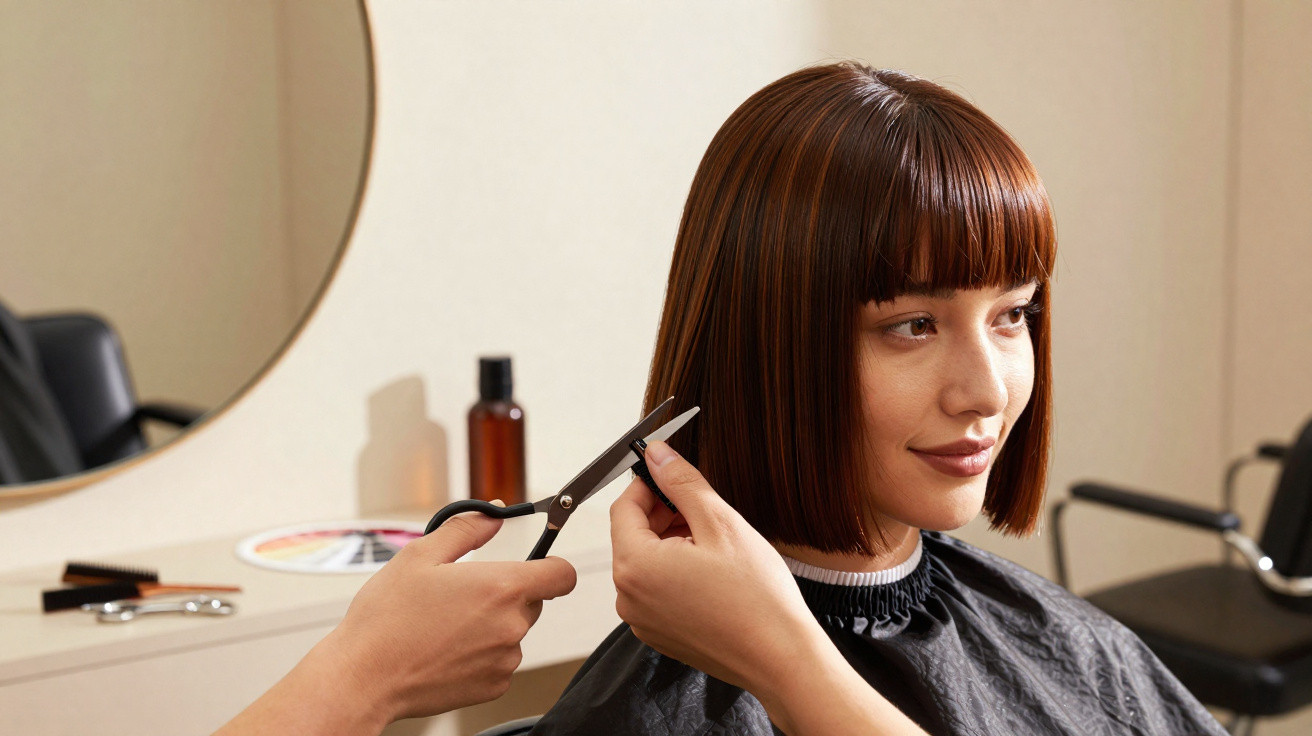
The young woman opposite me in the salon mirror is doing the thing we all do: saying she “just wants a little trim” while quietly wishing she will leave looking like an entirely new person. Her hairdresser winds a section around their fingers, checks her Pinterest board and gives a soft laugh. Every saved image? The French bob: that artfully undone, chin-skimming style that has dominated our feeds for three uninterrupted years. The stylist keeps scrolling before shaking their head as though they have already seen what is coming. “Cute,” she says, “but by 2026, this will look so 2022.”
Instead, she selects another picture: a crisper, more architectural square cut. The lines are clean. It is blunt, yet still somehow gentle. The woman immediately moves closer to the mirror, eyes wide, as if she has just found the next version of herself.
One square cut, countless personalities.
The square cut set to replace the French bob
Speak to any trend spotter in a major-city salon and the message is the same: the French bob is about to lose its crown. It will not be replaced by a shag or mermaid-length hair, but by a new square cut that falls somewhere between timeless and futuristic. Picture a near-geometric shape that skims the jawline, with sharply cut ends and an interior that is softly customised around the face.
At first, it appears remarkably straightforward, almost plain. Look again, though, and you see how it frames the cheekbones, defines the jaw and makes the neck appear longer, like an inbuilt filter. This is the square cut experts believe will shape 2026.
Trend forecaster and hair consultant Jenna Maillard refers to it as “the precision square.” Tracking catwalk looks and street style as they happen, she says the change is already visible in all the places that count: fashion-week backstage areas, private brand campaigns and among actresses tired of “the same Parisian hair brief.”
A streaming star recently turned up for a London shoot wearing a textbook French bob. Before the first day was over, the on-set stylist had recut it, creating a straighter edge, a slightly longer front and no separated, piece-y waves. When the first stills appeared in internal Slack channels, the brand’s marketing team reportedly replied with one message: “This. Is. 2026.”
What is different in practice? The French bob is built around texture, movement and romance. It suggests a “holiday in Montmartre” and depends on untidy waves and a tousled fringe. By contrast, the 2026 square cut is more pared-back and almost technological. It is a little longer-generally grazing the jaw or upper neck-and prioritises a precise silhouette over volume.
Experts say the move makes sense: after years of supposedly “effortless” styles that really required a curling iron and three products, women are seeking a look that appears deliberate without taking 20 minutes to style each morning. The square cut is your face, but under better lighting.
How to request and wear the 2026 square cut
First, do not arrive at the salon and vaguely say, “a bob, I think?” Your hairdresser is not a mind reader. For this new square cut, take two or three screenshots where the hairline is clearly shown, particularly at the jaw and neckline. Request a blunt outline that falls between mid-neck and the tops of the shoulders, with discreet internal layers to prevent it from sitting like a helmet.
Explain that you want the hair to look crisp when straight without becoming overly weighty when left to air-dry. That single sentence gives your stylist permission to personalise the interior while maintaining a sleek outer shape.
The biggest error is trying to recreate the exact cut seen on someone whose hair is entirely different from yours. Your friend’s poker-straight bob that behaves perfectly in rain could become triangular on your thick, wavy hair. Worse still, it might be cut too short, leaving you feeling like a mushroom for three months.
Be truthful about your real routine. If you know you will not blow-dry it every day, say so. If summer humidity flattens your roots, mention that as well. Let’s be honest: nobody really does this every single day. A skilled hairdresser will “future-proof” your square cut, so it remains stylish at 8 a.m. on a Tuesday with no styling at all.
Stylists are already changing the way they describe this look. Many have stopped using the term “bob” altogether because it brings too much French-bob baggage with it.
“I talk about geometry instead of trends,” says Paris-based stylist Lou Chassagne. “We decide together: straight line, slightly curved, or soft square. Then we choose where that line will live on the face. The right length is always about bone structure, never about Instagram.”
To make your appointment easier, save a few clear requests on your phone or write them down:
- Length zone: between mid-neck and the top of the shoulders
- Perimeter: straight, slightly rounded at the corners, no heavy stacking
- Movement: light internal layers or undercutting for thick hair
- Styling reality: “I air-dry most days” or “I use a blow-dryer and brush”
- Fringe: none, curtain, or soft micro-fringe, depending on your features
Why this cut suits 2026 better than the French bob
There is a reason experts are backing this square shape rather than another French bob variation. The world entering 2026 is more hybrid than ever: office and home, Zoom and real life, quieter weekdays and unexpected camera-on calls. Hair needs to keep pace. This square cut looks polished on screen, graphic in photographs and relaxed on a Sunday morning in leggings.
A single blow-dry can hold for three days, yet the shape still works if you simply tuck it behind your ears and leave the house. That’s the kind of low-drama consistency people are craving now.
There is also a subtle emotional change behind it. The French bob carried plenty of fantasy: the idea of a woman in linen, drinking natural wine and somehow never dealing with frizz. The 2026 square cut feels more realistic-less “character”, more “you but sharper”. It does not try to sell you a lifestyle you do not lead; it frames the life you already have.
Wear it with a red lip and trench coat one day, then a bare face and hoodie the next. It adapts without giving up its edge.
Its flexibility is not merely aesthetic. Colourists appreciate this shape because it displays shine and dimension without requiring elaborate balayage. In terms of products, a lightweight smoothing cream and one good brush can be enough. Most people don’t want a hair routine, they want a hair system that quietly works.
Experts also note a democratic benefit: this square is more forgiving across ages and textures than the trend-driven French bob ever was. On silver hair, it looks chic and architectural. On curls, when cut by someone who understands them, it becomes a soft cube that moves with you. We have all experienced that moment when a cut promises “cool girl” but delivers “why did I do this.” This one generally ages well.
A cut that could outlast the trend cycle
The irony of hair trends is that those with staying power often seem the least showy at first. This square cut does not demand attention on social media. Instead, it quietly appears in airline advertising, political portraits, independent fashion campaigns and your colleague’s new profile photo. Then, one day, you notice while scrolling that every woman you have unconsciously labelled “put-together, but not trying too hard” has the same broad outline framing her face.
That is the point at which a trend ceases to be a trend and becomes the default.
Hair experts looking ahead to 2026 believe this is precisely where things are going: fewer crazes, more intelligent basics. The French bob is unlikely to vanish; it will simply return to the archives as “that cute mid-2020s thing” that you show your children in the same way people now show ’90s Rachel layers. The square cut, meanwhile, has the structure of a future classic.
You may grow it out, alter the fringe or experiment with colour, but the central concept-a clean, face-framing square with understated movement-could remain with you for years.
So the real question is no longer “French bob or not?” It is this: what kind of outline do you want around your life in this next chapter? A gentle storybook silhouette belonging to somewhere else, or a precise frame suited to the reality of your day-to-day life? Salons will continue to introduce fresh names and micro-trends. You will continue scrolling, saving and second-guessing. Somewhere amid all that noise, this uncomplicated square will still be there, offering something unusual in beauty: calm, lasting, slightly unexpected confidence.
| Key point | Detail | Value for the reader |
|---|---|---|
| The 2026 “precision square” cut | Jaw-to-shoulder length, blunt perimeter, soft internal tailoring | Gives a clear reference to take to the salon and helps visualise the trend |
| Adapted to real-life routines | Works air-dried or blow-dried, needs minimal products and keeps its shape for days | Cuts daily styling time while still looking deliberate and modern |
| More inclusive than the French bob | Suits multiple ages, hair types and personal styles | Makes the cut a safer long-term option rather than a risky fad |








Comments
No comments yet. Be the first to comment!
Leave a Comment