
The hairdresser turns the chair, smiles and delivers the line you have heard countless times: “With your fine hair, a short cut will give you so much volume.” Looking at your reflection, your long ends already seem limp and worn out. Suddenly, the idea of a buoyant French-girl bob feels like the reset you have been waiting for. TikTok endorses it. Friends send before-and-after reels. The salon lighting is kind. You agree, and the scissors begin moving.
Three weeks later, you are standing at the basin watching short hairs block the plughole, asking yourself how a supposedly volumising cut has made your hair appear even thinner.
That distance between the dream and the result is where fragile fine hair can quietly suffer.
When “volumizing” cuts quietly reduce your density
For women with fine, fragile hair, the first pitfall is the highly layered short cut that appears so weightless on Instagram. On thick hair, choppy, separated layers can look naturally full and carefree. On delicate strands, however, they often divide up the little visual density you have. Viral reels do not show that part: they show the round brush, the immaculate blow-dry and the stylist’s skilled hands.
In ordinary bathroom lighting, without several mousses and 20 minutes of styling, those layers can quickly fall into limp, flat pieces that cling to the scalp.
Consider Elise, 39, who arrived at a fashionable salon with a long bob that had lost its lift and left with a feathered pixie-bob designed to create “lift and movement.” For the first two days, with the stylist’s finish still intact, she felt as though she belonged in a shampoo advert. The cut swayed, moved and had bounce. Her colleagues praised the new style.
By the end of the week, with no round-brush expertise behind it, her crown had become limp. The layers at her temples began splitting into narrow, stringy sections. Beneath the unforgiving office bathroom lights, she could see more scalp than she had before. Naturally, the cut had not reduced the number of hairs on her head, but it had halved the appearance of her volume.
There is a straightforward explanation for this subtle thinning effect. Fine hair depends on visual mass: strands sitting together appear denser, fuller and more substantial. Short cuts with too many layers divide that mass into small, separate areas. Every section must then hold its own, which is a risk when the hair is already fragile.
Moreover, the shorter the hair, the more visible every cowlick, flattened area and slight thinning along the parting becomes. The “airy, light” finish promised by stylists can simply mean more exposed scalp. Once the hair has been cut, there is no rapid way to reverse it.
The 4 popular short cuts that can backfire on fragile fine hair
The main offender is the very short pixie with heavy texturising. On social media, it is the familiar transformation: a tired long bob becomes an edgy French crop. The stylist uses a razor through the crown, chops into the sides and lifts it all with powder. It can look like instant volume. For fragile hair, though, razor cutting may create a problem area. The short, shredded ends expand on the first day, before fraying, splitting and lying flat only weeks later.
If your hair tangles easily already, a heavily texturised pixie creates ongoing friction, demands additional styling and causes more breakage where the strands are weakest. Volume on day one, regret on day ten.
The algorithm’s second favourite is the rounded stacked bob, with a very short nape and strongly graduated layers through the back. From the side, it offers an appealing outline: a full back, smooth front and an ideal angle for selfies. With fragile fine hair, however, this dramatic graduation concentrates much of the apparent weight at the nape and crown.
As it grows, the stacked section soon loses its shape, producing a bulky area at the back and flatness on top. Styling turns into a daily fight involving a round brush, heat and hairspray. Realistically, no one keeps that up every day. Often, the shape has faded within two weeks of the salon appointment, while the hair grows more delicate through constant restyling.
Third is the very layered “Italian bob”, or shaggy bob, which promises effortless volume through shattered lengths. It can be beautiful on thicker hair. On fine hair, every cut-in section gives away another piece of density. Rather than a compact, springy outline, the result may be transparent ends and the dreaded “triangle” shape: flat at the crown, puffy at the bottom, and then unexpectedly sparse.
Lastly, a micro-fringe or baby bangs combined with a short cut may look cool and editorial online. However, it takes valuable density from the front hairline. Where that area is already slightly sparse, a tiny fringe can draw attention to recession and leave the upper face looking exposed. Four trends, one shared risk: if you cut your hair to pursue artificial volume, your natural texture is often left without a safety net.
Fragile fine hair: cuts and habits that offer protection
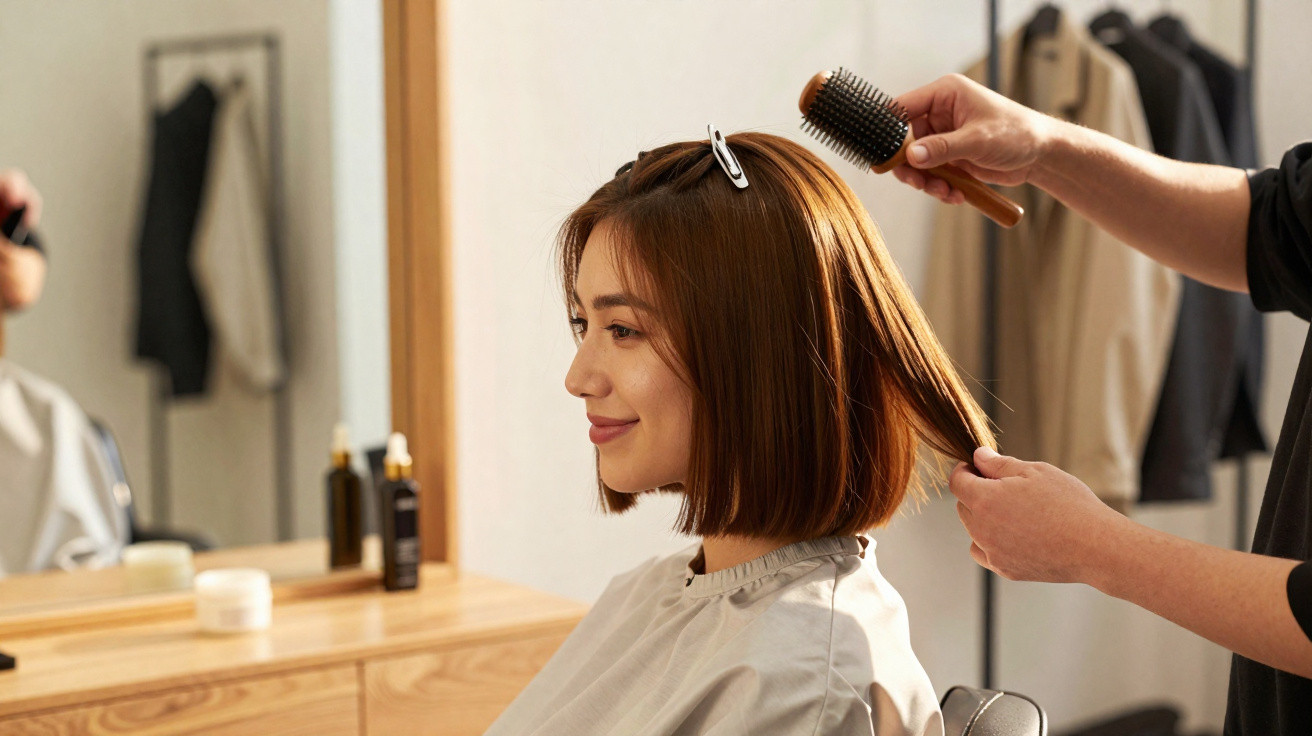
For fragile fine hair, a safer approach is to choose “compact structure” rather than “maximum layers”. In practice, this generally means short-ish rather than extremely short. A blunt bob, or one with soft graduation, falling between the jaw and collarbone often provides the strongest balance: it is short enough not to weigh down the roots, but long enough to retain visual mass.
Ask your stylist to leave the perimeter reasonably full and add only subtle internal layers around the crown and sides. The aim is a rounded shape with movement, without breaking your density into separate pieces. A useful technique is to have the ends slightly bevelled so they turn under, immediately creating the impression of greater thickness at the bottom.
For styling, pursue soft lift rather than a daily battle. A lightweight volumising spray at the roots, followed by drying with your head tipped slightly forward and using only your fingers, can provide more movement without excessive heat. Do not backcomb every day or use harsh dry shampoos at the scalp, as these can dry out and irritate fragile roots.
If you enjoy powders and texture sprays, save them for occasional use rather than making them part of your usual routine. Over time, they may weigh the hair down, reduce shine and leave strands more likely to snap when brushed out at night. Your hair does not need to look “TV perfect” every morning. It needs to last the week.
Sometimes the bravest choice for fine hair isn’t the boldest cut, but the one that quietly respects what you naturally have instead of fighting it at every centimeter.
- Less layering, more structure: Select cuts with a solid perimeter and only minimal, carefully placed layers. This maintains visual density and prevents see-through ends.
- Gentle styling, not daily warfare: Choose low-heat tools, finger drying and lightweight products. Your fragile hair will lose less keratin and retain its natural elasticity for longer.
- Discuss your real routine: Tell your stylist how much time you genuinely spend on your hair. A flattering cut must suit your life, not just a salon blow-dry.
- Monitor your hairline: If you spot thinning at the temples or along the parting, avoid micro-fringes and harsh texturising in those areas. Keep the density that remains.
- Plan for the grow-out.
Rethinking volume when your hair is already tired
A subtle change takes place when you stop viewing fine hair as a problem requiring correction and instead recognise it as a texture with its own rules. Pursuing dramatic, volumising short cuts can feel exciting for a day, only to become deeply disappointing once the styling effect disappears. That emotional high and low carries more weight than we often acknowledge.
We have all experienced it: the salon mirror shows a “new woman”, while the bathroom mirror asks, “what did I do?” Between before-and-after fantasies and the reality of your scalp, though, lies another question: what if the best cut is the one that does not require you to fight your hair every morning?
That may mean declining the edgy pixie your friend loves or the stacked bob your stylist insists will add volume. It may mean retaining a little more length, even when trends proclaim “short or nothing”. It may also mean waiting a month, speaking openly with a hairdresser you trust and watching your hair in its unstyled state before making a major change.
One plain truth applies: your hair’s fragility does not care about trends. Once the excitement has passed, you are the person living with the grow-out, breakage or unexpected transparency at the roots. Perhaps genuine confidence with fine hair begins there: at the moment you choose preservation over performance.
| Key point | Detail | Value for the reader |
|---|---|---|
| Short, over-layered cuts can reduce visual density | They split fine strands into numerous small sections and reveal more of the scalp | Helps you see why some “volumising” cuts can make hair look thinner |
| Structured bobs are safer than extreme pixies or stacked shapes | A fuller perimeter with light internal layering retains mass | Offers practical guidance for conversations with your stylist |
| Gentle styling protects fragile hair over time | Low heat, few products and realistic routines | Safeguards your hair’s long-term health and helps prevent ongoing breakage |
FAQ:
- Question 1: Are short cuts always bad for fine hair?
- Question 2: Which short haircut is the least risky for already fragile hair?
- Question 3: How can I tell if my stylist is cutting too many layers?
- Question 4: Can products really compensate for a bad volumising cut?
- Question 5: How long does it take to recover from a too-short, over-layered haircut?














Comments
No comments yet. Be the first to comment!
Leave a Comment