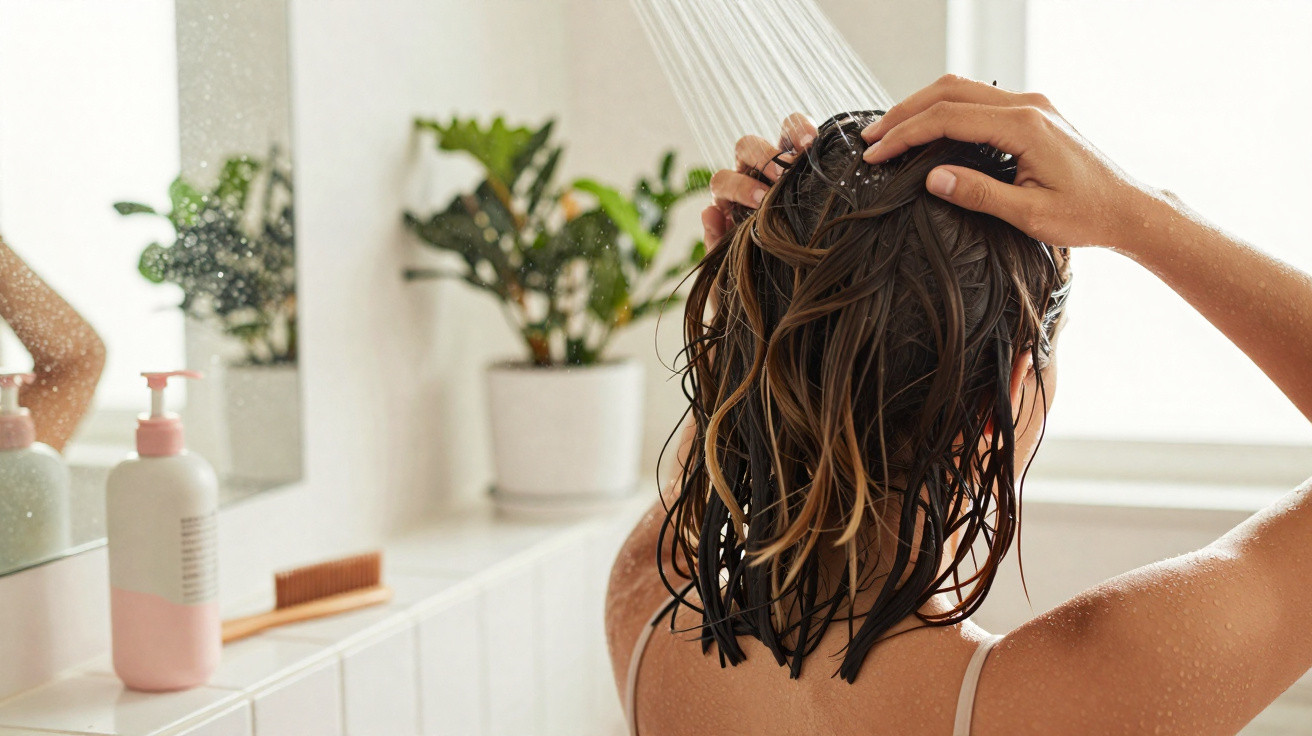
The woman standing beneath the gym shower looks irritated.
She wrings out her ponytail, shakes her head at the mirror, feels around her roots and silently mouths “Why?” at her reflection. Her hair ought to look good. She used the costly conditioner, worked it through, left it on, then rinsed really thoroughly. But once dry, it lies tight to her head, almost glued to her scalp, as though it has lost all confidence.
Elsewhere, on the bus, another woman flicks through TikTok hair hacks and stops at clips promising “instant volume” and “runway blowout at home.” Her issue is identical: the ends are soft, while the top looks limp and weary. She assumes she needs another product, a different cut or perhaps even a new stylist.
The answer may be far less exciting. It could be hidden in how we rinse our hair.
Why conditioner can secretly steal your volume
Hair often looks flat not because the conditioner is wrong, but because of where the product is left behind. Conditioner belongs on the lengths and ends, but it has a habit of travelling towards the roots. In a hot shower, as water runs directly downward, the creamy formula moves across the scalp and sticks to the hair nearest it. Those extra grams at the roots can be enough to pull the whole style down.
We tend to blame humidity, hormones or “bad hair days”, though the explanation is frequently more technical. Conditioner flattens the hair cuticle, which is ideal for softness and shine. If that smoothing action reaches the roots, however, hair loses its natural hold and lift. The result is hair that appears newly washed but performs like third-day hair: heavy, flat and faintly oily around the scalp.
Imagine a hectic Tuesday morning. A 29-year-old marketing manager in London is hurrying towards a 9 a.m. meeting and washes her hair quickly while checking emails. She squeezes out a generous amount of conditioner and runs it from the mid-lengths to the ends - or so she intends. Beneath the powerful shower stream, she leans her head back, shuts her eyes momentarily and lets the water “do its thing.”
As she plans her day, the conditioner slips upwards and coats the roots. Two minutes later, she assumes it has all rinsed out. By 11 a.m., she spots the problem in the office bathroom mirror: her hair is glossy, certainly, but the roots are pressed against her head, particularly along the parting. She blames the London weather and considers dry shampoo. The rinse never crosses her mind.
Some salon surveys indicate that up to 70% of clients apply or rinse conditioner too near the scalp, even when they “know” not to. Plenty of people enjoy how “slippery” their hair feels in the shower, only to complain about a lack of volume in the salon chair. Flat hair often begins in that gap between what we believe we are doing and what really happens under running water.
Chemically, conditioner uses agents that coat each strand, making it smoother and less prone to frizz. Those ingredients attach to the hair shaft and do not disappear after a quick rinse. When they build up near the roots, they produce a sleek finish that works against texture and volume. Rather than gripping together to hold a shape, strands slide past one another. The scalp may feel coated too, allowing natural oils to travel more quickly and further.
It is rather like putting a rich moisturiser on your face before trying to dust on fluffy powder. The powder has nothing to grip, so it simply sits there. Volume sprays and mousses face the same problem when conditioner residue clings around the roots. Even an excellent blow-dry has difficulty overcoming that unseen coating.
Rinsing also influences the direction in which the cuticles settle. A forceful downward stream presses hair flat to the scalp and encourages it to dry in that position, particularly when hair is fine. Combine conditioner at the roots with hot water and a vertical rinse, and you effectively train your hair to collapse. It is not “lifeless”; you have simply, without realising it, smoothed the life out of the root area.
The conditioner rinse routine that restores lift
The solution is not especially glamorous, but it can feel like a small backstage trick. Apply conditioner from the ears downwards, then twist or clip up the lengths for a minute to keep them away from the scalp. That straightforward boundary prevents the product from travelling upwards. Next, bend your head forward beneath the shower and allow the hair to fall away from your scalp while rinsing from the nape through to the ends, rather than letting water run vertically from the crown.
Changing the angle has two benefits: it guides product away from the hair instead of onto the roots, and it helps release wet hair from the scalp. Many stylists refer to this as the “gravity rinse.” Use your fingertips to softly separate the sections at the nape and behind the ears, where residue tends to linger. The scalp should feel clean rather than slippery. Keep the lengths silky, but allow the roots to feel slightly more “squeaky.”
In practice, this is the stage most people hurry through. We devote time to massaging shampoo in, then rinse conditioner half-heartedly while thinking about breakfast. We’ve all done the 30-second “that’s probably fine” rinse. That is often where flatness begins. Spending just one additional minute on the first three centimetres from the scalp can alter the way your hair sits for the rest of the day.
Temperature matters too. Finishing the roots with slightly cooler water can close the cuticle a little without making it so soft that it falls flat. There is no need for an icy ordeal; simply move from hot to lukewarm water for the final rinse. Give the roots room to breathe while letting the ends retain their comfort.
Here is the truth few of us want to acknowledge: most of us use more conditioner than we actually need. Advertisements show generous blobs of product, and we copy them without much thought. For fine or medium hair, an amount between the size of a hazelnut and a coin will generally do. Thick or curly hair requires more, of course, but it still does not need conditioner at the roots. When hair looks flat but feels greasy near the scalp by day two, over-conditioning combined with inadequate rinsing is often the cause.
Applying conditioner immediately after shampoo is another frequent error. If the shampoo has not been fully rinsed away, leftover cleanser, fresh conditioner and natural oils all begin to mix on the scalp. The result is a dulling combination that takes away both shine and lift. An extra rinse between the two steps, concentrating on the hairline and crown, creates a clean foundation that will not work against your styling later.
Let’s be honest: nobody truly does this every day. Most mornings, we simply want to get clean and leave the bathroom. Adjusting your rinse does not have to add extra minutes, though; it changes where you place your attention. Focus less on “scrubbing everywhere” and more on “roots clean, lengths pampered.” Once it becomes routine, volume feels less mysterious and more like a reliable result.
“People think they need a ‘volumizing’ miracle product,” says a London hairstylist who works backstage during fashion week. “Half the time, I just teach them to rinse their conditioner away from the roots. Suddenly, their usual products work twice as well.”
This minor technical adjustment can feel unexpectedly emotional. On a difficult day, flat hair can amplify everything: tired-looking eyes, an unfinished to-do list and the sense that nothing quite “lands.” On a better day, even a little lift at the roots can make the reflection in the mirror seem lighter. A quiet change to your rinse routine will not solve your whole life, but it may remove one daily frustration. On a very human level, that matters.
- Apply low, rinse wisely – Keep conditioner on the mid-lengths and ends, rather than the scalp.
- Change the angle – Tip your head forwards or sideways so product flows away from, not onto, the roots.
- Finish cooler – A short lukewarm rinse at the end may help the roots remain buoyant.
Let your hair breathe at the roots
Once you begin noticing how conditioner is rinsed out, other patterns become obvious. You spot colleagues with beautiful colour but flattened crowns. You see friends with expensive cuts that never quite “sit right” at the top. You notice people tying their hair up by midday because it feels heavy close to the scalp. Each of these small gestures points to the same issue: roots that are never quite allowed to breathe.
At this point, the focus shifts from products to habits. It is tempting to reach immediately for a new spray, mask or promise in a bottle. Yet the biggest difference often starts in those two or three minutes beneath the shower head. Much like how we sleep or sit at a desk, the way we rinse our hair is a small daily ritual that quietly affects how we feel in our own skin.
Whether on a crowded commute or in a peaceful Sunday bathroom, that realisation can feel surprisingly grounding. You are not “bad at hair”. Your hair is not “lazy”. It is merely reacting to what you have taught it. Tell someone who always complains about flat hair, then watch their expression when they try the forward-tilt rinse for the first time. That little moment of “Wait, this actually works” is a form of everyday magic we seldom discuss, yet instantly recognise.
| Key point | Detail | Why it matters to the reader |
|---|---|---|
| Targeted application | Conditioner on the lengths and ends, not the scalp | Less greasy roots and more natural volume |
| Rinsing angle | Head tipped forwards, rinsing from the lower sections towards the ends | Stops product travelling back to the roots and flattening them |
| Time and temperature | A longer rinse, finishing with lukewarm water | Lighter hair, better styling hold and a longer-lasting clean feeling |












Comments
No comments yet. Be the first to comment!
Leave a Comment