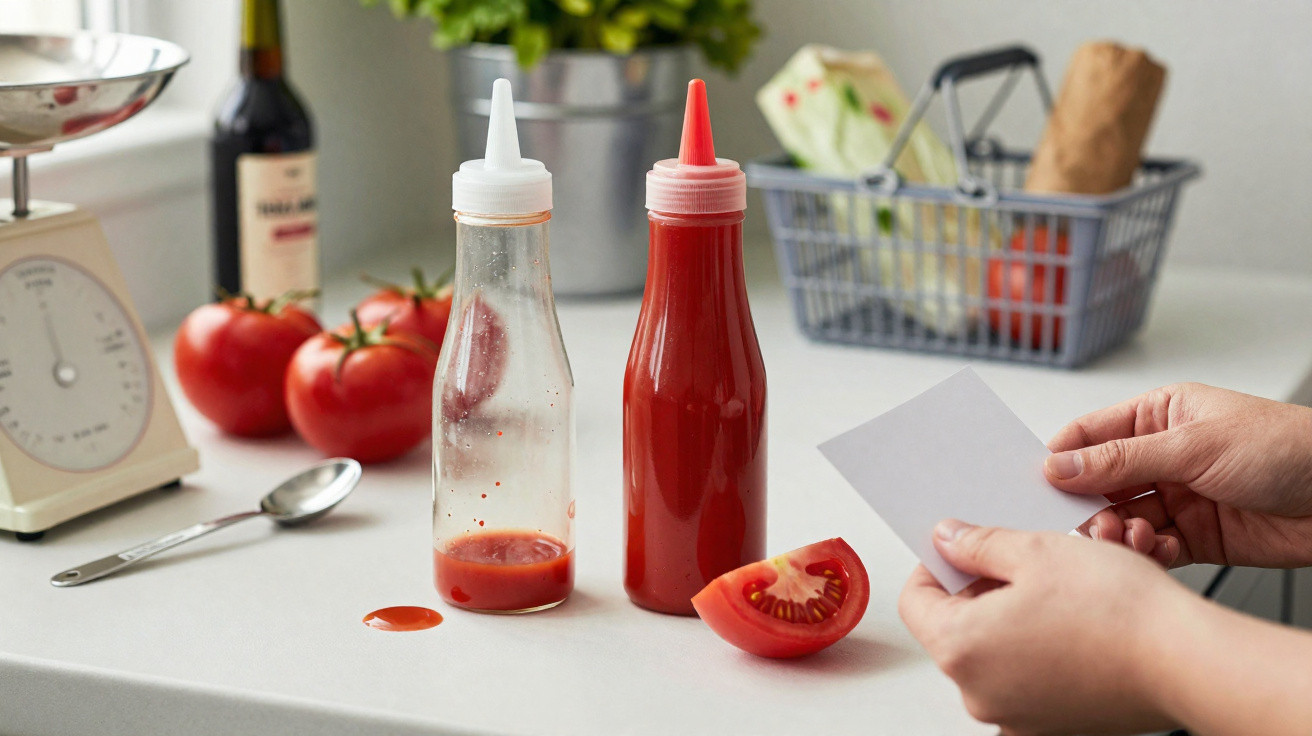
Choosing ketchup can seem like the smallest decision in the trolley, until you compare two bottles and find a sizeable difference in price, sugar, salt and taste. The useful trick is simple: ignore the front-of-pack impression at first and compare the unit price with the nutrition panel and ingredients list.
A German comparison of 23 ketchup products is a reminder that the most familiar or expensive bottle is not automatically the best buy. One Lidl own-label ketchup, Kania Classic, performed well for value and is sold in Poland. That does not make it a recommendation for every UK shopper: recipes, pack sizes and availability can vary between countries. The more useful lesson is how to choose the bottle in front of you.
What the comparison assessed
The products were assessed by Stiftung Warentest, a German consumer-testing organisation. The range included well-known brands, organic products and supermarket own-label ketchups.
The comparison looked beyond flavour. Its criteria included:
- taste, aroma and texture;
- ingredients and tomato content;
- sugar and salt levels;
- laboratory findings, including certain contaminants;
- labelling; and
- packaging and recyclability.
That broader approach is sensible. A ketchup can taste rich and tomatoey but still be a less suitable everyday choice if it is much higher in sugar or salt than similar products. Equally, a lower-sugar ketchup is not automatically preferable if you dislike its flavour or do not want the sweetening ingredients it uses.
The shelf price is only part of the story. Compare the price per 100ml, then turn the bottle around.
What the result means for shoppers in Britain
The comparison found that inexpensive own-label products could hold their own against better-known brands. Lidl Kania Classic was among the products noted for value in the German test, and the version referred to in the title is available in Polish Lidl shops.
However, this needs a little caution. A result for a particular product bought in Germany is not a guarantee that a similarly named bottle in Britain, Poland or elsewhere has the same recipe. Manufacturers can use different factories, ingredients, labels and pack sizes for different markets.
For UK shoppers, Kania Classic may not be the relevant product at all. Lidl’s British range changes regularly, and a product with a similar name may not be identical. Instead of trying to track down a supposed winner from abroad, use the comparison as a prompt to look more closely at own-label choices in your local supermarket.
How to compare ketchup in the aisle
A quick check takes less than a minute and makes it easier to choose between regular, reduced-sugar and premium-looking bottles.
1. Start with the unit price
Look at the shelf-edge label for the price per 100ml rather than the price of the whole bottle. A large bottle may cost less per 100ml, but it is not a bargain if your household uses ketchup only occasionally and much of it ends up being thrown away.
2. Compare sugar and salt per 100g
Nutrition labels normally show values per 100g, which makes products easier to compare fairly. Tomatoes contain naturally occurring sugars, but many ketchups also contain added sugar. Salt levels can vary too.
If ketchup is a frequent fixture with chips, sandwiches or children’s meals, these figures are worth checking. There is no need to treat one number as the whole answer: compare the full label and choose a product you will actually enjoy using.
3. Read the ingredients in order
Ingredients are listed by weight, from greatest to smallest amount. Look for tomatoes, tomato purée or tomato concentrate near the start, then check what else has been added, such as vinegar, spices, sugar or sweeteners.
This is particularly useful when comparing a standard ketchup with one labelled “no added sugar” or “reduced sugar”.
4. Choose a sensible bottle size
Squeeze bottles are convenient and can be less messy for family meals. Glass bottles may suit people who prefer the feel of glass or have easy access to glass recycling. The right option is the one your household will use up and can dispose of sensibly.
A note on the laboratory findings
The German comparison also reported that several products received poor ratings because laboratory testing found elevated levels of Alternaria toxins. These are compounds associated with Alternaria fungi, which can affect crops including tomatoes.
The findings applied to the individual samples tested at that time. They should not be treated as evidence that every bottle from a named brand, every ketchup product or anything currently sold on UK shelves has the same issue. A consumer comparison is not the same as a current food-safety recall.
Consumers cannot identify these compounds by looking at a sealed bottle or tasting a small amount. At home, the practical steps are straightforward:
- check that the seal and packaging are intact when buying;
- follow the storage instructions on the label after opening;
- discard ketchup with visible mould, an unusual smell, fizzing, leakage or other signs of spoilage; and
- do not try to scrape mould from food and use the rest.
If a product is subject to a safety alert in the UK, check the Food Standards Agency’s recall and alert information for the specific product, batch and retailer.
Are reduced-sugar ketchups always a better choice?
Not necessarily. A lower sugar figure may suit some households, but it is worth looking at the whole recipe. Some products replace sugar with sweeteners, while others simply use less sweetness overall and taste sharper because of the tomato and vinegar.
When comparing a reduced-sugar ketchup with a regular version, check:
- sugars per 100g;
- salt per 100g;
- the complete ingredients list;
- the unit price; and
- whether you like the taste enough to use it.
“No added sugar” describes one aspect of a recipe. It does not remove the need to read the nutrition panel.
A bottle that nobody likes is poor value, however appealing its claim may sound. If you are changing products for the first time, buying a smaller bottle can be a practical way to avoid waste.
Think about packaging as well
Packaging is easy to overlook when choosing ketchup. Plastic squeeze bottles are lightweight and convenient, while glass can be a good option where glass collections are straightforward. Neither format is automatically best in every household.
Recycling arrangements vary between UK councils, so use your local authority’s guidance rather than relying on a symbol alone. As a general rule:
- empty the bottle as fully as possible;
- rinse it only if your council asks for containers to be rinsed;
- leave caps on or remove them according to local guidance; and
- do not put packaging in household recycling if your council does not accept that material.
Avoiding waste matters more than choosing a theoretically cheaper large bottle that sits unfinished in the cupboard.
Common mistakes when buying ketchup
A few familiar habits can make it harder to find a good everyday bottle:
- Choosing by brand alone. A familiar name is not a flavour, nutrition or value guarantee.
- Comparing bottle prices instead of unit prices. Check the cost per 100ml.
- Assuming expensive means more tomato. Read the ingredients list.
- Treating “light” as the whole answer. Compare sugar, salt and sweetening ingredients.
- Buying the largest bottle by default. Consider how quickly it will be used after opening.
- Assuming overseas test results apply unchanged in Britain. Recipes and ranges can differ by market.
- Ignoring storage instructions. Once opened, ketchup should be stored as the label directs.
A practical way to choose your next bottle
In a UK supermarket, narrow your choice to two or three bottles within your budget. Compare the unit price, sugar, salt and ingredients, then choose a pack size you are likely to finish.
The Polish availability of Lidl Kania Classic is an interesting detail from the German comparison, but it is not the main takeaway for British shoppers. Good ketchup does not have to be expensive. The best everyday bottle is one with a flavour you enjoy, a label you are comfortable with, a pack that suits your household and a price that makes sense.
















Comments
No comments yet. Be the first to comment!
Leave a Comment