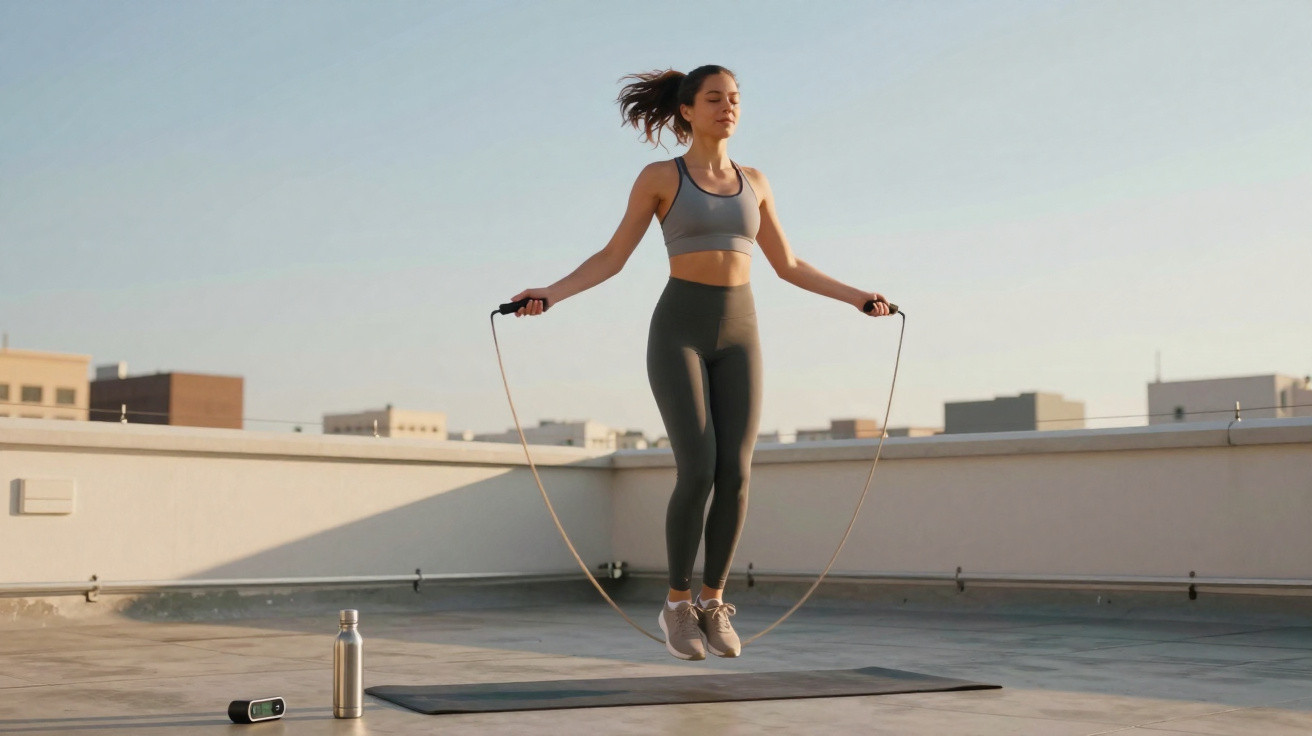
In her hand is a plain black skipping rope, nothing fancy. Her AirPods are hanging halfway out of her ears, she is audibly breathing out, and her forehead is shining. The first jumps look laborious, almost as if she is battling the rope. It is a familiar gym scene, somewhere between loud music and clanking weights. Two minutes later, something odd happens: suddenly, it all looks effortless. Her shoulders drop, her feet barely tap the floor, and the rope slices steadily through the air like a metronome. Beside her, a man is swearing after just 20 seconds before throwing his rope into the corner. The same rope, an entirely different experience. So what changed during those two minutes?
The moment the rope suddenly jumps “with you”
Anyone who has skipped continuously for more than half a minute will recognise this magical transition. At first, every impact feels harsh, your feet seem heavy and your shoulders are tense. Then, sometimes without warning, you slip into a flow. The rope striking the ground, your feet jumping and your breathing all suddenly settle into one shared rhythm. Just before that point, the movements often look jerky and anxious. Moments later, the very same person resembles an experienced boxer during a warm-up. It is the same body, but a different rhythm.
Many people assume this flow comes from superior fitness or greater strength. Being fit certainly helps, but it does not explain why even well-trained people can struggle with a rope. Some beginners develop a remarkably smooth style after only a few sessions. Others have been skipping “somehow” for years and still lose their timing after 30 seconds. There is no magic behind fluid movement, but there is one small, frequently overlooked technique: how you establish the rhythm in your head – rather than with your arms.
Imagine a study measuring heart rate, breathing rate and error frequency while people skip. Sports universities genuinely conduct experiments like this. What is interesting is that most mistakes do not happen when the heart rate is at its highest, but when the rhythm breaks down. One jump slightly too early, one wrist movement fractionally too late, and the rope catches on the front of the foot. These milliseconds often begin in the mind rather than the body. As soon as your internal timing becomes frantic, your movements fall apart. Once you have consciously noticed this, you realise the rope is like a lie detector for stress in your mind.
The small rhythm trick for skipping: 1-2 breathing, not 1-2 striking
The real game changer in skipping is subtle: count your breathing, not your jumps. Rather than counting “one, two, three, four” with every foot contact, use a two-part pattern: breathe in for two jumps, then breathe out for two jumps. In other words: jump-jump – in, jump-jump – out. The timing shifts away from frantic step-counting towards a calmer, more deeply rooted pattern. Internally, you tune into breath waves instead of the nervous “just ten more, five more, three more”. Your arms suddenly become looser because your mind is counting less and feeling more.
We all know that point when, after 20 jumps, you notice you have started holding your breath again. Your body is working, while your breathing stumbles along behind it. This is exactly where the breathing-rhythm technique comes in. Deliberately begin slowly, turn the rope and establish this four-beat pattern in your mind: two jumps in, two jumps out. A very quiet “in” as you rise, followed by an equally quiet “out” as you land again. At first it can feel almost artificial, like a forced beat. After just under a minute, it suddenly feels built in. Many people say that from this point onwards, they look at the clock less and listen more to the gentle movement in their chest.
The sober truth is that the body likes patterns lasting longer than a single beat. If you try to control every jump, you overload your system. Your brain is then juggling balance, arm movement, rope speed, the surface beneath you and every individual landing all at once. When you switch to a four-beat breathing rhythm, you group that control into a larger unit. That reduces the strain. Your lower body develops a light sense of autopilot because the brain is no longer commenting on every millisecond. The rhythm moves from conscious thought into that pleasantly muted zone where movements seem to happen by themselves. This is when rope training finally starts to look smooth.
How to put the skipping rhythm trick into practice
Getting started is straightforward: stand with the rope in your hands, but do not jump at first. Simply swing the rope from right to left in front of your body and follow the four-beat breathing pattern: inhale for two beats and exhale for two beats. Once that feels familiar, begin doing tiny jumps on the spot, still without the rope. Again, make two small jumps while inhaling and two while exhaling. Only in the third step do you add the rope. You combine both patterns as though layering two songs: the quiet song of your breathing and the clearly audible strike of the rope. Many people notice after their first session that their jumps become smaller and softer, because they are no longer trying to control each one individually.
The most common mistake is increasing the pace too soon. As soon as the rhythm begins to feel good, many people automatically speed up. The flow breaks, and their shoulders and neck suddenly become tense again. A better approach is to stay consciously at the “boring” pace for longer, even if your ego is telling you that you could go faster. Another classic mistake is fixating on the rope. Some people stare downwards as if looking at it could prevent tangles. Ironically, that is precisely what disrupts the rhythm. Instead, try keeping a soft gaze ahead, as though you are looking at someone standing two or three metres away. This makes it easier for your body to find the even tempo you are setting internally.
An experienced boxing coach once told me:
“You do not skip rope; you dance with a sound. If you can sing that sound in your head, you are not tired yet.”
That captures the essence of this rhythm technique remarkably well. You hear the rope hitting the floor, feel its frequency, and let your breathing sit over it like a second track. Small mental anchors can help:
- Spread quiet words in your head, such as “light – light – light – light”, across four jumps
- Inhale through your nose with your lips closed, then exhale gently through a slightly open mouth
- Keep the jumps deliberately tiny, as if you were landing on thin ice
- Listen only to the sound of the rope and briefly block out the rest of the noise around you
- After every lapse, return to the four-beat breathing pattern rather than stopping in frustration
What this small skipping trick does to your mind
Anyone who has skipped using this breathing rhythm soon notices that it changes more than just the movement; it also alters your inner mood. Skipping feels less like a punishing cardio session and more like a form of moving meditation. You are forced to remain in the present, because otherwise your rhythm falls apart immediately. Let us be honest: nobody really does this every day, especially not with complete concentration. That is exactly why a successful session feels so special. You step away from the rope sweaty, yet your mind feels strangely calm, almost cleared out. That feeling has much to do with the interaction between breathing and repetition.
The technique also transfers easily to other areas. Many runners use a similar pattern, such as breathing in for three steps and out for three. Musicians know it from practising difficult passages, while dancers know it from counting their steps. The rope is simply a particularly unforgiving mirror: if the beat breaks, the movement breaks too. That is what makes this training so honest – and so satisfying when you manage to stay “in it” for longer. Perhaps that is the real appeal: you can see in real time how your mind learns to turn stress into rhythm.
| Key point | Detail | Reader benefit |
|---|---|---|
| Control rhythm through breathing | Four-beat pattern: inhale for two jumps, exhale for two jumps | Less frantic movement, smoother skipping, longer intervals |
| Build familiarity step by step | Start without the rope, then jump without it, and combine everything only at the end | Less frustration and a clear learning path for beginners too |
| Control your gaze and ego | Keep a soft gaze ahead and deliberately maintain a low pace | Fewer mistakes, less stress on the joints and a more stable training rhythm |











Comments
No comments yet. Be the first to comment!
Leave a Comment