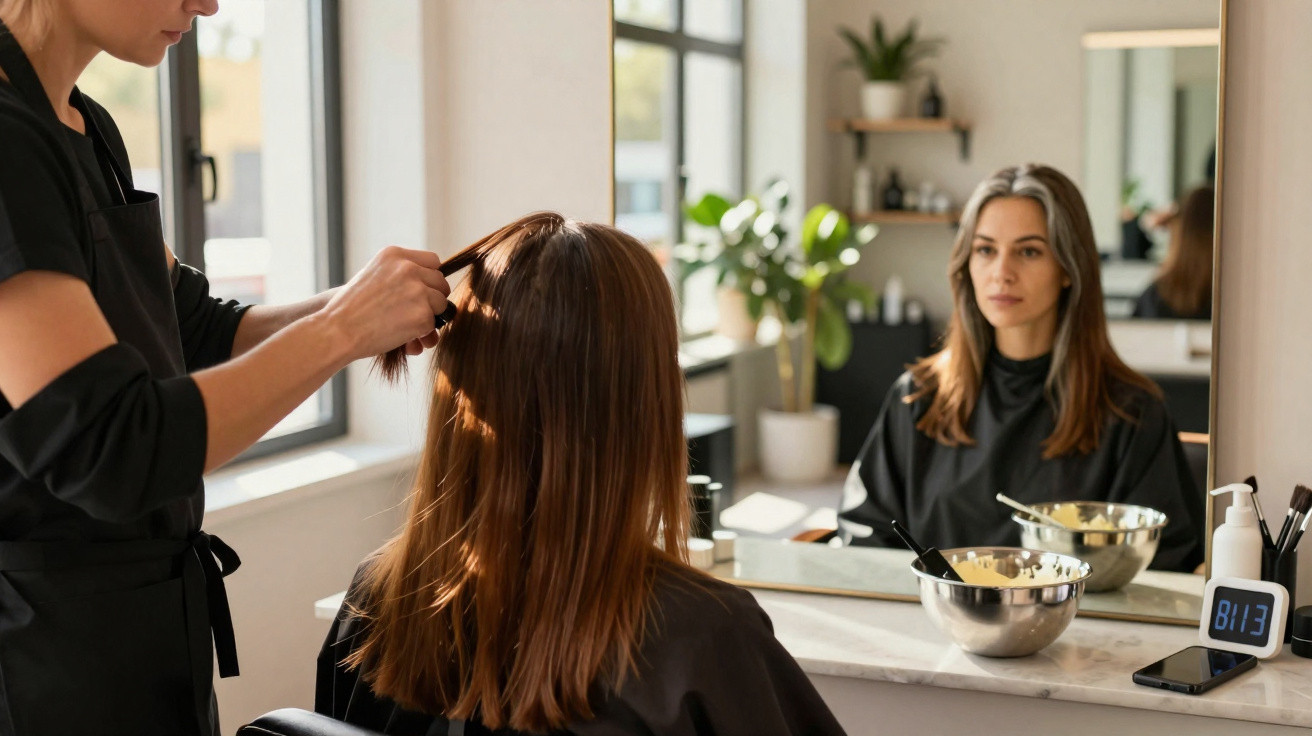
The woman in the salon chair sits perfectly still, staring at the mirror while each foil is removed. Her stylist, wearing gloves marked by blue-toned cream, gives the practised reassuring smile of an experienced hairdresser. Beneath the harsh ring light, the grey once visible at her roots has disappeared. There is no subtle balayage or gradual transition-only sharp, saturated, glowing “youth” from root to tip.
Around her, hairdryers whirr softly and card terminals beep. The salon owner checks the diary, which is packed with bookings for the new treatment that has discreetly displaced those dreamy balayage appointments.
It is a technique that removes every silver hair quickly.
It also ties clients to a costly routine that can be difficult to leave behind.
From soft balayage to zero-grey obsession
For nearly ten years, balayage was the fashionable answer to grey hair. A touch of brightness here, a little depth there, and an easy grow-out that allowed roots to go unnoticed for months. In many city salons, though, that approach is now giving way to a much more extreme promise: complete, high-coverage grey removal that appears immaculate in the first week but becomes unforgiving by week four.
Stylists describe it as “grey camo”, “glass coverage”, and even “youth reset color”. What clients notice is simpler: there is not one white hair in sight.
Watch the appointments unfold at a fashionable salon for an afternoon and the change is obvious. A middle-aged solicitor arrives faithfully every four weeks. She once had balayage done twice yearly. She now books complete scalp coverage, a bond-building gloss and a root shadow “for dimension”, all of which require topping up almost as regularly as her gel manicure.
She previously spent $220 on each of two annual appointments. With this new grey-erasing ritual, she now pays roughly $180 every month. The stylist who persuaded her to “upgrade” her colour? Their column is currently full for the next three months.
The reasoning is brutally straightforward. Balayage fades out gently, so missed appointments and tighter budgets are easier to manage. Complete root coverage creates a stark line instead. Even minimal regrowth appears glaringly obvious in the mirror, particularly beneath office LED lighting or on high-definition Zoom calls.
That is how the cycle gathers pace. The first visit acts as the hook: glossy, dramatic and age-defying. The next appointment is presented as “maintenance”. By visit three, it no longer feels like an optional beauty decision. It resembles an obligation-rather like paying a phone bill late while worrying about being cut off.
The radical grey erasing routine: how it really works
In theory, the technique sounds almost magical. The colourist assesses your pattern of greys, blends a permanent colour often one or two shades deeper than your natural hair, then applies it across every millimetre of exposed root. They may frame the face with a high-lift “brightness veil” and finish the lengths with a glossy shine treatment for that Instagram-ready result.
Its true mechanism lies in timing and layers. Colour is left to develop for precisely long enough to ensure total coverage, occasionally using pre-pigmentation on resistant white strands, so that no glint of silver remains visible.
For clients, however, the main risk is psychological rather than technical. After seeing yourself with all grey erased and your hairline looking flawless, returning to a softer, lived-in colour may seem like settling for less.
You begin arranging your life around your roots. Got a work presentation? Your touch-up is booked for the previous week. Invited to a wedding? You hurriedly schedule another gloss. Your natural hair gradually becomes something you glimpse only between appointments, in unflattering light and when nobody else is there.
“Grey coverage is my biggest money-maker now,” admits Clara, a colorist in her thirties who quietly doubled her income in two years. “I used to spend three hours painting a balayage that lasted six months. Now I have clients in every four weeks like clockwork. They feel good, I pay my rent. But I can tell some of them are trapped by it.”
- Service frequency jumps
From 2–3 balayage sessions each year to 10–12 root touch-ups. - Ticket size creeps up
Glosses, bonders, toners and “anti-fade” treatments are added to the bill at every appointment. - Emotional dependence grows
The mirror begins to control your diary, your spending and even your mood during a bad hair week.
What this trend really says about us
There is something uncomfortable about hearing women in their 40s and 50s tell their stylists, “I just can’t see any more grey, I’m not ready.” Wanting coverage is not the problem; the issue is that the cost of complete erasure is rarely made clear. Once you move into monthly, full-head permanent coverage, it enters the same category as lash extensions and injectable routines: expensive, repeated and quietly addictive.
In truth, hardly anyone keeps up this kind of routine every single day.
Some colourists are beginning to resist the trend, albeit carefully. They recommend blurring the line through micro-highlights, extending appointments to six weeks or trying translucent tints that fade more gently. They discuss “exit strategies” for clients who may eventually wish to grow out their more natural silver hair.
Others lean into the demand. They market grey erasing as self-care, empowerment and “owning your image”. Before-and-after reels collect likes, while booking links seemingly fill themselves.
Beneath it all lies a cultural conflict that is more difficult to colour-correct. We are living in a time when youthful-looking hair is presented as professional, energetic and “on top of things”. Grey remains associated with being tired, less relevant and, at times, even neglected.
This radical approach therefore does more than remove grey. It sells the fantasy of control over time, wrapped up in 120-minute appointments and repeated throughout the year. You leave the salon standing taller and looking glossier, persuaded that you have beaten the ageing game. The question is how much money and mental space you are willing to give up for that feeling.
| Key point | Detail | Value for the reader |
|---|---|---|
| High-frequency colour = high dependency | Monthly root coverage produces a visible demarcation line that demands regular appointments | Helps explain why this technique can feel like a subscription you cannot cancel |
| Balayage vs. full grey erasing | Balayage grows out subtly, whereas dense coverage reveals regrowth within 2–4 weeks | Provides a clear comparison before moving from low- to high-maintenance colour |
| Long-term strategy matters | Exit plans, appointment-stretching techniques and gentler formulas may lower emotional and financial pressure | Suggests ways to enjoy colour without feeling committed to a never-ending routine |

















Comments
No comments yet. Be the first to comment!
Leave a Comment