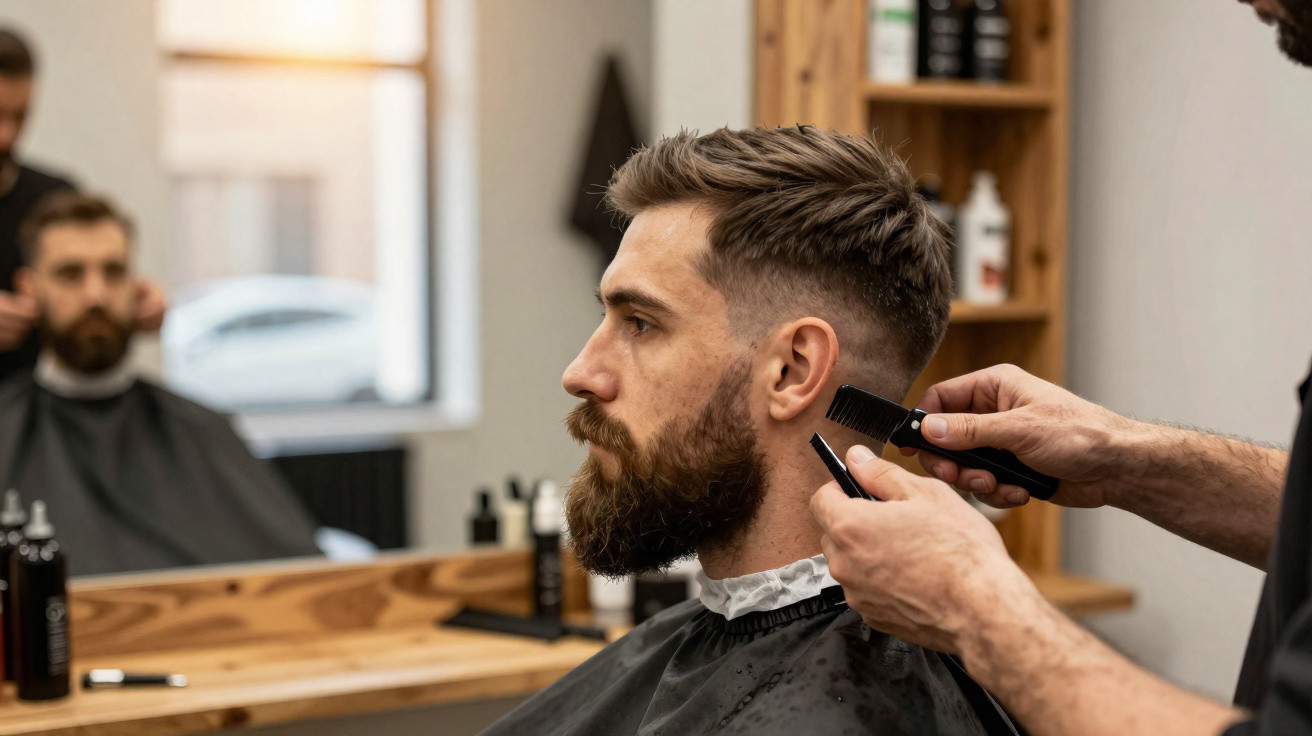
A man in the barber’s chair kept narrowing his eyes at the mirror. His face was long and slim, one of those shapes that photo apps never seem to handle properly. His beard was clipped close and neat, the style men often mean when they ask, “Just clean it up, nothing crazy.” Still, it did not look quite right. His chin appeared longer, while his jaw seemed sharper than he wanted. The barber cocked his head, moved back a step and offered an unexpected verdict: “You don’t need it shorter. You need it fuller. Wider.”
Ten minutes later, a more squared outline was framing his jaw and the same face looked somehow more settled. It seemed less elongated and more balanced. The client gave the sort of half-surprised smile that appears when the reflection finally feels like the person looking into it.
The answer was not a shorter beard. It was a better beard shape.
The beard shape that saves long faces from the “stretched” effect
Men with long faces often arrive at the barbershop requesting the same look: a short, close beard blended into the sideburns, with every line kept tidy and tight. It seems like the safe option: professional, low-maintenance and straightforward. On a round or square face, it can look exceptionally sharp. On a long face, however, it frequently produces the exact result you are trying to avoid. The forehead can seem taller, the chin more pointed and the entire face can appear “elongated”.
This is why many barbers discreetly recommend a different approach: a fuller, squarer beard with a little extra length at the sides and a softer finish underneath. It is not about creating an untamed lumberjack beard. There simply needs to be enough fullness around the cheeks and jawline to broaden the face visually and interrupt its length.
Speak to enough people and the pattern soon becomes familiar. A man with a long, narrow face may spend years believing that he “can’t pull off” a beard. He experiments with 3 mm stubble, a short goatee or a chin strap. Each time, the outcome is similar: his features appear taller and more vertical. One Paris barber recalled a client who had stayed clean-shaven for ten years because every close trim made him look “like a stretched filter on Instagram”.
When they finally tried a more defined, box-shaped beard, retaining 8–10 mm at the sides and easing the point below the chin, the effect was immediate. Friends wondered whether he had lost weight. His jaw appeared more powerful, his nose looked better proportioned and his forehead seemed less “dominant”. Nothing had changed apart from the geometry of the facial hair.
The optical reason is straightforward. We interpret faces as shapes: long faces emphasise vertical lines, whereas shorter or wider faces stress horizontal ones. A close, tightly trimmed beard leaves focus on the vertical axis - the nose, mouth, chin and neck. It can highlight every additional millimetre of facial length. A fuller beard with a squared outline instead brings horizontal lines across the cheeks and jaw. This makes the base of the face appear wider and breaks up the sense of excessive “height”.
Barbers refer to this as “building the frame”. By adding width around the jaw and making the underside of the chin very slightly rounded rather than narrowing it into a point, the beard works almost like a subtle photographic filter. It brings balance where bone structure alone cannot.
How barbers shape a beard for long faces without overwhelming them
For long faces, the technique used by most professionals begins with one choice: do not pursue extreme shortness. Clippers are commonly set at around 6–10 mm for the cheeks and jaw, before scissors are used for accuracy rather than simply buzzing all the hair down. The sides are retained slightly fuller, and the lower edge is gently curved instead of being cut into a precise V shape.
The neckline is set somewhat higher than many men expect, just above the Adam’s apple, which prevents the sagging appearance of a “neck beard”. The crucial detail comes next: the barber lightly squares the corners around the jaw rather than tapering the whole beard towards a point. This creates a neat, boxy beard that sits around the lower third of the face without pulling it downwards.
Problems usually begin at home four or five days later, during a hurried session at the mirror with the trimmer set to the wrong guard. Worried about “looking too hairy”, men with long faces often take too much from the sides while leaving the bottom a little longer. That delivers precisely the opposite effect: a narrow strip of hair that pulls the eye up and down.
We have all had that experience of trying to correct one tiny uneven patch, then adjusting each side repeatedly until the beard is half its original size. Eventually, you give up, fit the shortest guard and remove weeks of growth. Honestly, nobody really manages this every day. Knowing when to stop matters just as much as knowing what to trim.
Barbers give their long-faced clients the same essential advice time and again. It can start to sound like a mantra.
“Your face is already giving length. Your beard should give width and structure. Don’t fight your features, balance them. A slightly fuller, squarer beard is your ally, not your enemy.”
To make the advice easier to remember, many professionals offer these simple, practical rules:
- Leave the sides one guard longer than you initially think is necessary.
- Gently round the bottom rather than cutting a sharp, extended point.
- Keep the neckline immediately above the Adam’s apple, rather than halfway down the neck.
- Blend the sideburns into the haircut so the beard does not look as though it is “floating”.
- Photograph yourself from the side and at a three-quarter angle; the mirror lies, the camera doesn’t.
Living with a fuller beard when you already have a long face
The true challenge is not the first day in the barbershop. It is stepping outside with a fuller new outline on a face you have known your whole life. Many men with long faces instinctively resist the change: “I don’t want more on my face, I want less.” Once the first compliments arrive a week later, their internal image often begins to shift.
Some notice unexpected benefits. They may suddenly feel more comfortable in photographs, and their side-profile pictures appear more composed. The beard stops being a “style statement” and becomes more like a discreet architectural adjustment - one small design choice that subtly changes how your features communicate with the world.
At this point, the discussion often moves beyond hair and towards identity. A long face can feel like something you must compensate for. A properly shaped beard turns it into a feature you can work with. Rather than attempting to make your face smaller, you begin to frame it. That’s the small psychological click barbers love to see.
| Key point | Detail | Value for the reader |
|---|---|---|
| Choose width over extreme shortness | Keep the cheeks and jaw a little fuller, at 6–10 mm rather than ultra-short stubble | Minimises the “stretched” effect and visually balances a long face |
| Create a soft, boxy outline | Square the corners of the jaw, curve the bottom and avoid a long, sharp point | Produces a stronger-looking jaw and reduces the perceived length |
| Respect the key lines | Keep the neckline above the Adam’s apple, blend the sideburns and maintain a neat moustache | Delivers a clean, deliberate appearance rather than a heavy or untidy beard |
















Comments
No comments yet. Be the first to comment!
Leave a Comment