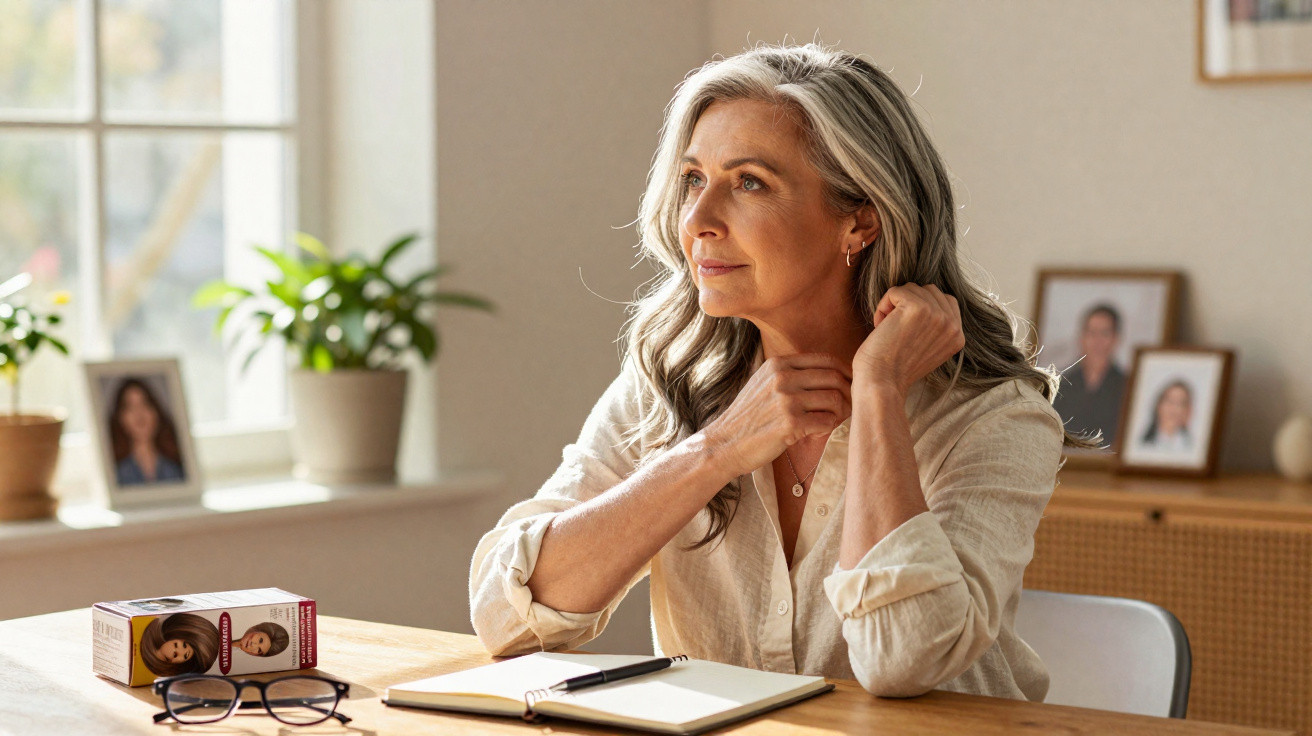
More and more women and men are choosing simply to let their hair turn grey. No frequent trips to the hairdresser, no covering up roots, no quietly erasing the passing years. This decision is usually about far more than convenience: it can reveal a great deal about self-image, values and inner resilience – and can noticeably affect both a person’s own life and the people around them.
Growing older with ease: what grey hair truly reveals
Many people are startled when they spot their first silver strand. Others notice it, shrug, and leave it alone. This latter group often displays a distinctive blend of calmness and clarity. Rather than seeing the ageing process as an enemy, they regard it as part of their own story.
People who keep their natural hair colour put life itself, rather than the façade, at the centre.
Psychologists observe that those able to accept outward changes generally deal with crises, losses and new phases of life in a more mature way internally too. Grey hair therefore becomes a visible marker of a journey, rather than a flaw.
1. A role model for courage and authenticity
People who openly show their grey hair can have an unexpectedly liberating effect on others. They challenge the unspoken rule that youthfulness should be maintained for as long as possible. That alone makes them quiet role models in everyday life.
- They convey: “This is what I look like now – and that is all right.”
- They challenge beauty standards at work, within their family and among friends.
- They show younger people in particular that growing older is nothing to be embarrassed about.
In a society where filters, anti-ageing creams and cosmetic procedures are everywhere, this honesty can seem almost rebellious. Those around them may feel more able to put their own insecurities into perspective – whether these concern wrinkles, scars or missteps in their career history.
2. A clearer focus: less superficiality, more of what matters
Regular colouring takes time, money and patience: appointments need arranging, roots need touching up, haircare products need buying, and disappointing shades can be frustrating. Anyone who decides against it makes a clear statement: their energy is intended for other things.
People who deliberately avoid hair colour typically:
- set priorities more according to meaning than appearance;
- arrange their daily lives in a more practical, less stressful way;
- no longer treat outward perfection as the measure of their self-worth.
That does not mean they stop taking care of themselves. They often choose a neat but uncomplicated hairstyle, comfortable clothes that fit well, and focus on health rather than continually ‘tuning’ their appearance.
3. A strong personality rather than a disguise
Showing one’s true grey makes one’s life story visible. In many cases, it comes across as a statement: “I do not hide my history.” This outlook points to a settled sense of identity.
Their impact is then defined more by their voice, bearing, humour and competence than by an artificially youthful appearance. Relationships can benefit as well: conversations become less focused on superficial matters and more on substance. People who wear their naturally greying hair often report more honest connections, both personally and professionally.
Grey strands can feel like an invitation to see someone as a whole person, not as a smooth surface.
4. Accepting change: every decade has its purpose
The first grey roots often represent an internal crossroads: resist them or accept them? Those who choose acceptance demonstrate a particular kind of maturity. Rather than fighting the passage of time, they seek to adapt their everyday lives to new stages.
This can include:
- shifting priorities: less desire to please others, more attention to personal needs;
- willingness to let go of former goals when they no longer fit;
- openness to new roles – for example, as grandparents, mentors or volunteers.
Every wrinkle and each silver hair then represents not only years gone by, but also lessons a person has endured and processed.
5. Self-confidence that does not come from the mirror
Someone who steps outside with their natural hair colour, even when it is grey or white, grounds their confidence differently. The question shifts from “How young do I look?” to “How do I feel about myself?”
In conversations, at work and during negotiations, such a person often comes across more clearly. People who do not conceal their age appear less dependent on external approval. This inner steadiness is visible to others and earns respect in daily life – particularly when they need to stand by their principles.
6. More time, more energy, less strain
One significant point should not be overlooked: giving up constant hair colouring eases the burden on both the body and everyday life. There is no chemical mixture on the scalp, no toxic fumes, and no pressure to ‘do the roots’ before an upcoming appointment.
The resources this frees up can go towards other things:
- hobbies that previously did not fit into the day;
- sporting activities that are healthier in the long term than any tint;
- genuine rest, rather than organising a to-do list while sitting in the hairdresser’s chair.
Many people say that, overall, they feel ‘lighter’ once they stop colouring their hair – not necessarily because they love the look of grey, but because the underlying pressure disappears.
7. Self-respect: not constantly correcting your body
Accepting grey hair sends a clear message to oneself: “My body does not need to be permanently improved to have value.” This inner attitude influences many areas of life.
Typically, these people are kinder to themselves when something does not go perfectly. Mistakes at work, conflicts and minor mishaps are less readily interpreted as personal failure. Self-criticism remains, but it no longer consumes everything.
Grey hair thus becomes a visible symbol of treating oneself with greater respect.
8. Lived experience instead of youth culture alone
Silver hair is among the strongest visual signs of a life that has been lived. It can bring to mind sleepless nights with young children, professional challenges, losses, fresh starts, house moves, illness and achievements. Those who show it openly place experience in contrast with the trend for being eternally ‘forever young’.
Many grey-haired people report that strangers speak to them differently: more calmly, respectfully and often with more questions. That can be tiring, but it can also be rewarding. In this role as an unofficial adviser lies the opportunity to pass on lived experience, rather than carrying it silently alone.
Why giving up hair colour is more than a style choice
Not everyone who colours their hair lacks self-love. Nor is everyone who does not colour it automatically wise and self-assured. Even so, a pattern emerges in many conversations: people who consciously allow their hair to go grey have usually gone through a process first – from the shock of seeing themselves in the mirror to making an inner decision.
Questions that arise include:
- Who am I trying to look young for – myself or other people?
- What am I truly afraid of: my appearance or getting older itself?
- Which compliments make me feel good – those about how I look or those about who I am?
Simply considering these questions honestly can change the way someone sees themselves. Those who eventually say, “I’m going to leave it like this now”, have usually done some inner work – and that is reflected in both their presence and behaviour.
Practical examples: how grey hair can be worn with intention
Moving towards a natural colour does not have to be radical. Many people try transitional stages:
- highlights that make the roots appear softer;
- a short cut that makes the two-tone effect disappear more quickly;
- care products that reduce yellow tones and enhance the silver shade.
It is interesting how clothing style can change alongside this: bold colours, clean cuts and striking spectacle frames can all make grey hair a deliberate feature. Rather than looking ‘old’, the result can often appear surprisingly modern and full of character.
Beyond appearance: health and social considerations
Ongoing colouring can irritate some scalps, trigger allergies or worsen hair breakage. Choosing not to colour gives the hair a break. Its condition may recover, and many people report fuller, stronger hair after a few months.
Socially, an interesting effect often emerges: people who initially feared becoming ‘invisible’ with grey hair find the opposite happens. Colleagues, neighbours and friends respond with curiosity, often with sincere appreciation. The new appearance becomes a conversation starter – and frequently the beginning of deeper discussions about age, expectations and life plans.
There is no obligation to keep one’s natural colour, nor any ban on hair colouring. The important question is what lies behind it: do I wear my hair in a way that genuinely suits me? Anyone able to answer “Yes” – whether their hair is grey, white, brightly coloured or darkly dyed – embodies precisely the qualities that make grey hair so interesting to many people: inner clarity, the courage to own one’s story and the determination not to be defined by appearances.










Comments
No comments yet. Be the first to comment!
Leave a Comment