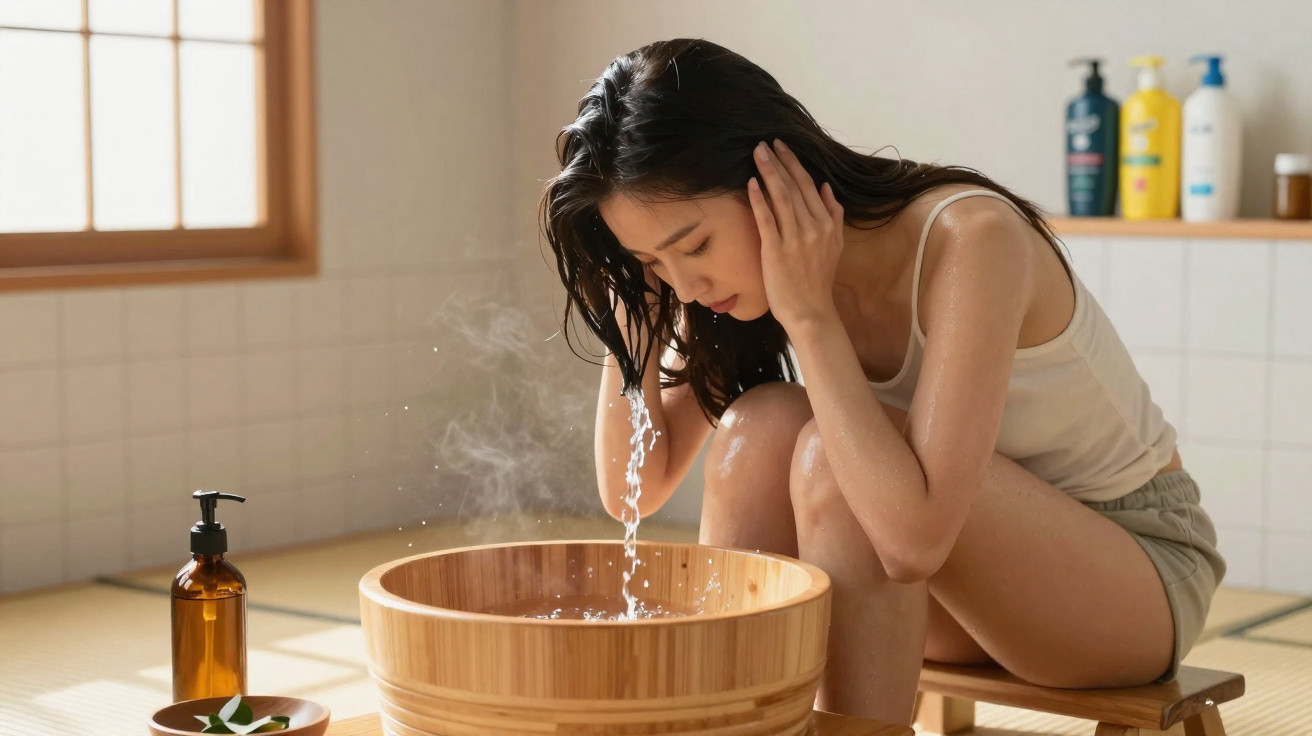
Her hair is damp rather than perfectly styled, and the lighting is slightly unforgiving. Bent over the basin, she slowly works her fingertips over her scalp, as though massaging it instead of washing it. There is no mountain of lather or fluorescent bottle in sight: only a small soap bar and a tiny measure of milky liquid in a glass bottle.
Ten minutes afterwards, her hair has dried into a smooth, glossy veil that appears both freshly washed and almost untouched. There is no halo of frizz or overpowering perfume. It is simply… hair, only better.
Elsewhere in the world, many of us use “moisturising” shampoo three times weekly, then wonder why our ends snap while our roots become greasy by the second day. One approach washes too much; the other practically nurtures the scalp.
Somewhere within that difference lies what Western shampoos would rather not discuss.
The understated secret of Japanese hair washing
Step into a Japanese chemist and pause in the haircare aisle. The contrast quickly becomes clear: bottles tend to be smaller, formulas are frequently milder, and nearby shelves are filled with scalp brushes, pre-wash oils and products labelled “non-foaming cleansers”. The underlying message is quiet yet unmistakable: haircare begins with scalp treatment, not the size of your lather.
Traditional Japanese washing rituals were not created around the shower-advert moment when foam engulfs everything. Instead, they centre on removing only what needs to be removed, and no more. Gentle cleansers, lukewarm water, brief product contact and hands moving as if delivering a facial massage rather than using a scrubbing brush. It is an approach intended to create lasting balance rather than temporary volume.
In Tokyo salons, stylists speak of “respecting the scalp barrier” much as Western dermatologists refer to the skin barrier. Hair is regarded as a continuation of skin health, not a separate task. After seeing hair washed this way, it becomes difficult to ignore how forceful many Western routines have grown.
Speak to Japanese women over 40 about their hair, and a recurring theme emerges. Many report washing it less frequently than Western women, perhaps every three days or even just once or twice a week, while paying close attention to their technique. A Tokyo office worker once described her mother’s routine: carefully brushing the hair before washing, warming the scalp with her hands, applying a very small amount of low-foam cleanser, then rinsing for twice as long as the cleansing stage.
There is a numerical aspect to this story too. Japanese surveys have identified increasing interest in “low-poo” and “no-poo” routines, while Western markets continued promoting “deep cleanse” and “clarifying” ranges. At the same time, dermatologists observed a rise in complaints of itchy, flaky and reactive scalps in countries where hair was washed most often. The trends appeared to nearly match: more washing, more problems.
Basic biology tells us that sebum is not an enemy: it lubricates and protects. Remove it too aggressively and the scalp reacts by producing additional oil; hair starts to look greasy sooner, and our answer is to… wash it again. That self-perpetuating cycle keeps shelves full of products for “oily roots, dry ends”. The Japanese method quietly avoids this hamster wheel. Washing less frequently, using gentler surfactants and concentrating on scalp-focused movements can settle sebum production over time. Western shampoos seldom warn that hair may look worse for a few weeks, then considerably better, if you simply stop over-cleansing.
How the Japanese hair-washing method works in practice
The Japanese-inspired traditional method begins well before shampoo reaches the hair. Brushing comes first. Dry hair is carefully detangled from the ends towards the roots, usually with a wide-tooth comb or wooden brush, helping to release debris and spread natural oils. Water follows only afterwards. Rinse the scalp with lukewarm water for at least one full minute, using small circular fingertip movements to loosen sweat and pollution before introducing any product.
Use shampoo sparingly: roughly a coin-sized amount, often diluted in the hand or a small foaming bottle. It should be placed primarily on the scalp rather than the lengths. Massage with your fingertips instead of scratching, concentrating on the roots and allowing the ends to be cleansed by the runoff. Keep contact time brief. The true centrepiece of the ritual then follows: rinse long and thoroughly, until the hair feels nearly squeaky beneath running water, without leaving the skin tight or stripped.
Western brands appear, on paper, to offer the same promise: a clean scalp, weightless lengths and healthy shine. Their ingredient lists can suggest a harsher reality, however. Many mainstream shampoos still use powerful sulphates and several fragrances to provide that gratifying feeling of being clean. The Japanese method discreetly reveals the inconsistency. Clean hair does not require an avalanche of foam; it requires balance. It requires a scalp free from inflammation and cuticles that are not continually roughened by aggressive surfactants before being weighed down again with silicones and waxes presented as “nourishment”.
This is where the concealed commercial logic appears. When shampoo dries out your hair, the same brand can sell a richer conditioner. If that conditioner creates build-up, you then “need” a clarifying shampoo. A mask is next to repair the resulting damage. The cycle is financially ingenious but biologically draining. By making the washing stage gentler and simpler, the Japanese approach can make half of those products seem unnecessary.
Trying the Japanese method at home: small changes, major difference
You need not discard everything on your bathroom shelf to adopt elements of the Japanese method. Begin with one straightforward adjustment: regard your scalp as you would the skin on your face. Gently brush your hair before entering the shower. Next, spend a full minute rinsing with warm water, moving your fingertips around the hairline, crown and nape. At this point, many people find that much of the sweat and light styling residue simply washes away.
Use less shampoo than you assume is necessary. Mix it between your hands with a splash of water, rather than placing a thick dollop directly onto one area. Apply it only at the roots, then massage slowly, particularly where oil tends to collect: the fringe, behind the ears and at the back of the neck. Allow the foam to travel through the lengths without scrubbing them. Rinse for longer than seems “necessary”. That additional minute is often where the magic happens.
In practical terms, the method also encourages less frequent washing. You might go from daily washes to every other day, or from three washes weekly to two. The opening weeks may feel unusual. Your roots may resist, and you may want to reach again for that volumising, ultra-cleansing bottle. This is the detox phase, not a sign of failure. Let’s be honest: nobody truly does this every day, even when adverts imply otherwise. Real life is untidy, and hair routines should adapt to real schedules rather than idealised ones.
What are the common errors? Scrubbing too vigorously, using water that is too hot, and applying conditioner to the scalp rather than only to the lengths. Many Western habits are born of haste. On a hectic morning, it is easy to treat the shower like a car wash: get in, get out and lather everything within 60 seconds. The Japanese method calls for the reverse: fewer products and greater presence.
At a deeper level, this washing style can feel unexpectedly calming. After a difficult day, a slow scalp massage beneath warm water becomes a small act of care. On a rushed day, even moving to a gentler shampoo and rinsing for longer may result in fewer tangles and less breakage, whether or not you do anything else. On a tiring evening, a water-only rinse and scalp massage can be enough to “reset” without beginning the full washing cycle.
“Healthy hair isn’t what you add on top, it’s what you stop stripping away.”
- Select a mild, low-foam shampoo, or a Japanese-style scalp cleanser, for routine use.
- Reserve one stronger “deep cleanse” product for occasional use rather than making it a weekly habit.
- Direct every cleansing movement at the scalp, while treating the lengths like delicate fabric.
- Experiment with your washing frequency and allow your scalp time to recalibrate.
- Pay attention: reduced itchiness, less breakage and softer new growth are the meaningful measures, not shine alone.
What the Japanese method reveals about Western shampoos
After experiencing hair that feels balanced instead of “stripped then coated”, it is difficult to view Western shampoo advertising in quite the same way. Foam becomes less persuasive. Terms such as “detox”, “purifying” and “ultra-clean” can begin to sound hostile rather than comforting. You may start to see how many products claim to repair damage caused by… washing your hair exactly as they instructed you to do.
This is not about condemning one continent or idealising another. Japanese brands are not all gentle saints, and Western shampoos are not all villains of the scalp. The issue is more about the thinking that shaped each routine. Across many Western countries, short hair, frequent colouring and everyday washing became normal for decades. Strong-cleansing, high-foam formulas suited that setting. In Japan, long hair, sun protection and a bathing culture rooted in ritual pushed products in a different direction.
The quiet insight offered by the Japanese method is that dryness, frizz and an itchy scalp do not have to be accepted as normal “side effects” of being clean. You can view your hair as a living fibre rather than plastic that is rinsed and reset. You can question why a shampoo needs so much fragrance to smell “fresh”. You can pay attention to how your scalp feels two hours after washing, not merely when you leave the shower. More profoundly, this change in awareness can carry over into other behaviours: less excessive facial cleansing, lighter make-up and slower, gentler routines.
We have all experienced that moment of looking at the shower shelf and feeling slightly overwhelmed by the number of bottles, each making a strangely specific promise: anti-pollution, anti-breakage, anti-frizz, anti-everything. The Japanese washing method cannot magically resolve every hair concern. It can, however, remove one significant uncertainty: are we harming our hair in the effort to keep it “fresh”? Once that question is openly raised, the conversation changes. People begin exchanging modest tips, candid photographs and stories of awkward transition periods.
There is something quietly radical in discovering that gentler, less frequent washing can leave hair looking more alive. It challenges a culture of perpetual “fixing” and encourages a slower, almost old-fashioned faith in the body’s natural rhythms. If the idea interests you, perhaps tomorrow morning’s next step is not another product purchase, but a different way of standing beneath the water.
| Key point | Detail | Benefit for the reader |
|---|---|---|
| Scalp-first approach | The Japanese method prioritises gentle scalp care, extended rinsing and minimal foam | Can help reduce itchiness, oil imbalance and recurring “oily roots, dry ends” concerns |
| Less frequent, gentler washing | Washing fewer times each week with milder products | May lead to stronger, shinier hair with less breakage and reduced frizz |
| Breaking the product cycle | Avoiding harsh cleansers reduces the need for “repair” and “rescue” products | Saves money and time, simplifies routines and supports long-term hair health |












Comments
No comments yet. Be the first to comment!
Leave a Comment