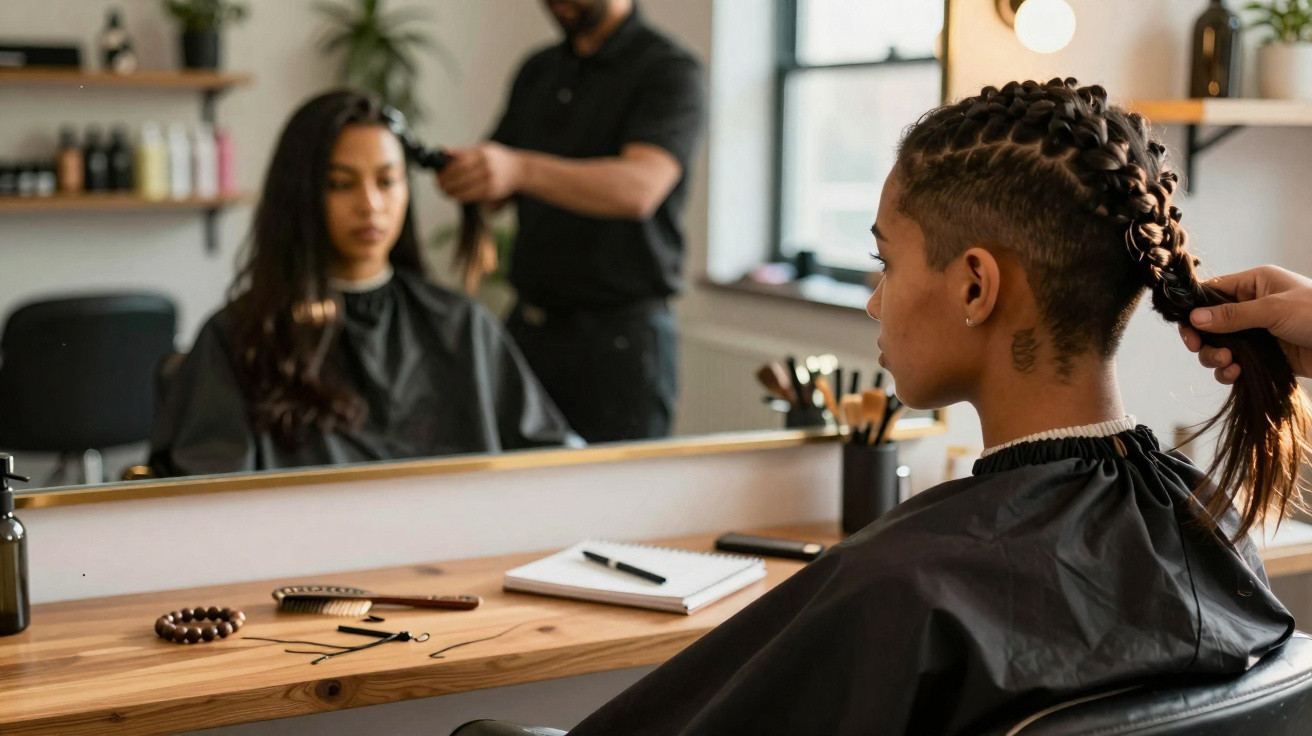
Everyone knows the feeling: a new haircut, a different reflection in the mirror – and people suddenly respond to you differently. What may seem like a routine choice at the hairdresser can profoundly affect how we experience ourselves and how others categorise us. Psychiatrist Marine Colombel explains how closely hairstyles are intertwined with identity, power, faith and unspoken social rules.
Why hair is far more than just “styling”
Hair grows quietly, by a few tenths of a millimetre each day. Yet from a psychological perspective, it is anything but incidental. It sits directly within view, frames the face, and can either provoke or reassure. It is also relatively easy to alter, unlike height, body shape or facial features.
A hairstyle is one of the most visible interfaces between inner experience and an outward role.
Psychiatrist Marine Colombel describes just how powerful that interface can be. One colleague shaved his head completely from one day to the next. Objectively, he had lost half a centimetre of hair length. Subjectively, it felt like an act of liberation. His surroundings needed a moment to adjust, but the initial shock soon turned into respect and even admiration. He remained the same person – but his outward “code” did not.
Hairstyles as an unspoken contract with society
The philosopher Michel Foucault regarded the way people wear their hair as more than a matter of taste. To him, it represented an act of submission to the society in which a person lives. This is especially apparent in tightly regulated settings: the military, prisons, boarding schools and certain religious groups. In these environments, rules determine how short, long or visible hair may be.
It becomes more interesting in everyday life. No official rule states how a woman should wear her hair in an office, or what haircut is acceptable in a law firm. Even so, many people follow unwritten conventions. This is precisely the internal mechanism of control Foucault described.
We often adapt our hairstyle without noticing that we are yielding to quiet group pressure.
What hair length reveals about social expectations
Choosing a particular length often reflects the “micro-system” in which we move. Here are some typical examples:
- Short and carefully styled: signals control, efficiency and adaptation to formal environments.
- Medium length and “low-maintenance”: often appears geared towards closeness and approachability without causing offence.
- Very long and deliberately well cared for: conveys individuality, patience and sometimes a touch of rebellion against practicality.
- Curls, an Afro or dreadlocks: may express cultural identity, pride or a conscious distancing from majority norms.
- Completely shaved: depending on the context, can stand for a fresh start, a break with expectations, illness – or radical self-determination.
The difference between the gates of a barracks and a co-working space is this: in the military, an external authority dictates the norm. In civilian society, people take on the role of the “internal police”. Anyone who wants to belong senses the boundaries and aligns themselves with them – often without ever hearing them spoken aloud.
When hair becomes a symbol of faith and spirituality
The historian of religion Mircea Eliade went a step further. He saw hair as a symbol of the connection between the body and something greater – the sacred, the supernatural or the divine. In many cultures, hair is regarded not merely as adornment, but as a carrier of life force.
Religious myths repeatedly draw on this idea. The best-known western example is Samson from the Hebrew Bible, whose superhuman strength was linked to his uncut mane. When his hair was cut, he lost not only his strength, but his people also fell into misfortune with him.
In many traditions, hair stands alongside blood and nails as a bodily substance with particular energy.
How different hair rituals are interpreted
Colombel summarises this symbolic level as follows:
- Shaving has a cleansing effect. It marks a new beginning, a kind of inner cut – a separation from the old.
- Keeping it has a protective effect. Hair worn long is seen as a “shield”, as accumulated strength and experience.
- Offering it has a consecrating effect. In some cultures, locks of hair are brought to sacred places as an offering or expression of thanks.
Whether when entering a monastery, starting military service, following a separation or beginning therapy, a visit to the hairdresser often accompanies major turning points in life. Those who cut or dye their hair often instinctively feel that more than their reflection is changing.
What your haircut can reveal about your inner world
Psychiatrists and psychotherapists do pay attention to hairstyles during consultations. This is not a matter of simplistic categories, but of clues about how someone relates to their body, self-image and surroundings.
| Hairstyle type | Possible message |
|---|---|
| Perfectly styled, with no hair out of place | A strong need for control, fear of judgement |
| Unchanged for years | Stability, but also fear of change or uncertainty in new roles |
| Frequent radical changes | A search for identity, a desire for liberation, sometimes inner unrest |
| Deliberately striking colours or cuts | A need to be seen, testing boundaries against norms |
| Barely cared for, apparently unimportant | Possible exhaustion, depressive tendencies or a conscious rejection of norms |
Importantly, no hairstyle “proves” a diagnosis. Instead, it provides starting points for questions: Does the person feel comfortable with it? Was the look chosen independently, or simply “because that is what people do”? Does the hairstyle change alongside crises or periods of upheaval?
The radical cut as a step towards yourself
The psychiatrist mentioned at the beginning, who suddenly had his head shaved completely, told Marine Colombel about his greatest concern: above all, he feared the judgement of his colleagues. Not the cold without a hat, nor the sight in the mirror – but the looks in the corridor.
When he took the step anyway, the atmosphere changed noticeably. After the initial surprise, many people approached him with renewed openness. Some admitted they had been considering something similar themselves for years. His shaved head thus prompted conversations about identity, courage and conformity – in an environment that appears strictly rational from the outside.
Anyone who chooses their hairstyle consciously makes a statement: “I belong to myself first.”
In this sense, two lines of thought come together in this man: Foucault’s idea of a body directed by norms, and Eliade’s view of hair as the bearer of an inner, almost sacred force. For him, the cut marked a new form of belonging – not to a group, but to his own feelings.
How to understand your own hair language better
A practical approach is to look at old photographs of yourself from different phases of life. What hairstyle did you wear during good times, and which one during crises? Did you adapt yourself for others – a partner, work or family – or primarily for yourself?
Useful questions for reflection include:
- What image do I want to communicate through my current hairstyle – consciously or unconsciously?
- Does my haircut feel like “me”, or like a role I am playing?
- What hidden wishes emerge if I could decide entirely freely?
- Which reactions from others have so far stopped me from making a change?
Hair can be changed, trimmed, dyed or grown out. This very adaptability makes it an ideal space for exploring identity. Anyone who considers their own hairstyle often arrives sooner than expected at very fundamental questions: How much conformity do I want? Where does my freedom begin? And how much courage do I have to make that visible?














Comments
No comments yet. Be the first to comment!
Leave a Comment