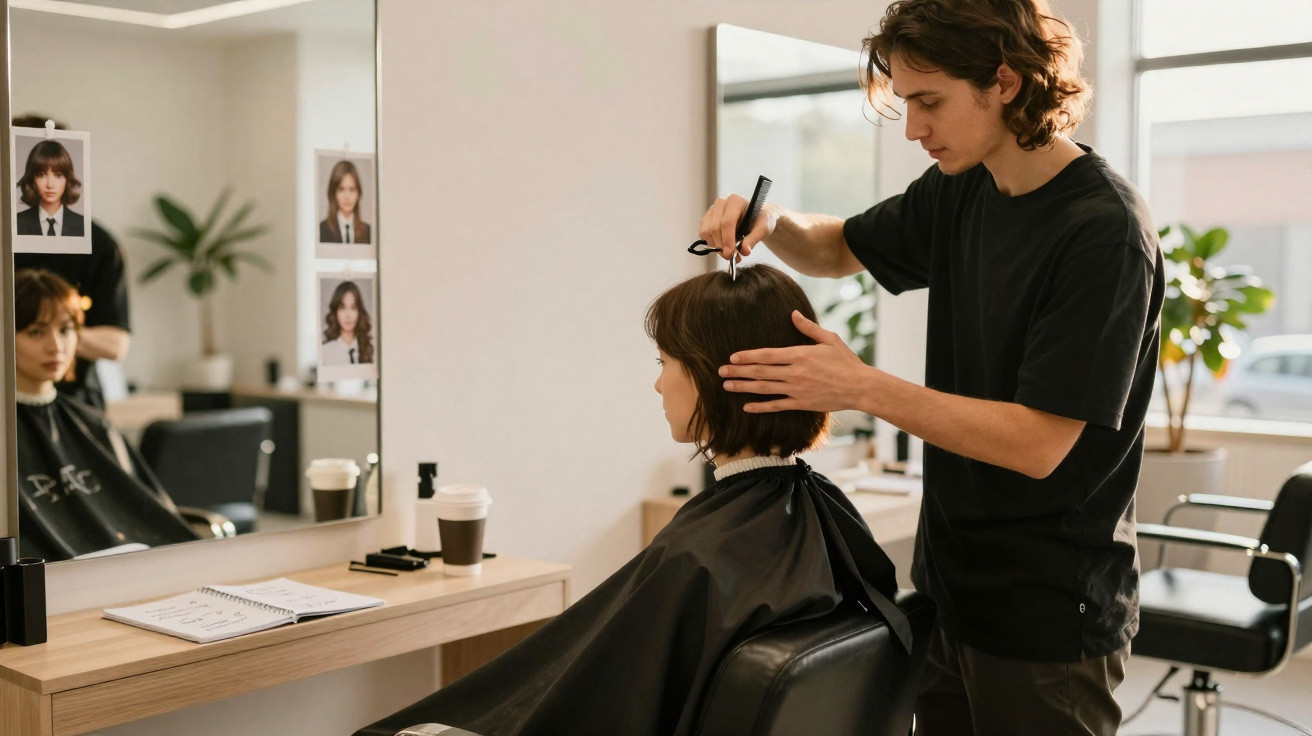
It smells of hairspray and coffee, while the low hum of hairdryers drowns out the radio. In front of the mirrors sit people hoping to reinvent themselves: shorter, lighter, smoother, somehow “fresher”. The hairdresser brushes the hair from their face, smiles with practised ease and asks: “How much would you like off?”
We all know that moment when we hope a professional will finally be honest. That someone will say: “Look, your hair is breaking; what you actually need is something completely different.” Instead, we nod, show a photo on our phone, and everyone pretends it is achievable. What most people do not realise is that, behind the mirrors, there is an unspoken code: one sentence that nearly every hairdresser knows but hardly anyone says aloud.
The sentence your hairdresser thinks – but never says
The main moment rarely happens in the mirror; it happens the second you sit down in the chair. In nine out of ten cases, a professional can immediately see what is really going on with your hair. Porous, overloaded with care products, dried incorrectly, straightened too often – it stands out like a neon sign. At the same time, that professional knows that, if they were completely candid now, you might never come back.
So the wording is softened. Rather than “Your ends are burnt”, you hear: “There is a little stress through the lengths.” Rather than “The bleach is destroying everything”, it becomes: “In the medium term, we could colour it more gently.” The unspoken sentence is: Your biggest hair problem does not start here in the salon, but at home – every day, in front of your bathroom mirror. It sounds harsh. But that is precisely what professionals laugh about, groan over – and keep quiet about among themselves.
A Berlin stylist told me about a client who arrived every six weeks with utterly ruined ends, yet insisted she “only air-dries” her hair. One day, she casually admitted that she always pulled her wet hair into a tight bun and slept like that. For eight hours. On wet hair. Every night. He said nothing: he coloured, cut, conditioned and took payment. “At some point, I thought: she does not want to hear the truth; she wants a miracle,” he said later. That conflict runs through almost every salon – whether it is a village hairdresser or a high-end hairstylist in Hamburg.
The sobering truth is this: no haircut in the world can repair what you damage at home every day. Hairdressers know that very well. Yet their business model depends on you feeling good in the salon, not feeling guilty. Being too frank risks drama, defensiveness and poor reviews. So they dispense reality carefully. Professionals use looks, hints and gentle suggestions, hoping you will draw the right conclusions. It is a quiet agreement between chair and mirror.
The real secret tip: the conversation before the first cut
The one sentence professionals almost never say sounds so ordinary that it becomes radical: “Tell me how you really treat your hair – not how you would like to treat it.” It is the starting point for every good haircut, and also where most client consultations fall apart. Many people describe their ideal life rather than their real one.
The difference is enormous. “I only blow-dry on cool” turns into “I often go to bed with wet hair”. “I use heat protection” really means: “There has been a bottle in my cupboard for three years.” Let us be honest: nobody actually does it every day. A truly skilled professional tries to build an accurate picture without making you feel exposed. If you play along and become genuinely honest, an entirely different level of consultation opens up. Suddenly, it is no longer just about “layers or a bob”, but about habits.
The biggest mistake? At the salon, we speak almost exclusively about the result and hardly ever about daily life. Yet that is exactly where the leverage lies: when do you wash it? How hot is the water? How do you brush it? Do you always pull your hair into the same ponytail? From those answers, a good hairdresser can learn more than from any Instagram photo. Anyone who understands how you really live can finally give you a haircut that can cope with that life. That is the real professional move, though it is rarely stated so clearly.
“The best product is useless if someone does not tell me what they actually do at home,” a Cologne salon manager told me. “My most honest conversations happen when people say: ‘Okay, I do everything wrong, help me.’ That is where real change begins.”
To reach that point, a few simple phrases can completely transform your next appointment:
- “Treat my hair as though we are being brutally honest with each other.”
- “Pretend I am your friend: what would you really tell me?”
- “I will briefly tell you what I do at home – and you tell me which parts are harming my hair.”
- “If you could change only one of my habits, which would it be?”
- “Show me the one thing that will visibly improve my hair in six months.”
What happens when you can handle that honesty
Imagine going to your next appointment and consciously choosing to break through that silent barrier. No more sugar-coating, no more “I hardly ever use the straighteners” when they are actually on every other night. You sit in the chair, take a deep breath and say: “Okay, here is the truth. Make something of it.” The response surprises many people – most professionals feel relieved.
All at once, you hear sentences usually reserved for the staff room. “You need fewer products, not more.” “Your hair is not ‘fine’; it is overloaded.” “That Instagram blonde does not suit your routine, so we are not doing it.” Sometimes it hurts. Sometimes it is a complete relief. And sometimes you realise your hair problem was never genetic; it was simply the outcome of habits that nobody dared to point out.
In the end, that brings you three quiet benefits. First: you spend less money on miracle products meant only to conceal mistakes in your everyday routine. Second: your hairdresser is more likely to become an ally than a service provider expected to create “something pretty”. Third: you no longer have to hope every time that the mirror will somehow lie more kindly to you. Over time, something rare emerges in the beauty world: a relationship in which honesty matters more than politeness. That is the real secret tip rarely discussed in salons – but one you can ask for from today.
| Key point | Detail | Benefit for the reader |
|---|---|---|
| The problem begins at home | Hairdressers spot everyday damage immediately, but often raise it only cautiously | Awareness: hair quality depends more on your own behaviour than on a salon visit |
| An honest initial consultation | Reveal your real routines rather than an idealised version (“I hardly blow-dry”, “I use heat protection”) | Better advice and cuts that suit your actual lifestyle |
| Courage to face uncomfortable truths | Specifically ask for clear, direct feedback and be prepared to hear it | Healthier hair in the long term, fewer unsuitable purchases and a stronger relationship with your hairdresser |
FAQ:
Question 1: What should I definitely tell my hairdresser during the first consultation?
Everything you genuinely do to your hair: how often you wash, blow-dry, straighten and colour it, which tools you use, and whether you often wear a ponytail, bun or hat. The more honest you are, the better they can tailor the cut and care to you.Question 2: How can I tell whether my hairdresser is telling me the truth?
Look for clear, specific wording rather than empty polite phrases. A good professional shows you visibly in your hair what they mean and remains calm, even when the assessment is not flattering.Question 3: Can I ask directly for an honest assessment?
Yes, and many hairdressers actively want you to. Phrases such as “Please be brutally honest about my hair” or “Pretend I am your sister” often open up the conversation.Question 4: What is the most common everyday hair mistake?
Too much heat with too little protection, combined with friction: blow-drying too hot, straightening without protection, sleeping with wet hair or constantly tying it up tightly. Together, these small habits make hair appear brittle.Question 5: How quickly will I see changes if I follow the advice?
For many people, the texture improves after just four to six weeks of a gentler routine. Noticeably new, healthy lengths need several months depending on hair growth, often half a year or longer.














Comments
No comments yet. Be the first to comment!
Leave a Comment