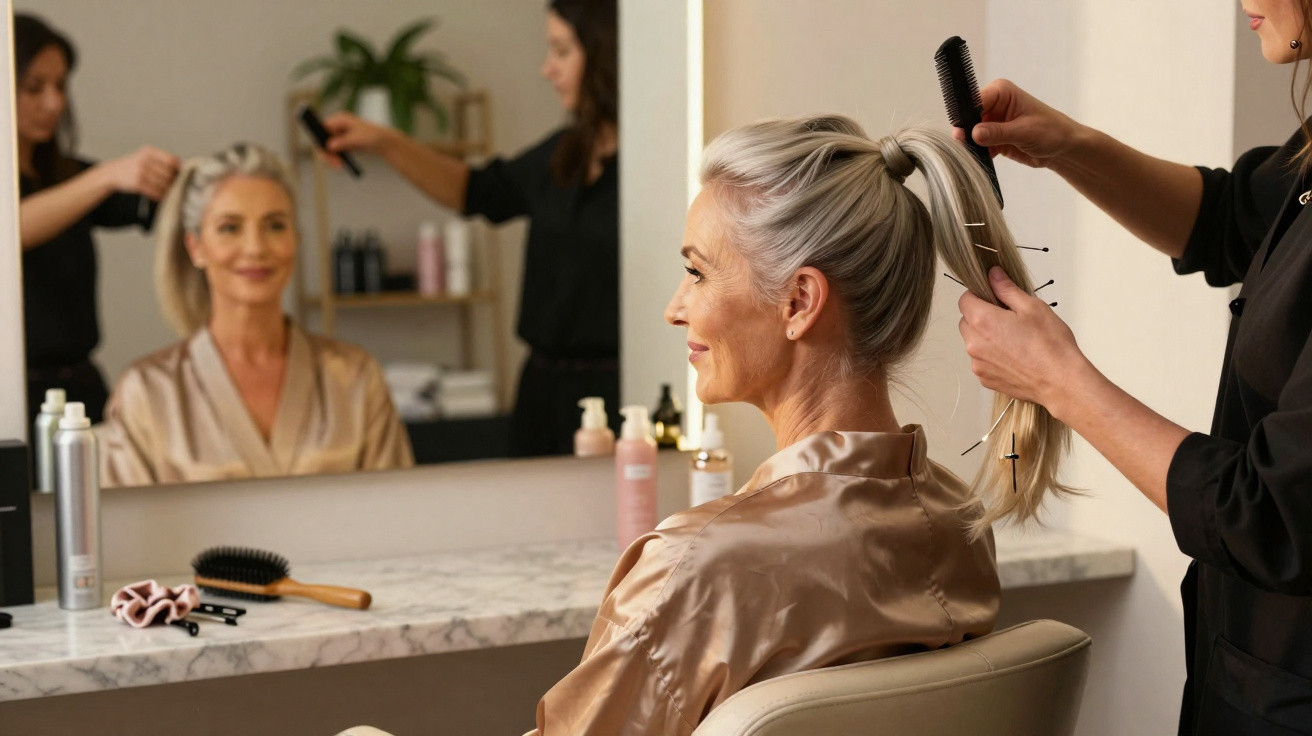
Many women notice it in the mirror in the morning: facial contours seem softer, the chin looks slightly less defined and the eyes appear more tired. Professional hairdressers swear that the right hairstyle can counteract some of this effect. Styles secured high on the head are the answer, as they visually lift the features and create a surgical-free lifting effect.
Why high-up hairstyles for women over 50 can look so rejuvenating
The principle is straightforward yet remarkably effective. When hair is drawn back and upwards in a controlled way, it creates gentle tension around the temples and eye area. Fine lines can look smoother, the eyes appear more open and the face looks more awake.
“Moving the tension in the hair upwards creates the illusion of a lifted face – at least for a few hours.”
There is also a lighting benefit: with the forehead uncovered, more light reaches the upper part of the face. Dark circles and shadows beside the nostrils appear less pronounced, while facial contours look clearer and more elongated. Particularly as skin loses firmness over time and visual focus shifts towards the chin and neck, a hairstyle that directs attention upwards can help.
Hairdressers place these looks within a trend for tightly secured ponytails and updos that shape the face. Their key characteristics include:
- strongly smoothed roots, especially around the temples
- a defined upward line from the face towards the hairline
- volume concentrated at the crown rather than at the nape
A natural-bristle brush, often one with boar bristles, is generally used as the foundation, laying the hair close to the scalp. A light layer of gel or wax holds the outline in place, while hairspray provides lasting hold.
Important warning: do not pull hair too tightly
As tempting as the instant result may be, the hair must not be pulled excessively tight. Hairdressers repeatedly see two issues among women who wear extremely tight hairstyles all the time:
- Headaches: Ongoing tension at the roots can trigger migraines or tension headaches.
- Traction hair loss: Particularly at the temples, permanent strain on the hair roots can lead to traction alopecia.
Professionals therefore advise varying the height of the hairstyle, alternating with looser looks and gently massaging the scalp in the evening. This supports circulation and relieves pressure on the hair roots.
The three most effective lifting hairstyles according to hairdressers
1. A high ponytail for sharper facial contours
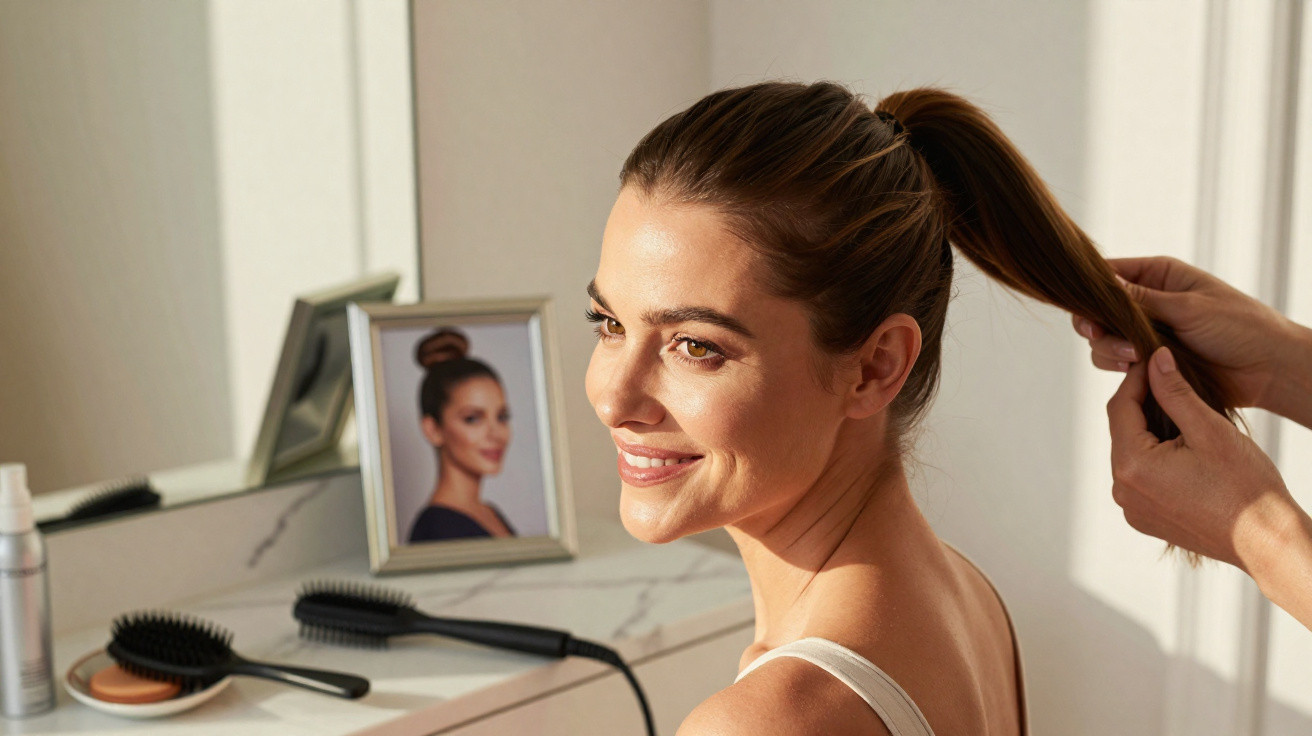
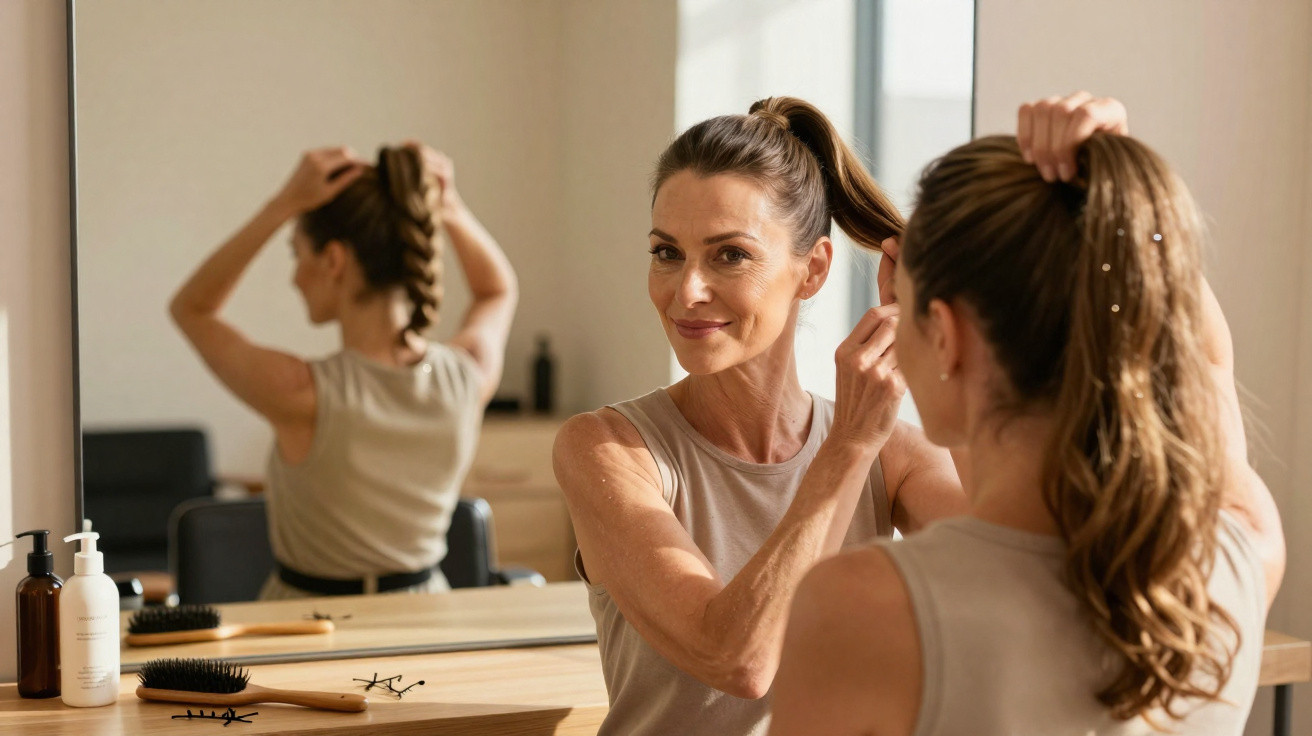
A high ponytail is the quickest route to a visual mini-lift. The placement of the hair tie is crucial. Hairdressers use an imaginary line running from the chin, past the outer corner of the eye and up to the crown. The ponytail should ideally sit where this diagonal ends.
“A ponytail positioned high on the head automatically draws the eye upwards – a benefit for tired-looking features.”
Using a brush, guide the hair at the temples firmly towards the base of the ponytail. This smooths the area around crow’s feet and makes the sides of the face appear sleeker. The lifted roots also create an effect that make-up artists often use to give the eyes an almond-shaped appearance.
This style is especially suitable for:
- medium-length to long hair
- round or oval face shapes
- women whose contours around the chin have become slightly softer
Important: a ponytail tied too low highlights precisely the area many people want to disguise – the chin and neck. Position the hair tie very high, close to the highest point at the back of the head.
2. A high twisted bun as an “anchor” for the lifting effect
Hairdressers’ second favourite is a compact bun made from a very high ponytail. First, tie the hair firmly upwards. Then twist the ponytail length tightly and wrap it in a spiral around its base.
This creates a secure knot that maintains the tension for several hours. At the same time, all the volume is gathered at the crown. The result is that the cheeks can appear slimmer, the jawline more defined and the neck remains entirely visible – useful if you would prefer not to add further emphasis to this area.
This look works well on warm days, for business appointments or formal occasions. With a glossy hairspray and neatly brushed contours, it appears particularly elegant. For a softer finish, leave a few fine strands loose at the nape or sides. This reduces the severity without completely losing the lifting effect.
3. A high half-up hairstyle for a softer look
For many women over 50, a high half-up hairstyle is the ideal compromise. Only the upper section of the hair is pulled firmly back, while the lower lengths are left loose. The separated section runs roughly from ear to ear and finishes at the crown.
“The half-up hairstyle lifts the forehead and eye area, while the loose lengths flatteringly frame the neck.”
The side sections are taken back firmly, creating smoother-looking roots and a subtly lifted appearance around the eyebrows and upper eyelids. Meanwhile, the hair falling downwards softens sharper contours and can visually conceal an area of the neck that has lost some firmness.
A high half-up hairstyle is particularly suited to finer hair because not all of its fullness is pulled upwards. One small detail can enhance the result: lightly backcomb the separated section before securing it to add volume at the crown. This lengthens the facial silhouette a little further.
Which lifting hairstyle suits which hair type?
Not every hair texture responds to these techniques in the same way. This broad guide can help with the choice:
| Hair type | Recommended lifting hairstyle | Hairdresser’s tip |
|---|---|---|
| Fine, straight hair | High ponytail or half-up hairstyle | Prepare the roots with volumising spray and lightly roughen the lengths |
| Thick, straight or slightly wavy hair | Twisted bun or sleek high ponytail | Apply smoothing cream around the contours so everything lies neatly in place |
| Curly or coily hair | Half-up hairstyle with defined curls | Use curl cream and avoid pulling too tightly to prevent breakage |
Professional health and styling tips
To ensure the lifting look does not come at the expense of hair health, hairdressers recommend several basic rules:
- Use padded hair ties or spiral bands rather than sharp metal clips.
- Wear hairstyles with strong tension for only a few hours at a time, not day and night.
- Regularly care for the roots with nourishing products.
- Undo the hairstyle slowly and without tugging.
Anyone with a sensitive scalp should begin with a slightly softer version and increase the tension gradually until it feels comfortable. A mild sensation of tightness is normal, but pain is a warning sign.
What the lifting look cannot do – and what it can
High-up hairstyles are not a replacement for medical treatment and will not smooth deep wrinkles. Their main effect is a visual redistribution of focus: more attention on the forehead and eyes, and less on the chin and neck. Pairing the style with pale eyeshadow, a little highlighter at the inner corner of the eyes and well-groomed brows intensifies this result.
The psychological aspect is also interesting: many women report that a more lifted-looking face makes them stand taller and feel more self-assured. Their posture further changes the overall impression, acting as a subtle enhancement to the hairstyle trick.
For anyone wanting to look younger and more awake with minimal effort, a high ponytail, twisted bun or high half-up hairstyle offers three simple tools. On many days, a mirror, a hair tie and a brush are all that is needed for a small everyday lifting effect.








Comments
No comments yet. Be the first to comment!
Leave a Comment