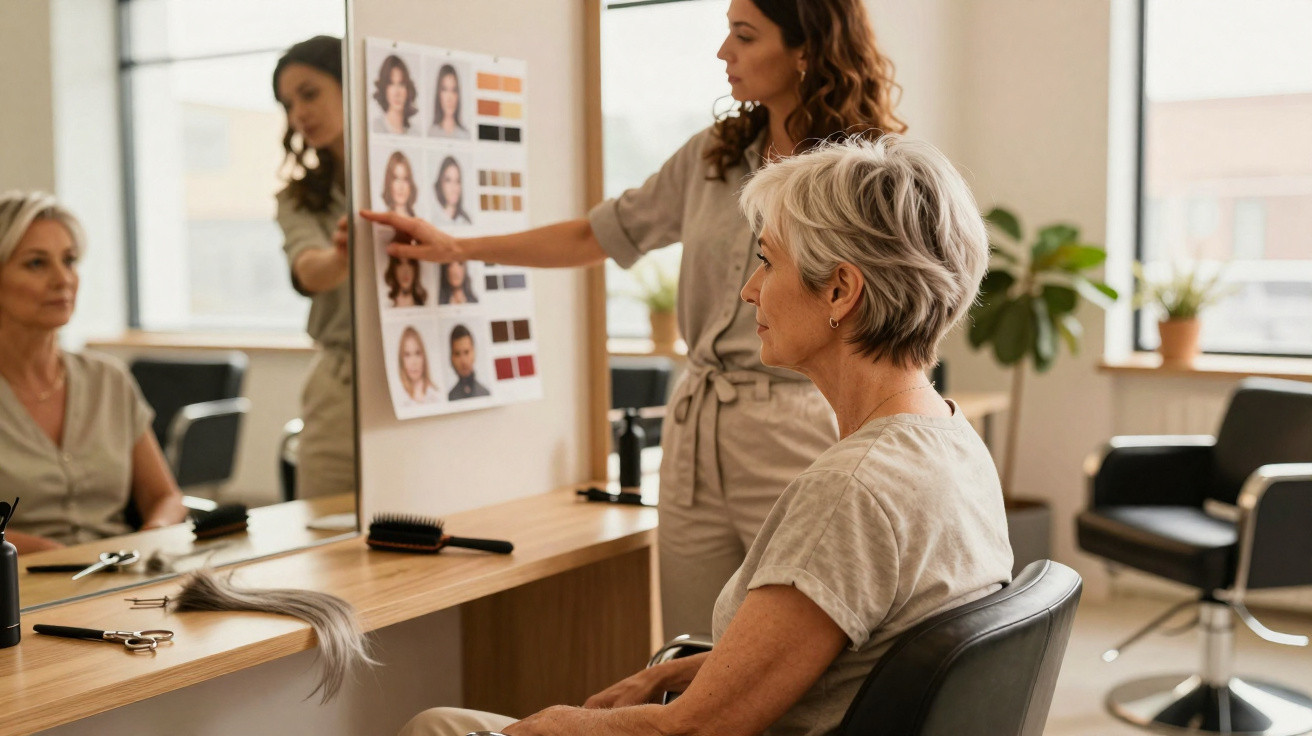
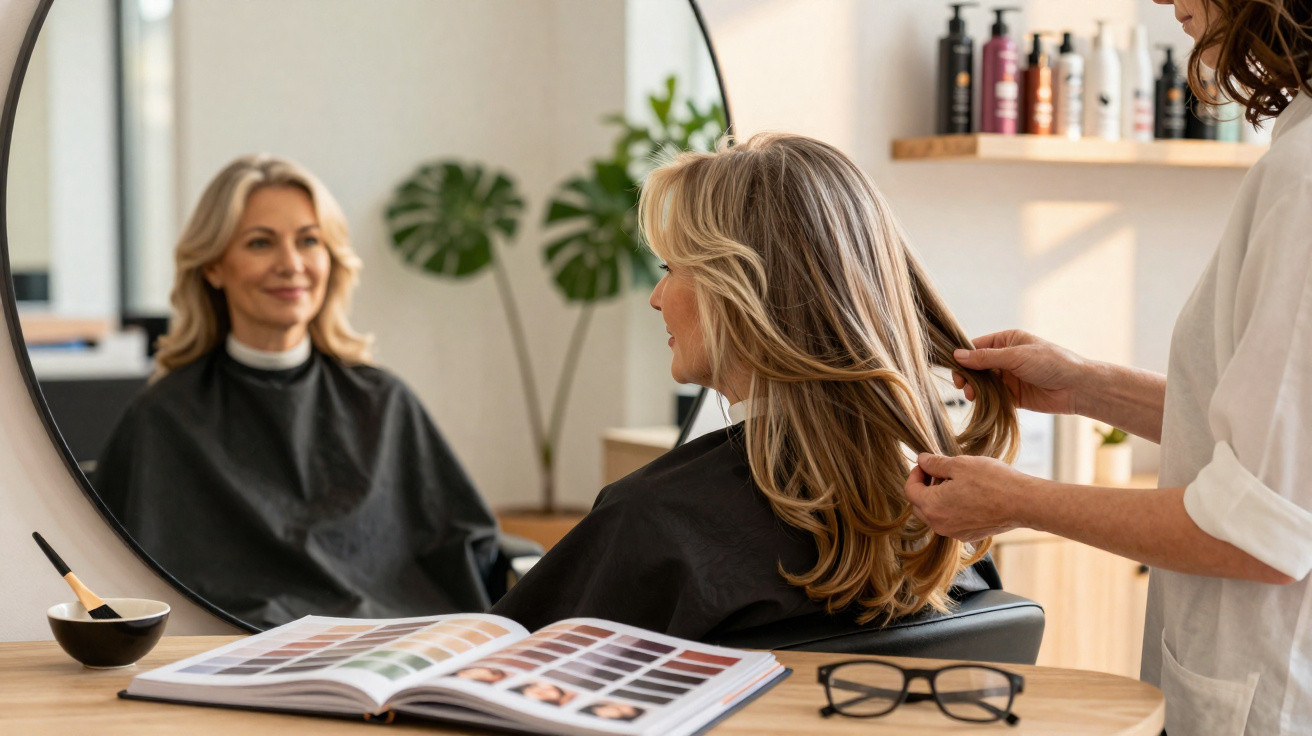
The salon was already buzzing when she arrived. Grey roots showed through her dated chestnut bob; a cardigan was carefully folded over her arm, and she wore the familiar expression of someone both anxious and resolute. “I want it short,” she told the hairdresser. “You know. I’m over 50 now. Time to be sensible.”
The stylist smiled, though her gaze briefly assessed the client’s jawline, crown and the way her hair settled as she took the chair. For a moment, there was only the whirr of a hairdryer at the back of the salon and the click of a kettle switching off.
Then she said the words that transformed the entire appointment.
Words many women over 50 privately fear.
The hard truth your stylist wishes you knew about short hair after 50
The hairdresser eventually explained: choosing short hair after 50 is not automatically an improvement.
It can make you look older. It can make facial features seem harsher. And it can appear “sensible” in all the wrong ways.
For decades, women have been given an unspoken rule: turn 50, cut it short and become “practical”. Yet hair pays no attention to birthdays, nor do cheekbones, necklines or individual style.
Stylists repeatedly notice the same thing: women are cutting their hair because of a number rather than considering their face, hair texture or daily routine.
That is often when the problems begin.
Emma, the hairdresser I spoke with, has spent 22 years cutting hair in a small salon on the High Street.
She can often estimate a client’s age from the opening request: “Just do it short, it’ll be easier.” She also understands how often that decision is regretted. “I’d say at least four out of ten women over 50 who go very short end up trying to grow it back,” she said.
Three weeks later, they return, touching the back of their necks and saying they “don’t feel like themselves”. Their make-up no longer looks quite right, their clothes unexpectedly feel wrong, and the mirror appears less kind.
It is seldom because the haircut has been poorly executed. Rather, the style does not suit the person they still feel themselves to be.
After 50, hair commonly changes in texture, fullness and behaviour.
Grey hair can become drier and more wiry, while hormonal changes may reduce density at the crown. An unsuitable short cut reveals every thin area, cowlick and uneven section. Under unforgiving bathroom lights, a severe crop can draw brutal attention to the jawline and neck.
More length can soften the outline of the face. With one short, blunt cut, some women lose that softness overnight.
Emma’s straightforward message to clients is this: short hair is not automatically more flattering, more modern or more “age appropriate”. It is simply a tool. On certain faces, it is transformative; on others, it amplifies details you would prefer to keep subtle.
When short hair works – and when it really doesn’t
Emma begins with bone structure rather than age.
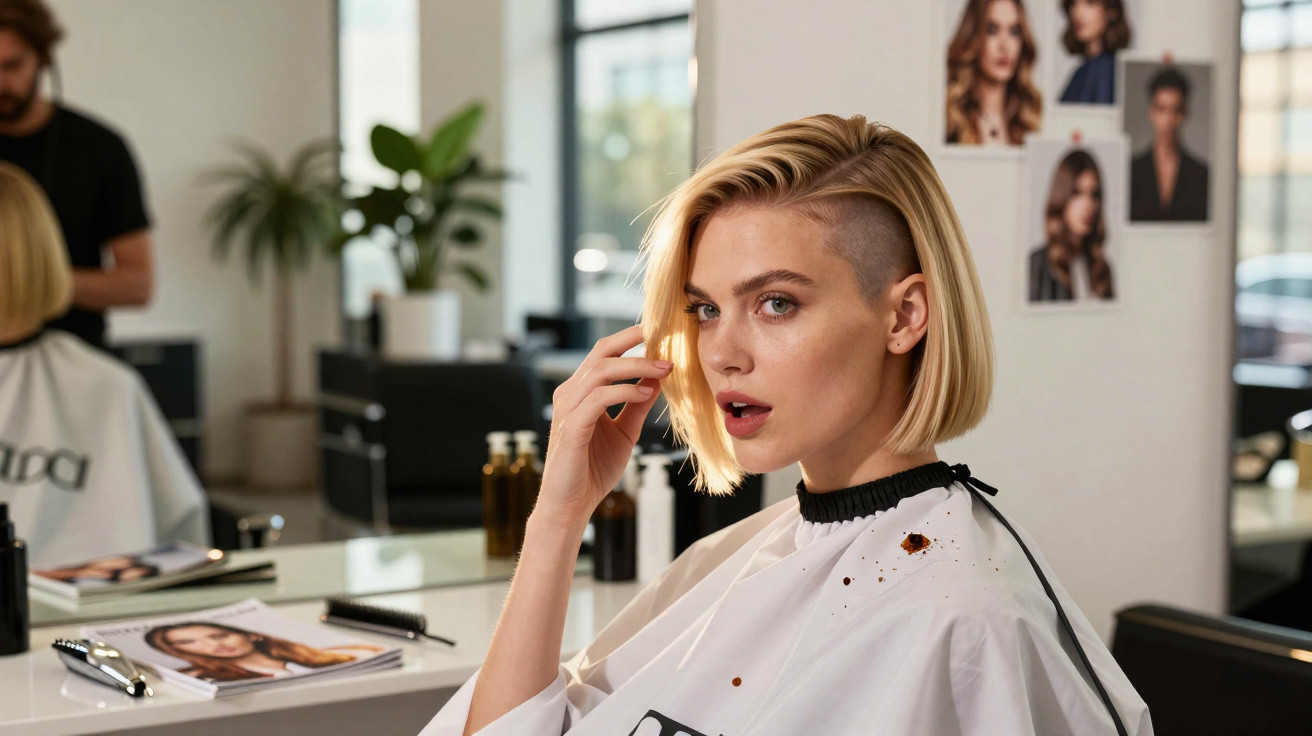
For women with high cheekbones and a jawline sharp enough to catch the light, a shaped pixie cut or short textured bob can look striking. Height at the crown, softness around the ears and a fringe can create vibrancy instead of severity.
However, if facial features have become softer, the neck is shorter or hair is thinner on top, an uncompromising crop can have the opposite effect. The shorter the cut, the more prominent the scalp and shape of the head become.
Her revealing test is to gently lift the hair away from the face. If the client flinches at their reflection, Emma knows an ultra-short cut could mean a lengthy growing-out process.
One recent client, Claire, 57, had spent weeks looking through Instagram images of glamorous silver pixie cuts.
In reality, Claire had fine, naturally wavy hair, and her crown was already slightly sparse. She arrived with a screenshot and the sentence hairdressers quietly dread: “I want exactly this.”
Emma could have reproduced the style. Instead, she asked Claire to tip her head forwards, then move it from side to side. Under the salon lights, the hair on top looked transparent. A close pixie would have turned that into the focal point.
Together, they chose a gently layered bob falling just beneath the jaw, finished with a feathered side fringe. Claire left saying she felt like “an upgraded version” of herself rather than a stranger borrowing another person’s life.
The reasoning behind Emma’s “hard truth” is rooted in physics as well as appearance.
Short hair has less weight and less movement, so its shape is visible from all angles, even when you are not doing anything. That works brilliantly when a style is designed around your head shape and lifestyle. It is far less forgiving when the hair is thinning or persistently flat.
Longer layers can disguise uneven density and create the impression of fuller hair, whereas short, blunt lines reveal it.
There is also the practical issue of styling. A “wash and go” pixie is largely a myth for hair that is wavy, cowlicked or limp. It requires product, careful direction and regular trims. The real secret: many women over 50 end up spending more time on a short cut than they ever did on their longer hair.
The stylist’s playbook for flattering short hair after 50
Women over 50 who genuinely look their best with short hair nearly always have one thing in common: their cut has been tailored to the millimetre.
Every consultation for short hair begins with three checks for Emma. She examines the crown for thinning, assesses neck length from ear to shoulder, and observes how quickly the fringe area drops towards the eyes.
Where the crown is sparse, she avoids shaved or extremely close sections in that area and creates gentle height through layers instead. If a client has a short neck, she leaves a little extra length at the nape to form a vertical line that visually elongates the whole look.
Only after that does she discuss the length around the face, whether to include a fringe, and how much “pieceyness” the client is realistically willing to manage every day.
The idea of effortless short hair is what catches many women out.
They imagine getting out of bed, passing a hand through a stylish crop and being ready to go. That can happen with naturally compliant, thick hair. For most people, though, the mirror offers another version of events.
Short styles expose bed hair, cowlicks and flattened patches more mercilessly than longer hair. They often require a quick blow-dry using a round brush, a pea-sized amount of paste or cream, and two minutes of lifting and shaping at the crown.
Let’s be honest: nobody truly does that every day. This is why so many supposedly “easy” short styles quietly grow into frustrating, shapeless cuts.
If styling is something you dislike, a softly layered cut that skims the shoulders may be the more realistic choice.
Emma has a way of voicing what many stylists believe but seldom say openly:
“You don’t owe short hair to your age. You owe yourself a haircut that tells the truth about who you are today, not who the rulebook says you should be.”
When she senses that a client may be close to making a regrettable choice, she suggests an intermediate step: cut the hair to the collarbone first, introduce relaxed layers and perhaps add a fringe. Then live with it for several weeks.
If the client still wants to go shorter, Emma proceeds gradually, section by section, watching their expression in the mirror throughout. That pause can prevent months of an awkward growing-out phase.
For women who feel overwhelmed, she reduces her guidance to a short checklist:
- Put face shape before age.
- Examine your crown in bright light before choosing a very short cut.
- Test a “mid-short” length, from jaw to collarbone, before making a dramatic change.
- Be truthful about the time you will spend styling, rather than the time you hope to spend.
- Request softness around the face if you are concerned about appearing harsh.
Short hair, long story: what this choice really says
Hair after 50 is never merely hair. It can represent history, bereavement, reinvention, freedom and loss.
Some women cut it following a divorce, redundancy or health scare. Others grow it long as a defiant, quiet declaration: “I’m not done yet”. That is why the blanket instruction to go “short after 50” feels so cruel when real lives are considered.
Short hair can feel freeing when it fits your own story. But it may also feel like surrender when it is chosen because of pressure, rules or an offhand remark from someone who does not see you in your bathroom mirror every morning.
We all know the experience of looking at our reflection and wondering, “Is this really me?” Hair has a remarkable ability to make that question feel much louder.
The more Emma speaks with clients, the more apparent it becomes that the true choice is not short versus long.
Instead, it is this: do you want softness or definition? Do you want hair that frames the face or hair that sculpts it? Would you rather blend in or stand out a little?
A cropped silver pixie can look fiercely current and powerful on a 67-year-old who walks quickly, wears red lipstick and loves statement earrings. That identical cut might overwhelm a gentler, quieter woman who feels most herself in linen shirts and minimal make-up.
The most flattering haircut is the one you can live in, not just pose with. That is the real test: can you still recognise yourself on a Tuesday at 7am, with toothpaste on your T-shirt?
A quiet generational change is also taking place in salons.
Women now in their 50s and 60s watched their mothers cut their hair as soon as the first grandchild arrived. They are less prepared to follow the same script.
Rather than asking, “What should a woman my age do?”, they ask, “What do I actually want?” That small shift is enormous.
So when a hairdresser offers the difficult truth - that short hair may not be your magic answer, or that your long grey braid looks genuinely powerful - it is not an insult. It is an invitation.
An invitation to view your hair not as a rule you must obey, but as a language you can rewrite, strand by strand.
| Key point | Detail | Why it matters to the reader |
|---|---|---|
| Short hair is not automatically flattering after 50 | Face shape, hair density and lifestyle matter more than age | Helps prevent regretful cuts prompted by age-based myths |
| Personalised cuts are better than “one-size-fits-all” rules | Stylists should assess the crown, neck and fringe behaviour before cutting | Provides practical questions for your next salon appointment |
| The reality of styling often outweighs the fantasy | Short hair may need more daily work than longer layered styles | Helps you select a cut you can genuinely maintain each day |










Comments
No comments yet. Be the first to comment!
Leave a Comment