
Your coffee is still too hot to drink, notifications are lighting up your phone, and you are running late already.
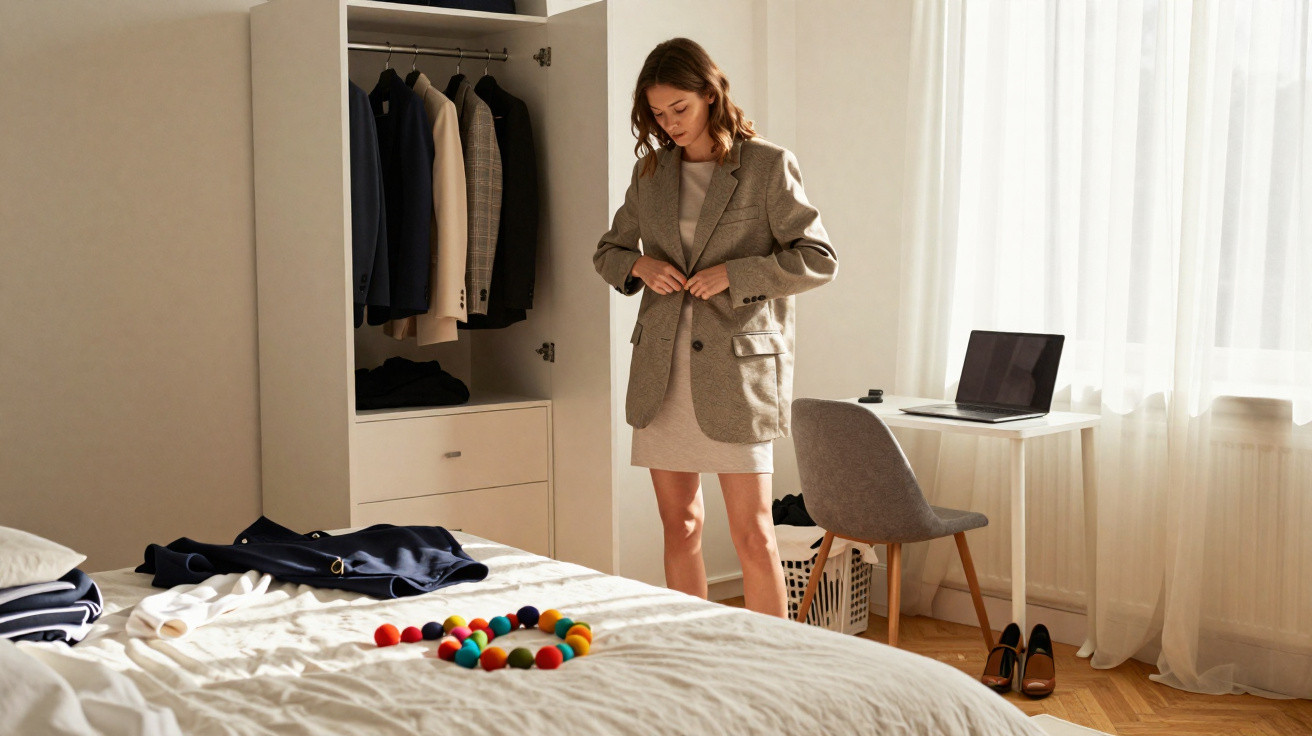
Half dressed in front of your wardrobe, you stare at a rail packed with clothes and hear yourself think the same muted, desperate thought: “I have nothing to wear.” Tops end up on the bed, shoes gather on the floor, and the minutes disappear. When you finally leave, the bedroom resembles a sale-day changing room and your mind feels equally chaotic.
The odd thing is that this happens even to people who own “nice clothes”. The issue lies not with what is on the hangers, but with how outfits are selected. Morning chaos rarely begins in the morning.
It generally begins the evening before.
Why our mornings explode in front of the wardrobe
People often believe they are simply picking an outfit. Actually, while only half awake, they are making a hundred small choices: the weather, their mood, meetings, the commute and comfort, all squeezed into five hurried minutes. That level of mental juggling before breakfast does more than consume time; it exhausts your decision-making capacity before the day has begun.
The wardrobe turns into a giant question mark. Each hanger says “maybe”, while every pair of trousers presents another “what if”. By the third option, your mind is weary, your confidence has started to falter, and you settle for something that is “good enough” instead of an outfit that genuinely serves your day.
That low-level irritation then leaves the house with you.
One rainy Tuesday in London, I saw a marketing manager dress three separate times for one day. She started with a cream blazer that abruptly seemed “too much” for an informal coffee with a client. Next came jeans that looked brilliant in the mirror but were impractical for her wet commute. In the end, she returned to the original outfit with different shoes. Twenty-five minutes disappeared between the hangers, mirror and self-doubt.
Her experience is far from unusual. A small 2023 survey by a UK wardrobe app found that, on average, people spend 17 minutes each morning deciding what to wear. Across a year, that amounts to almost four complete days spent not dressing, but considering how to dress. Four days of half-finished coffees and rushed departures.
Add up the mornings that begin with you already irritated with yourself, and it becomes a hidden drain on your energy.
There is a straightforward reason this pattern persists: the human brain dislikes open loops. A disorganised wardrobe, assorted sale purchases and clothes that do not fit your actual life all generate endless mini-questions. “Does this still fit?” “Is this too dressy?” “Where’s the top that goes with this skirt?” Every one of them takes a small amount from your concentration.
Planning outfits in advance does not merely “save time”; it resolves those loops beforehand. Once tomorrow’s outfit has been chosen, the morning no longer involves a live styling session and becomes a calm sequence: wake up, get dressed, carry on. Your brain is spared fashion roulette, and that spare mental room later appears in more focused meetings, quieter commutes and fewer “I hate everything I’m wearing” spirals.
Put simply, the choice you make at 10 p.m. can shape how you feel at 8 a.m.
How to pre-plan outfits without becoming a fashion robot
Pre-planning is most effective when it feels easy, almost lazy, rather than like a Pinterest-standard project. Treat it like the wardrobe equivalent of leaving your keys in the same bowl every evening. You are not aiming for perfection; you are preventing disorder. Begin small by selecting only tomorrow’s outfit before bed: top, bottom, shoes, underwear and outer layer. Keep the full set together somewhere visible, such as on a chair, hook or dedicated shelf.
As you do this, look at both the weather and your diary. A day involving plenty of walking calls for different shoes from a day of desks and meetings. A day of video calls may require a more defined top, while the lower half can remain casual. This brief two-minute habit quietly drives calmer mornings.
Let’s be honest: nobody truly does this every day. The aim is not 365 flawlessly planned outfits, but perhaps three or four dependable, low-stress mornings a week. That alone can alter the pace of your life.
The main danger is making pre-planning into yet another perfectionist task. You do not need a capsule wardrobe, a spreadsheet, colour analysis and a mood board to get dressed for work. Most people struggle because they attempt to reinvent their style every morning, rather than relying on several dependable “uniforms” that already work.
On a personal level, we also undermine ourselves with “fantasy clothes”: the jeans you expect to fit into “again one day”, heels for parties you never go to, or a shirt that suits only a life you do not really lead. When these pieces sit beside your everyday choices, they delay you and silently pass judgement. This is why pre-planning frequently begins with a kind audit: remove those fantasy items from your immediate view.
We have all experienced trying on something from three years ago, only for body image rather than breakfast to take over the entire day.
“The outfit you choose should remove problems from your morning, not add new ones,” says a New York stylist who works with time-poor founders. “Clothes are tools. If they demand too much from you at 7 a.m., they’re the wrong tools for this season of your life.”
- Trap 1: Leaving the decision about what to wear until you are exhausted and stressed.
- Trap 2: Mixing seldom-worn, guilt-inducing clothes in with your everyday basics.
- Trap 3: Preparing outfits that function only in ideal weather or ideal moods.
- Trap 4: Overlooking shoes and outerwear, then having to restart the outfit when it rains.
- Trap 5: Treating every day as a fashion show rather than creating a few reliable formulas.
The quiet power of a week’s worth of outfits
Spending 15–20 minutes on a Sunday to create loose outfits for the coming week changes something. These need not be polished lookbook moments, only straightforward, realistic combinations suited to genuine plans: three “work focus” outfits, one “office plus drinks” look, and one “errands and laptop in a café” day. Hang each outfit together, or arrange them in hanger order, and Monday to Friday becomes nearly automatic.
This approach does not eliminate spontaneity; it provides a starting point. If your mood shifts, you can still trade Wednesday’s look for Thursday’s. You are simply no longer beginning with a blank page. The real benefit is emotional: mornings feel less like a test and more like a routine you trust without fuss.
That breathing room - the sense that “this is already handled” - often carries over into everything else.
Once their outfits are pre-planned, many people discover that other small routines begin to fall into place. They can drink their coffee while sitting down, pack a proper lunch, or play with the dog and speak to their children without becoming snappy. These are not fashion benefits; they are life benefits that happen to begin in the wardrobe.
This is why pre-planning outfits helps even when trends do not interest you. It is less about resembling an Instagram grid and more about not debating with your mirror at dawn. For some, it becomes a small act of self-respect: “Tomorrow-me deserves something that feels good and doesn’t make her late.”
The reality is that outfits are stories you tell yourself before anyone else sees you. If that story opens in panic, all that follows feels slightly wrong. If it begins with quiet preparation, your posture changes somehow. You respond rather than react, and your mind can move on to bigger matters than “black trousers or blue?”
Even on the mornings when you do change your mind, you will notice something different: chaos is at least the exception rather than the default.
| Key point | Detail | Benefit for the reader |
|---|---|---|
| Prepare the outfit the night before | Choose clothes, shoes and an outer layer in 2–3 minutes | Reduces morning stress and frees up mental energy |
| Set aside “fantasy clothes” | Put aside pieces that are too small, too rarely worn or unrealistic | Makes choosing easier by retaining only genuinely wearable options |
| Create personal uniforms | Identify several outfit formulas that work every time | Saves time while maintaining a cohesive, enjoyable style |












Comments
No comments yet. Be the first to comment!
Leave a Comment