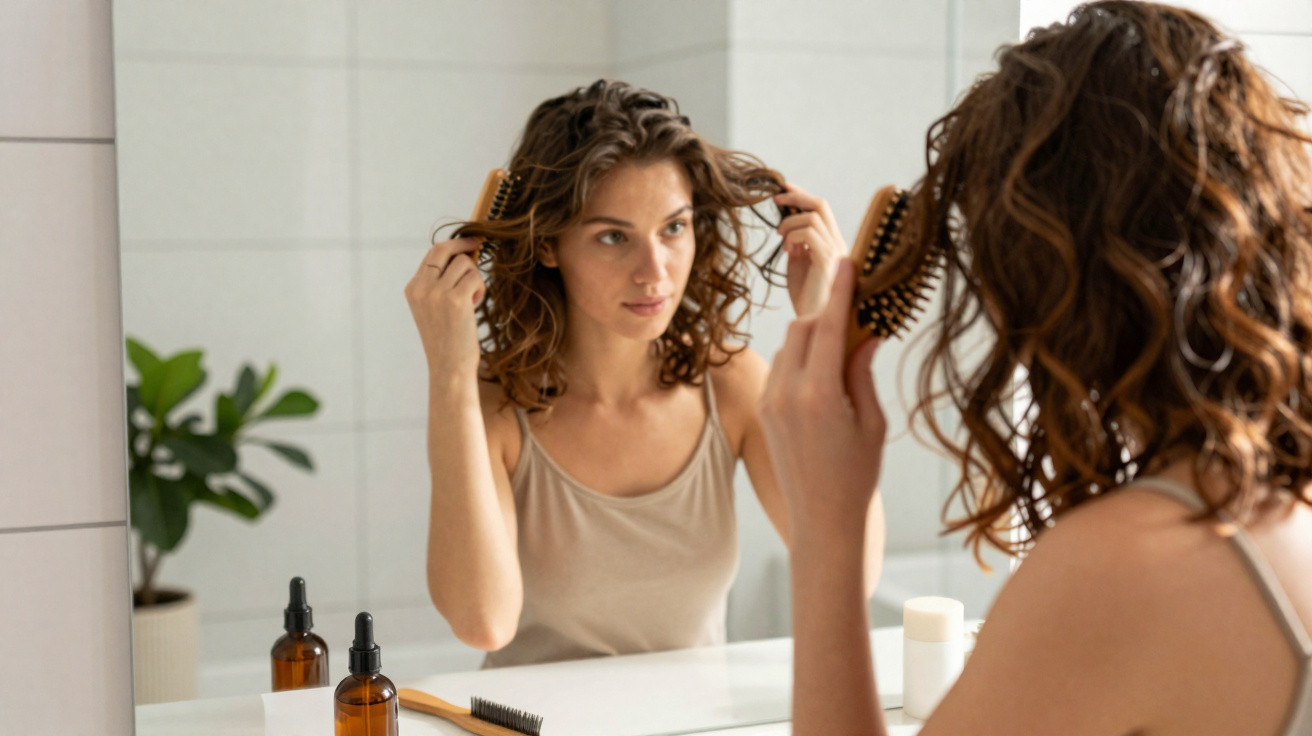
You casually run a hand through your hair and, suddenly, it looks flat, tired and somehow finer than it did a few years ago. The immediate response is usually more product: extra volumising mousse or anything labelled “Thickening”. Then you spot someone on the train confidently massaging their scalp, running a brush through their hair once, and their strands instantly appear thicker, fresher and almost as though they have had a secret styling appointment. It is a small scene that lingers. Quietly, it raises the question: can a few seconds with a brush really achieve more than half the beauty aisle?
What brushing your scalp actually does
When we watch someone brush their hair, it tends to look like a routine task: a few quick strokes while walking about or scrolling on a phone. Yet more is happening beneath the surface. Every pass of the bristles stimulates the skin, opens tiny capillaries and helps blood move more quickly. The scalp stops feeling like merely the place where hair grows and becomes living tissue that responds. Within seconds, the result can be more noticeable in the mirror than expected. That is where the appeal of this straightforward ritual begins.
Many people will remember a grandmother insisting on “100 brush strokes” every evening. It may sound like a meme from another era, but it was not entirely superstition. Trichologists and dermatologists now suggest that even brief, deliberate brushing can encourage the scalp’s microcirculation. In small studies, participants have reported fuller-looking, more manageable lengths after a few weeks. These are not miraculous transformations, but subtle changes that can still be felt. Anyone who has compared before-and-after photographs of regularly brushed roots can see the slight lift at the base, which creates the impression of more hair even though not a single new strand has grown.
The explanation is rather matter-of-fact. Brushing gently distributes sebum and natural lipids from the scalp through the lengths. Roots can look less greasy while the ends seem less dry. At the same time, the brush movement and mild increase in circulation lift hairs at the roots ever so slightly. It is similar to stroking grass against its natural direction of growth: the area suddenly looks denser. Our eyes automatically read this newly created texture as “more volume”, “more fullness” and “more hair”. In this case, the optical illusion works in our favour.
The right scalp-brushing technique: a few seconds, noticeable impact
The secret is not an hours-long haircare regime, but a realistic mini routine. Twenty to 40 seconds in the morning or evening is enough. First, tip your head slightly forwards so that your hair hangs freely. Using a soft brush-ideally one with boar bristles or flexible nylon bristles-brush from the nape towards the parting. Keep the strokes short and intentional rather than tugging frantically. Lift your head again, then brush around the crown in small sections as if working through invisible “zones”. The aim is to reach the scalp, not simply drag the brush through the ends. Finish by lifting the roots with your fingertips for deliberately imperfect but natural-looking volume.
Two common brushing mistakes are excessive pressure and doing it too infrequently. Worrying about hair loss can make people brush so timidly that they only skim the lengths and barely touch the scalp. That limits the effect on circulation and sebum distribution. At the opposite extreme are those who force a hard plastic brush through wet hair until it snaps. Let us be honest: nobody does this as gently every day as tutorials make it appear. A healthier approach lies in between: light pressure, dry or only slightly damp hair, and short, regular sessions rather than one aggressive effort each month.
Once you deliberately test the results, it quickly becomes clear how effective this small step can be. Imagine a day when you simply let your hair air-dry without styling products. Briefly brush only your scalp, then take a photograph. The next day, repeat everything exactly but leave out the brush. Initially, the difference may seem understated, but the root hairline, the slight “wave” over the parting and the texture at the back of the head all produce a visibly different silhouette. A trichologist put it plainly in an interview:
“We are not talking about suddenly new hair, but better-presented hair. Good circulation and movement at the scalp allow existing strands to realise their potential.”
To make the effect as pronounced as possible, keep a few simple points in mind:
- Choose a soft brush that is kind to the scalp rather than sharp-edged plastic pins.
- Keep each session to a maximum of 30–60 seconds, but repeat it daily or every other day if you wish.
- Avoid brushing immediately after heavy styling with lots of hairspray, as this can cause breakage.
- If your scalp is itchy, irritated or flaky, have the cause assessed by a doctor first.
- Use the moment intentionally: breathe slowly, drop your shoulders and take a brief pause from the day.
Why this small hair-brushing gesture matters more than it seems
Once you understand that “fuller hair” is often about presentation, you may look in the mirror differently. It is not solely about genetics or expensive treatments, but also about what we do every day with our scalp nerves, hair roots and view of ourselves. A few seconds of brushing can become a ritual that says: I care for the part of myself the world sees first. That is not narcissism, but a quiet act of self-respect. Usually, it is exactly this attitude that we admire in people whose hair appears “somehow fuller”.
| Key point | Detail | Benefit for the reader |
|---|---|---|
| Scalp stimulation |
Hollywood stylist swears by OWC: how damaged hair becomes visibly smoother in 4 weeks
The perennial bloomer for lazy gardeners: why lantana belongs in every garden now
Breast cancer shock: why young women are affected far more often today
A preference for blue, a clever mind? What your favourite colour reveals about your intelligence
Authority advises keeping a supply of ice: how to save your food during a blackout
4 turbo vegetables for March: ready to harvest in just 30 days
Brilliant DIY ideas: everything you can sew from IKEA bags in 2026
Brilliant 1p frying-pan trick: no more oil splatters when frying
Copyright © 2026 Koester-kuechen
Back to top














Comments
No comments yet. Be the first to comment!
Leave a Comment