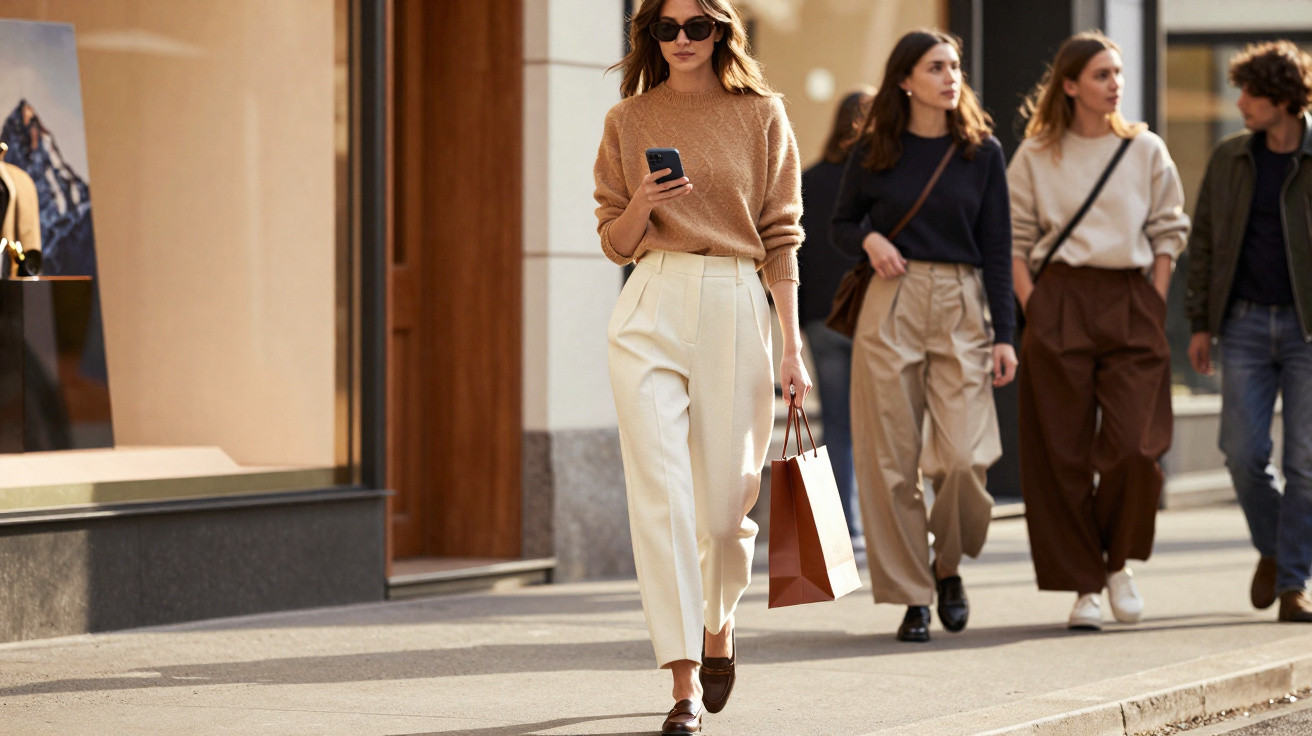
The shift happened almost live, on the streets and across our feeds. Vast cargo trousers sweeping the pavement began to vanish, replaced by mysterious, highly structured bottoms that influencers now call “Gstaad pants”.
Cuts are becoming slimmer, fabrics more luxurious and prices increasingly steep. Anyone who does not know the new rules already feels left behind.
One evening in January 2026, a brief TikTok clip filmed in a luxury hotel lobby reached 18 million views. Three fashion creators stood side by side: XXL baggy trousers were out, replaced by perfectly pressed cream trousers breaking precisely over gleaming loafers. The comments poured in: “Are wide pants over?”, “What are THESE?”, “How do we even wear that?”. Within a week, the hashtags #gstaadpants and #goodbyewideleg were trending worldwide.
On Instagram, images of figures drowning in oceans of denim are steadily being replaced by crisp, readable, almost architectural legs. An Alpine-chic look is appearing everywhere: cable-knit jumpers, lightweight puffers, beige roll-necks and, at the heart of it all, this near-obsessive trouser.
Beneath these apparently sensible cuts lies a genuine style war, driven by an uncomfortable question: who can keep up, and who gets left behind?
From sloppy wide to sharp Gstaad: the 2026 flip
Throughout 2024–2025, wide trousers were the default silhouette for an entire generation. They forgave everything, from extra weight to worn-out trainers. In 2026, the biggest fashion accounts are declaring the change with no mercy: cuts are narrowing, waists are rising and legs are becoming leaner.
The “Gstaad pant” has emerged as its emblem: a straight line, pronounced creases, premium fabrics and a five-star chalet mood, even outside a corner shop.
This change is not coming from the catwalks alone. It is also being driven by sponsored trips to ultra-exclusive resorts including Gstaad, St. Moritz and Aspen, filmed as intimate vlogs. One Italian creator presents “her” ideal suitcase for three days in Switzerland: four nearly identical pairs of trousers in taupe and mouse grey, all from a discreet fashion house that is far beyond the average person’s budget.
In the comments, teenagers compare the price of those trousers with a month’s rent paid by their parents. Fashion has rarely felt so remote, yet everyone still wants to understand it.
The figures tell the same story. Platforms such as Lyst and Vestiaire are already publishing reports showing falling searches for “oversized pants” alongside growing demand for more specific terms such as “wool pleated trousers” and “alpine tailored pants”.
This is no longer merely a trend: clothing is being used to redraw social hierarchies. The wide trouser was democratic, often inexpensive and easy to imitate. The Gstaad pant demands dry cleaning, millimetre-perfect hems and, at times, a tailor. Beneath that expectation sits an unspoken question: who has the time, money and mental headspace to follow this script?
How the “elitist” Gstaad pant quietly dictates new rules
The real harshness of the Gstaad pant lies in its precision. It needs a flawlessly fitted waist, a length that brushes the shoe, and a drape that creates neither odd creases nor unflattering bunching.
A Paris stylist sums up the unofficial rule: “If your trousers could not pass for a palace uniform, they are not real Gstaad.” That says it all.
We have all experienced the moment when a new dress code arrives and, suddenly, our wardrobe feels “dated”. With these trousers, that feeling is intensified. The creators setting the pace post videos titled “How to ditch your sloppy pants in 24h”, symbolically throwing their baggy trousers into a bin bag.
Let us be honest: nobody actually does that every day. But the point lands. Holding on to wide cuts suddenly places you in the “old TikTok, old-money wannabe, not in the 2026 mood” category.
The elitism is not only about cost, but also the lifestyle implied by it. The Gstaad pant assumes that you do not run for a bus, sit on a damp pavement, or visit places where pale trousers are at risk.
It also requires a ritual: the right hanger, light ironing, clean shoes and a coordinated coat. Behind one simple straight leg is a highly coded world, where a single glance reveals who “lives like this” and who is simply wearing a costume for a selfie.
How to survive the Gstaad takeover without losing yourself
The first way to ride out this wave without being consumed by it is to interpret rather than copy. Take the Gstaad pant idea - a clean cut, a slightly refined fabric and calm colours - and apply it to what you can genuinely wear.
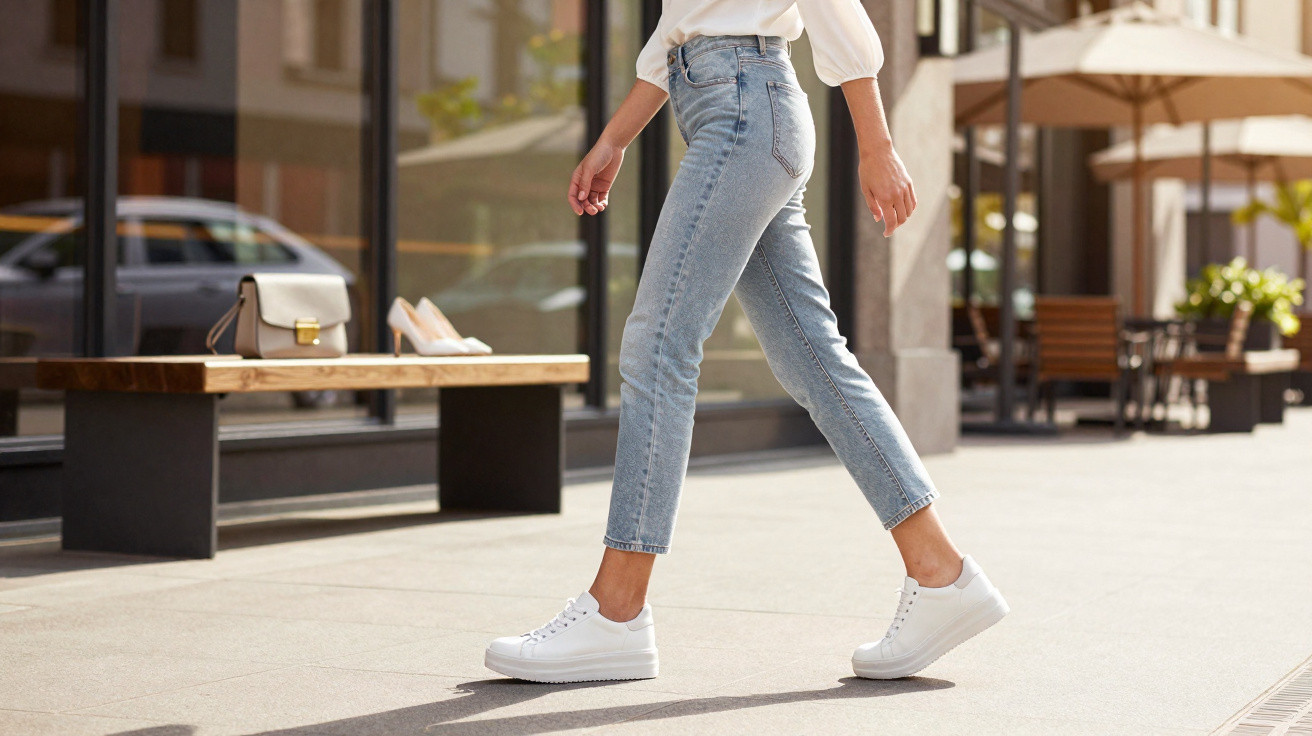
A well-cut, pressed chino in soft beige can already create an Alpine-bourgeois feel, even without a hidden logo on its label.
Another practical move is to focus on hems. A slightly too-wide fast-fashion trouser can be altered at the waist and ankles by a local tailor for around €30. The result? A more structured silhouette that creates the impression of an expensive piece.
Add clean shoes, a simple belt and a neutral jumper. The secret is not price but visual consistency. One cheap-looking detail stands out; three considered details create an aura.
The most common mistakes always come down to rigidity. Some people abruptly abandon their wide trousers only to squeeze themselves into overly tight cuts, like a 2010s office uniform. Others replicate influencer looks without considering their own body shape or the reality of their days.
A better balance looks more like a “local Gstaad”: one or two better-cut pairs of trousers than your old ones, worn with your favourite pieces so that your own signature remains intact.
“If you can breathe in your trousers, you have already won the style battle.”
- Start small: one neutral, cleanly cut pair of trousers can already transform your silhouette.
- Take care with maintenance: a proper wash, quick iron and sharp crease can give even an affordable item a “Gstaad” feel.
- Adapt it to daily life: if you walk a lot, choose a fabric with a little stretch rather than an ultra-stiff wool cloth.
- Keep some of yourself in the outfit: a graphic T-shirt, familiar hoodie or personal piece of jewellery prevents it becoming a complete costume.
- Watch the street, not only the feeds: genuinely lasting trends show up on pavements, not in hotel lobbies.
What this style war really says about us in 2026
The conflict between wide trousers and Gstaad pants tells a story beyond simple cuts. It reveals how quickly a generation can abandon a symbol of comfort in pursuit of a new form of visual respectability.
We switch trousers as though changing our imagined social class, for the duration of an Instagram carousel.
There is an odd tension here: everyone wants to look more “polished”, more grown-up and more “stable”. In an uncertain world, well-cut trousers resemble a promise of control. Yet this shift also excludes people without the time or money to keep pace.
The wide trouser concealed differences; the Gstaad pant highlights them.
What will probably fascinate people in a few years is not only the aesthetic of these 2026 silhouettes. It will be how feeds managed to turn a straightforward trouser leg into a test of status, seriousness and almost maturity.
The real question is not “should we follow?”, but “what are we trying to prove when we replace our old trousers with these immaculate pieces?”. As long as that question remains unanswered, every new pair of jeans, every new suit and every new “it pant” will offer another excuse to debate, compare, share and quietly ask ourselves: who exactly am I trying to resemble?
| Key point | Details | Why it matters to readers |
|---|---|---|
| Typical Gstaad pant cut | Mid- to high-rise, straight leg, a light break over the shoe, a pressed front crease, often with discreet side adjusters rather than a conspicuous belt. | It helps you identify pieces that genuinely suit the trend instead of buying another random pair that will not create the expected silhouette. |
| Affordable “Gstaad” fabrics | Poly-viscose blends, brushed cotton and wool-mix twill offer a rich appearance without the dry-clean-only worry associated with pure cashmere or flannel. | You can achieve the Alpine-chic mood without wrecking your budget or spending every week at the dry cleaner. |
| Key colour palette | Soft beige, stone, greige, charcoal and muted navy - hardly any bright shades, with plenty of winter-light neutrals that recall snow and wood. | Choosing the right colour can instantly bring your existing wardrobe closer to the new aesthetic, even when the cut is not 100% perfect. |









Comments
No comments yet. Be the first to comment!
Leave a Comment