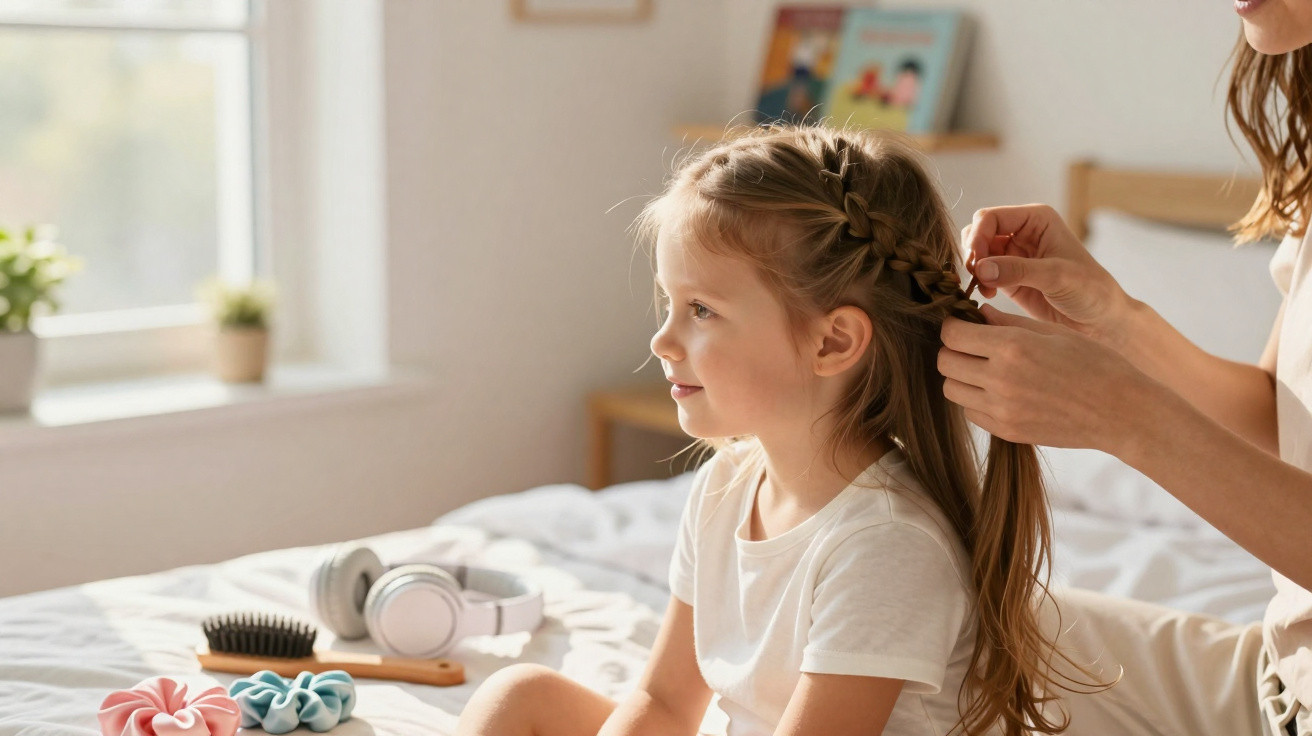
Her mother stands behind her, brush in one hand and hairband in the other, already saying sorry: “Just one second, I promise.” Before the brush has even reached her hair, the girl recoils. It is not attention-seeking behaviour; her nervous system is sounding the alarm.
One loose strand brushes her cheek, and she repeatedly swats it away. She wants long hair, but she also needs it nowhere near her face. With her spare hand, her mother scrolls through tutorials: tight ponytails and shiny braids that may look brilliant on Instagram but feel unbearable in everyday life.
Then the mother pauses, takes a breath and attempts something gentler. The finished braid looks fairly unremarkable. Her daughter’s response is anything but.
The hidden difficulty behind “simple” hair
In plenty of households, the morning routine does not collapse over breakfast or putting on shoes. It breaks down when the hairbrush appears. A light brushstroke can feel like sandpaper, while an ordinary ponytail may feel like a clamp. For children with sensory processing issues, hair touching the face can be as distressing as a style pulling tightly at the scalp.
Parents are often criticised for “letting” their children reject certain hairstyles. However, what can appear to be defiance is frequently self-protection. A strand brushing the forehead can disrupt concentration for the entire day. An elastic pulled tight at the crown may make it impossible to read. Hair is no longer merely about appearance; it becomes an ongoing negotiation with the nervous system.
On difficult mornings, nobody comes out well. The child cries, the parent gives in, and the hair is left down. The fringe falls forwards, teachers request “neater hair”, and the same pattern begins again the following day, with slightly more strain in the room.
In a small Facebook group for parents of autistic and sensory-sensitive children, one mother shared a photograph of her daughter’s hair. It was not a polished ballerina bun or a conventional three-strand braid, but a soft, broad plait sitting along the sides of her head. “This is the first hairstyle she’s kept all day,” said the caption. The comments quickly followed, focusing less on its appearance than on how relaxed her daughter seemed.
Another parent described her son, who dislikes hairbands and had chosen to grow his hair longer. Sport had become extremely difficult. The usual solution - a high, tight ponytail - stayed in place for ten minutes before he pulled it out. A therapist then showed them how to make a loose, anchored side braid that moved the hair away from his face without creating the sensation of having it “pulled back”. He kept it in through a whole football match, with no meltdown and no clutching at his head from the sidelines.
There is no major clinical study specifically examining braids for sensory-sensitive children. Instead, there are experiments at the kitchen table, observations on the school run and the small successes that can feel enormous at 7:45 in the morning. When something finally helps, the stories parents share reveal a pattern, even when the hairstyle itself looks rather plain in photographs.
Sensory processing issues can mean that the brain interprets touch as louder, sharper and more persistent than other people do. Hair is particularly challenging because it is light but always present. A strand against an eyelid can be like a dripping tap in an otherwise silent room. A tight elastic pulling at the roots may feel like a thumb pressing into the scalp all day. There may be nothing visibly wrong, but internally everything is turned up.
Conventional tight braids rely on tension along the hairline. That is useful for dance performances, but can be punishing for a hypersensitive child. The most helpful approach reverses that principle: use as little tension on the scalp as possible while creating secure support along the sides. The aim is broad, low-pressure contact rather than a sharp, concentrated pull. Hair is kept away from the face through gentle guidance and secure placement, rather than being dragged backwards.
A particular braiding method works quietly well here. It functions like a headband without feeling like one, contacts more hair than skin, and acknowledges that some children need their head to feel like their own even when they do not want hair flying into their face.
The gentle anchor braid that makes a difference
Hairdressers may describe it as a loose Dutch or French headband braid. In sensory parenting groups, it is often simply known as “the soft side braid that actually works.” The technique is straightforward: form a braid travelling from one temple to the other, keeping it low and relaxed so it forms a built-in barrier against hair falling forwards.
Begin with clean hair that is dry or slightly damp. Take a broad front section, starting near one temple. Split it into three strands and start a standard braid, with one key adjustment: keep your hands a few centimetres away from the scalp. As each strand crosses over, add only a small amount of hair from above the braid, rather than taking hair from below near the neck. This allows the braid to sit like a padded band instead of a rope fixed tightly to the head.
When you arrive at the other side, fasten it softly behind the ear with a gentle, snag-free elastic. Next comes the crucial step: carefully pinch and tug at the outer edges of the braid to pancake it, making it broader and flatter. The wider it becomes, the less it resembles a tight cord. Instead, it acts as a soft anchor that stops the fringe and front layers from moving into the face.
For many children, the styling process is harder to tolerate than the finished look. Small changes can make a major difference. Prepare the hair with a wide-tooth comb instead of a fine brush, and stop immediately if they begin to tense up. Slightly textured hair is often easier to handle: leave-in conditioner, a little curl cream or even braids taken out from the previous day can help fingers move through the hair without snagging.
Explain each stage as you go, so there is no unexpected attack from behind. Allow them to hold the elastic and choose the side on which the braid begins. If anxiety is high, try a “practice round” in the evening, when there is no pressure to get ready for school. Let’s be honest: nobody really does this every day, but trying it once or twice is often enough to ease the fear.
The most common errors are simple to correct. Pulling sections too firmly can create the buzzing, helmet-like sensation that can send some children directly into fight-or-flight mode. Braiding too near the hairline can tug at the tiny, already-sensitive baby hairs. Working too quickly can feel chaotic on the scalp. Slow, gentle and deliberately imperfect hands nearly always work better than speed or flawless styling.
“The first time we did the soft braid, I nearly cried,” says Emma, mum to a seven-year-old with sensory processing disorder. “Not because it looked cute, but because she forgot about her hair. She came home and it was still there. No complaints. No red marks. Just… normal.”
That sense of “normal” is what many families are quietly seeking. Children should not have to choose between a look they like and a nervous system they can manage. Parents should not have to choose between a calm morning and a hairstyle considered “neat enough” for school. A simple braid can become a small gesture of respect for a body that experiences the world more intensely.
- Choose soft, fabric-covered elastics to prevent harsh pressure points.
- Make the braid broad and loose, particularly around the temples.
- Involve the child: let them hold clips, select colours or look in the mirror.
- Trial the hairstyle on a calm day, rather than before an important event.
- Pay attention to body language, as discomfort often appears before it is put into words.
More than a hairstyle: a small everyday act of care
Choosing comfort over “perfect” children’s hair can feel almost radical. Once you have seen the contrast between a tight, polished style and a gentle anchor braid that a child barely notices wearing, the standards set by glossy tutorials can start to seem unimportant. The priority changes from being “Instagram ready” to being able to get through maths without repeatedly pulling at their roots.
Practically speaking, this technique restores energy for everyone involved. A child who is not constantly sweeping hair out of their eyes or struggling with a headband has a few more mental spoons available for everything else. A parent who does not need to redo hair at every break has a little more patience remaining by bedtime. At a human level, it sends a quiet but important message: comfort matters as much as appearance, perhaps even more.
On a broader level, these small changes can prompt useful conversations. Teachers may notice that a child is fidgeting less. Grandparents, raised with the belief that “tight equals tidy”, may begin to recognise sensory needs as genuine rather than excuses. Friends may ask how the braid is created and gradually learn about nervous systems that operate at a higher volume. A piece of hair styling can become an opening for discussing how different brains and bodies experience the world.
| Key point | Detail | Why it matters to the reader |
|---|---|---|
| Gentle anchor braid | A loose, wide braid along the front hairline that sits away from the scalp | Provides a clear, practical alternative to tight ponytails and painful hairstyles |
| Minimal scalp tension | Hands work a few centimetres from the scalp; hair is guided rather than pulled | Limits sensory overload while continuing to keep hair away from the face |
| Child-led choices | Children choose the direction, accessories and timing | Encourages cooperation, autonomy and everyday trust in a sensitive routine |












Comments
No comments yet. Be the first to comment!
Leave a Comment