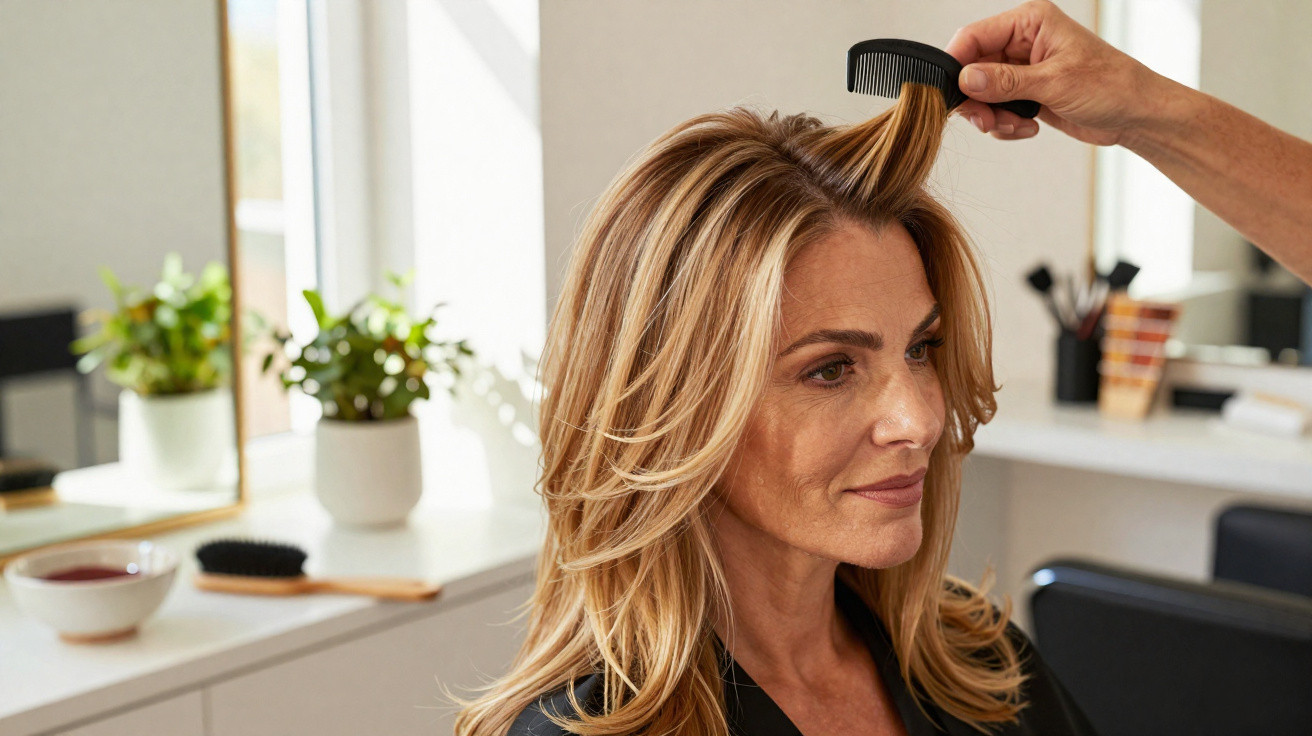
The salon was already full of energy when she settled into my chair, her shoulders slightly tight and her roots showing a little too much. “I turned 52 last week,” she sighed, “and suddenly my hair color just makes me look… tired.” She delivered “tired” as though she were saying “tax audit”.
I studied her reflection: a beautiful face, strong bone structure and thick hair. But the flat, single-tone brown she had relied on for years was pulling her whole look down.
We talked about work, children and the birthday meal she had barely found time to enjoy.
Then I angled her head towards the light, and the answer became obvious.
Her age was not the issue.
The problem was a colour acting as if she were still 35.
The subtle hair-colour shift that instantly softens the face
There is a particular moment I see repeatedly in the salon.
A woman in her 50s takes a seat, points to her regrowth and says, “Same as usual, please.” Yet her eyes are asking a quieter question: “Can you make me look a bit more… awake?”
That “same as usual” is often where things go wrong.
A shade that suited you at 38 can begin to appear severe at 53, particularly if you colour your hair regularly. Skin can lose some of its warmth, the contrast around the face shifts, and that formerly ideal dark shade or ultra-cool blonde begins to dominate rather than complement.
The face is softer, but the hair stayed in 2012.
That is the point at which colour can start making you look older.
One regular client of mine-let’s call her Marie-had coloured her hair a solid, rich chocolate brown for years. There was no variation, no highlights and no grey visible.
She took pride in “hiding everything”.
Then, one afternoon, she arrived in the unforgiving 2 p.m. sunlight, and I saw the way that dense block of colour cut across her forehead. It drew attention to every small shadow: slight under-eye circles, expression lines and a little softness at the jaw.
Technically, the colour was flawless, but the person in the mirror looked hard, almost stern.
We made her base only half a shade lighter and introduced extremely fine, warm mocha veils around her face.
It was not a dramatic change in theory, but the result was striking. Her features appeared gentler, her eyes looked brighter, and she kept touching her cheeks while saying, “I look rested.”
This is what is really happening.
As we get older, our natural pigment softens: brows, lashes and even the whites of the eyes change a little. Holding on to the same bold, opaque colour you wore at 35 creates too much contrast. It is rather like increasing the sharpness on a television: everything appears more defined, especially expression lines.
By contrast, slightly softer, less uniform shades sit more gently alongside the skin. A touch of warmth around the face can create a subtle “filter” effect, as though you had slept properly and remembered to hydrate.
You do not need a dramatic overhaul.
You simply need to stop battling your age with a solid wall of colour.
The one rejuvenating tip I give all my 50+ colour clients
This is the advice I repeat throughout the week:
For women in their 50s who colour their hair, the most rejuvenating step is to lightly brighten and soften the colour around the face rather than darkening everything in an attempt to cover grey.
I call it “the soft halo”.
We retain a base close to the shade you love, while lifting the tone slightly at the hairline, along the parting and at the sides of the face. There are no thick stripes or 2000s-style highlights-only ultra-fine veils, one to two tones lighter than your base, with a trace of warmth.
This halo reflects the light.
It guides attention towards your eyes rather than your roots.
Many women arrive convinced that they require more coverage, more pigment and more dye.
They point to the grey and say, “Color it darker, it shows less.” I understand the instinct. Grey regrowth can feel like a betrayal that returns every week.
However, over-darkening produces the reverse result: the regrowth line becomes more pronounced, the face can look more severe and every sign of tiredness is amplified. I once had a client, Elena, who was dyeing her medium-brown hair almost black at home. In photographs, she looked defined, certainly, but also older than she felt.
We raised her base by just one shade, added a few caramel threads at the temples and through the fringe, and her whole face immediately brightened.
Her friends did not ask whether she had changed her hair colour. They asked whether she had been away on holiday.
Let’s be realistic: no one can truly keep this up every day.
Most women do not have the time-or the budget-to practically live in the salon. That is why this approach needs to remain workable.
I advise my 50+ clients who colour their hair to concentrate on three key areas:
“If the hairline, first 3 cm around the face, and the natural parting look soft and luminous, the entire head reads as fresh… even if the back is due for a visit,” I often tell them in the mirror.
Then I explain exactly what they should request.
- Ask for a base no more than one shade deeper than your natural colour.
- Request micro-highlights or “baby lights” only around the face.
- Opt for a gently warm shade-beige, honey, mocha or soft copper-rather than flat ash.
- Book colour appointments every 6–8 weeks, using quick hairline touch-ups between visits.
- Apply a toning conditioner to keep the halo luminous instead of brassy or dull.
Let your hair colour grow up with you, not against you
There is a quiet kind of beauty in the moment when a woman stops pursuing the hair she had at 30 and begins asking, “What suits me now?”
That is generally when the real magic takes place in my chair.
The aim is not to remove every grey hair or to act as though your skin has not changed.
The aim is harmony: colour, skin, eyes and texture all telling the same story. When the tones framing your face are slightly softer, and there is light and shadow rather than flat opacity, your features seem more relaxed and open.
You do not look “younger at all costs”.
You look like yourself on a particularly good day.
| Key point | Detail | Value for the reader |
|---|---|---|
| Lighten the face frame | One to two shades lighter around hairline and parting | Softer features and brighter eyes without drastic change |
| Avoid ultra-dark, flat colour | Stay close to natural base, add subtle dimension | Reduces harsh regrowth and “helmet” effect that ages the face |
| Work with warmth, not against it | Choose beige, honey, mocha, or soft copper tones | Creates a gentle, flattering glow that mimics healthy skin |
FAQ:
- Question 1 What if I have a lot of gray and feel “too” light already? You can still use the soft halo trick. Keep a slightly deeper base at the back, then add just a whisper of warmer, translucent color around the face to avoid a washed-out effect.
- Question 2 How often should women in their 50s color their hair? Every 6–8 weeks is a good rhythm for full color, with quick hairline touch-ups at 3–4 weeks if regrowth bothers you a lot.
- Question 3 Can I do the halo effect at home? It’s delicate, so I recommend getting the first one done at a salon. Once the map is set, some clients maintain just the roots at home between visits.
- Question 4 Which tones are the most rejuvenating on mature skin? Soft, slightly warm tones - beige-blond, honey, light mocha, soft chestnut, muted copper - tend to flatter most 50+ complexions more than very ashy shades.
- Question 5 Will embracing a bit of gray make me look older? Not necessarily. A well-blended mix of gray and soft color can look incredibly chic. What ages the most is strong, flat contrast, not the gray itself.










Comments
No comments yet. Be the first to comment!
Leave a Comment