More and more salons are cutting back their gel appointment lists and offering a treatment that sounds more like a spa ritual than a nail salon service. The so-called Japanese manicure promises healthier, stronger nails and a subtle shine that appears to come directly from the nail plate rather than a bottle.
What the Japanese manicure really involves
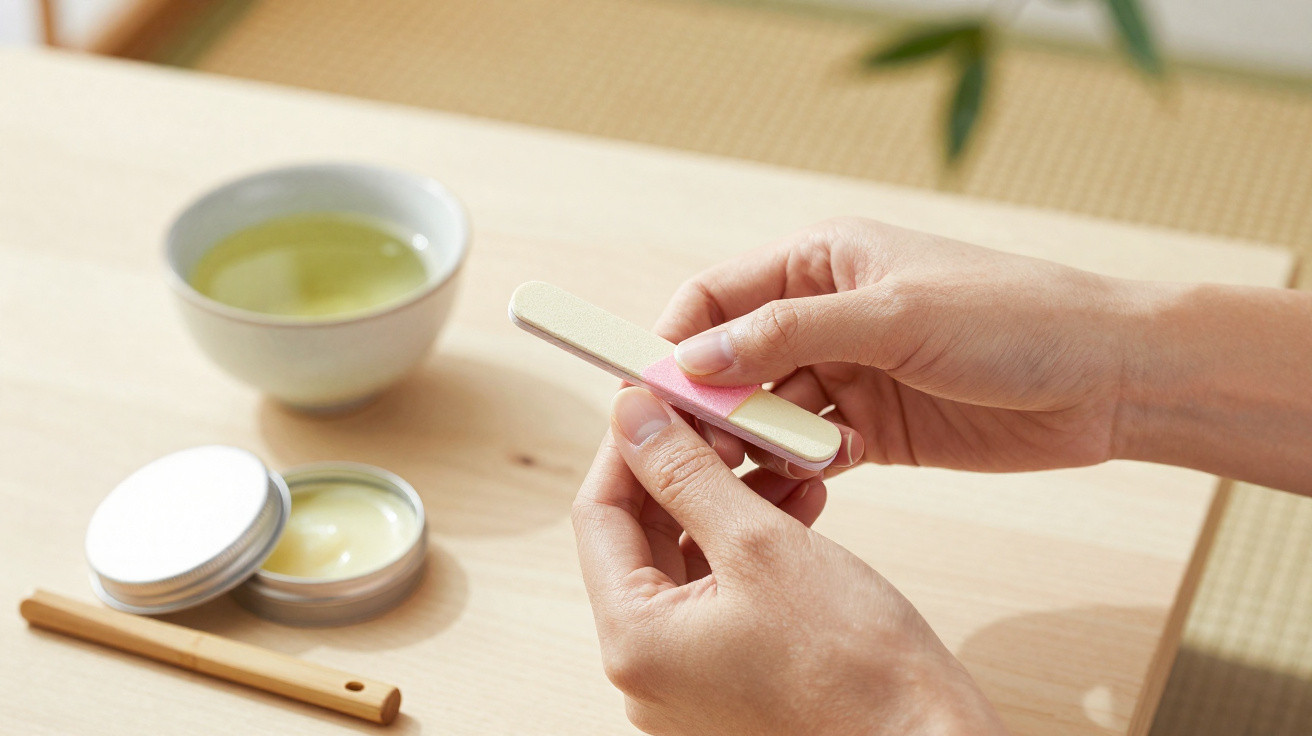
A Japanese manicure is not a new type of polish, but a care ritual. Its purpose is not to attach anything to the nails, but to improve their natural condition. Rather than liquid plastic, nourishing pastes and powders are worked into the nails.
“The result looks as though nothing has been done – except you suddenly have truly beautiful, healthy nails.”
Typical ingredients include:
- Beeswax, which creates a protective film and provides moisture
- Keratin-containing components intended to strengthen the nail plate
- Minerals, such as silicon compounds from the sea
- Vitamins to care for dry, brittle nails
The procedure follows a clear sequence. First, the beauty therapist massages a rich paste into the natural nail. A fine powder is then buffed on to seal in the caring ingredients and create the signature, softly pearlescent sheen. There is no drying time, UV curing or solvent smell.
Why the trend is taking off now
After years of gel, acrylic and BIAB (Builder in a Bottle), many people are noticing how much these methods can strain the natural nail. Nails can become thin, split easily and tear – then seem to need even more artificial reinforcement. It is a familiar vicious cycle.
This is exactly where the Japanese manicure comes in. It is presented as a kind of “rehabilitation programme” for overworked nails: away from plastic layers and towards care and recovery. That fits neatly into a wider beauty trend, with fewer artificial effects and greater emphasis on substance and long-term health.
“Many clients are swapping their monthly refill subscription for a care subscription for natural nails.”
There is also a very practical reason for the trend. Anyone deliberately trying to strengthen their nails can reduce the number of salon appointments over time. The effect lasts for several weeks, and the surface does not look worn because nothing can chip away – the shine simply grows out with the nail.
How a Japanese manicure is performed in a salon
The process may look straightforward, but it requires precision. At reputable salons, an appointment usually includes:
- Gently trimming and shaping the nails without aggressive filing
- Caring for the cuticles, usually pushing them back rather than cutting them away drastically
- Cleaning and lightly buffing the nail surface with fine polishers
- Massaging the nourishing paste into each nail plate
- Buffing in the powder, which binds the active ingredients and provides shine
- A short hand massage using a light care cream
The difference from a classic manicure is that nothing opaque is applied, nothing is sealed beneath a coating and nothing is removed with solvents. The treatment works with the nail, not against it.
The Japanese manicure look: “Your nails, only better”
Visually, the finish ranges from “almost invisibly groomed” to “softly pink and pearly”. The surface appears smoother, while the colour resembles an extremely subtle, sheer pink. It is ideal for workplaces where bold nail art is not particularly welcome.
Those who still do not want to give up effects altogether can add small accents:
- An ultra-fine pale line along the nail tip (Micro French)
- A delicate glazed effect using a transparent top coat after a few days
- One accent nail with a minimal design
The foundation, however, always remains the same: your own visible natural nail. Many people say they gradually move away from vivid colours because the polished natural look is enough for them.
Advantages over gel, Shellac and similar treatments
A direct comparison shows why so many people are making the switch. Here is a broad overview:
| Aspect | Gel / traditional enhancement | Japanese manicure |
|---|---|---|
| Material | Synthetic polymers | Naturally derived care pastes and powders |
| Removal | Filing, acetone, regular refills | Simply grows out with the nail |
| Strain on the nail | Risk of thinning and cracks | Focus on strengthening and regeneration |
| Appearance | Opaque, often noticeably artificial | Natural look with a soft shine |
| Suitable for | Statement nail art, long nails | Short to medium-length, natural nails |
The method is particularly interesting because it may also suit sensitive skin and people who need to avoid certain ingredients, including during pregnancy. As no harsh solvents or UV radiation are used, the risk of irritation is considerably lower.
Who can benefit from a Japanese manicure
This treatment is not just for Instagram beauty fans. It can be especially worthwhile in the following situations:
- After years of gel or acrylic, when nails have become thin and soft
- For nails that tear or split quickly
- For anyone who needs neat but understated hands at work
- If nail polish and remover are not well tolerated
- As a reset phase before considering stronger methods again
Do not expect overnight miracles. Nails grow at their own pace. Those who repeat the treatment every few weeks will usually notice after two to three months that the new nail growth is coming through stronger and smoother.
Can you recreate a Japanese manicure at home?
More and more kits are appearing online that promise to bring the ritual into the home. In principle, the method can be replicated: gentle buffing, a nourishing paste and powder to seal it in. The difference often lies in the product quality and the level of care needed.
Anyone wishing to experiment themselves should keep the following points in mind:
- Do not use coarse files or hard buffers
- Never tear the cuticles; carefully push them back instead
- Choose products with ingredient lists that are as clear and understandable as possible
- Leave breaks between treatments so the nails are not over-buffed
For severely damaged nails, it can make sense to have at least the first one or two treatments done at a professional salon, paying close attention to the technique and the pressure used on the nail plate.
Risks, limitations and useful combinations
Although the method is very gentle, it does have limitations. Anyone with badly damaged, painful nails or known nail conditions should seek medical advice beforehand. In cases of fungal infection or severe inflammation, any form of polishing or sealing is counterproductive.
For everyone else, a Japanese manicure can be combined effectively with simple everyday habits: wearing cotton gloves over hand cream overnight, using cuticle oils and putting on gloves while cleaning. These steps support the effect of the salon treatment and reduce the need for further buffing.
Anyone who eventually returns to colour will benefit too: a healthy, smooth natural nail applies polish more evenly and looks groomed even without elaborate designs. This is precisely why many professionals currently regard the Japanese manicure as the quiet star of nail trends – understated and unfussy, yet with a clearly visible effect.













Comments
No comments yet. Be the first to comment!
Leave a Comment