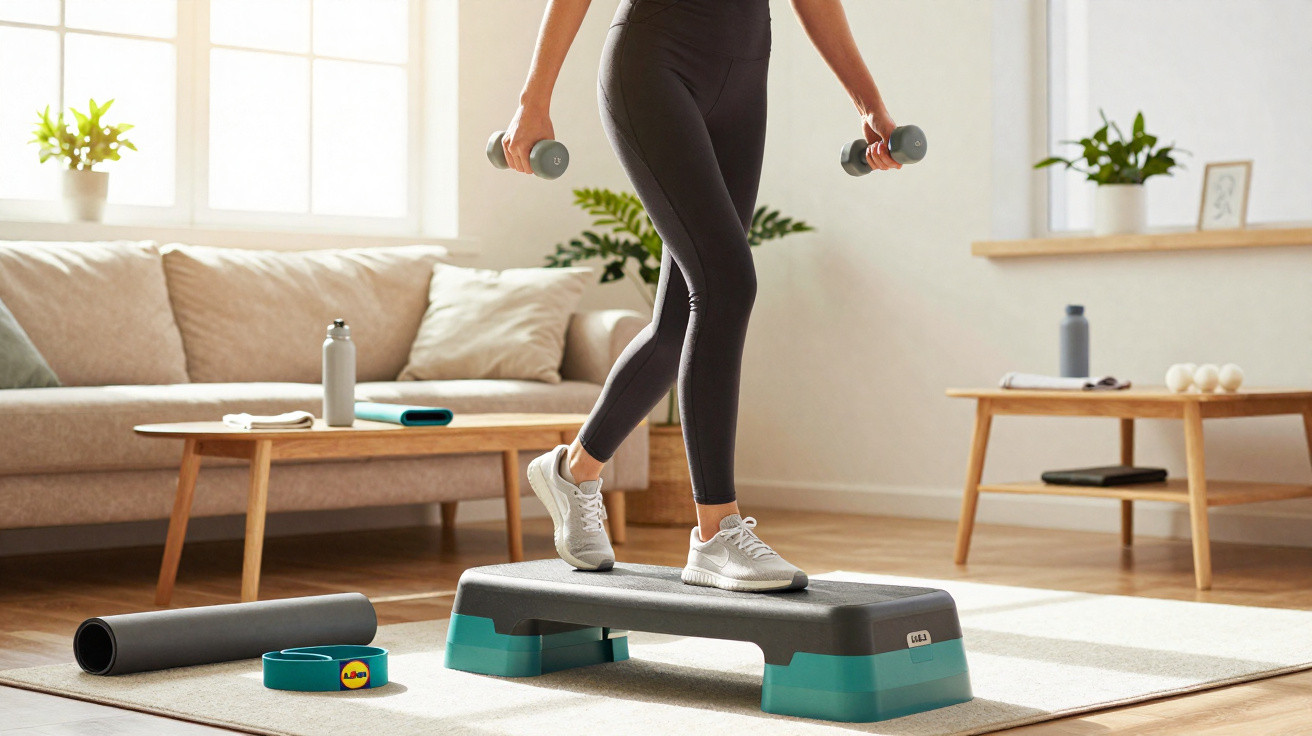
If you want to move more, it is easy to end up signing up for costly Pilates and fitness classes – then forget about the subscription again after three weeks. Lidl now offers a simple, compact solution that promises cardio, strength training and balance work in one piece of equipment, while taking up little more room than a large board.
What is behind Lidl's fitness board?
The product in question is a Step-Board from Lidl's own Crivit brand, priced at €22.99. It looks fairly unremarkable: a sturdy plastic platform with a non-slip surface and secure feet. However, it is a surprisingly versatile piece of training equipment.
"With a single board, you can train your cardiovascular system, glutes, legs and upper body – entirely without a gym contract."
At around 2.8 kg, the board can be carried easily from one room to another. In homes with limited space, it can be stored upright in a corner or slid beneath a bed. That is precisely what makes it appealing for small city flats: there is no exercise bike taking up half the living room.
Cardio, strength and balance: one compact board, multiple uses
Fundamentally, the equipment is a traditional Step-Board for endurance workouts. Repeatedly stepping up and down raises the heart rate in a similar way to an aerobics class. At the same time, the platform provides a base for stability exercises and conventional strength training.
Ways to use the Step-Board
- Step training for the heart: dynamic step-ups and step-downs, side steps, and combinations with arm movements.
- Muscle building for glutes and legs: lunges, squats and step-ups with additional weight.
- Balance and core training: single-leg balance holds and planks with hands or feet placed on the board.
- Upper-body work: the integrated resistance bands allow you to train your shoulders, arms and back too.
The built-in resistance bands in particular set this product apart from a basic gym Step-Board. Using them means many exercises can work the leg and arm muscles at the same time, such as stepping movements combined with rowing pulls or shoulder presses.
Adjustable height for beginners and advanced users
The board has two height settings: 10 centimetres for a gentler introduction and 15 centimetres for greater intensity. Switching between them takes just a few seconds and requires no tools.
"A few extra centimetres of height may sound harmless – but you notice the difference immediately in your thighs and glutes during a workout."
Those just starting out should use the lower setting first and take time to get used to the movement. At this height, the workout is well suited as an alternative to a brisk walk or an easy jogging session in the park – ideal when it is raining outside or time is simply short.
The higher setting is considerably more demanding. The increased lift makes the leg muscles work harder, while the heart rate rises more quickly as well. It is particularly beneficial for:
- people who want to reduce their weight
- athletes looking to improve everyday endurance
- people who want to tone their glute and thigh muscles specifically
Stability and safety in the living room
A common criticism of affordable fitness equipment is the quality of its construction. This is an area where Lidl's board performs well. According to customer reviews, it has an average rating of 4.9 out of 5 stars. Stability and durability are mentioned particularly often.
The stepping surface is textured and non-slip. Whether you train barefoot, in socks or wearing sports shoes, it provides dependable grip. Rubberised feet underneath the board prevent it from sliding, including on tiles or smooth parquet flooring.
Even so, anyone using it for the first time should allow enough space and place the board so that no furniture is positioned to either side. During faster step combinations, an awkward foot placement could otherwise quickly result in a twisted ankle.
Value for money compared with Pilates classes
A block of studio classes can easily cost €60 to €150 per quarter, depending on the city and provider. At €22.99, the Crivit board is substantially cheaper – and remains yours permanently. Of course, a plastic board cannot replace guidance from an experienced instructor. Nevertheless, for many people it can provide the starting point for a regular exercise routine.
| Aspect | Pilates class at a studio | Training with a Step-Board |
|---|---|---|
| One-off cost | – | around €23 |
| Ongoing costs | monthly or quarterly fees | none, optional online videos |
| Guidance | instructor on site | self-directed, using instructional videos |
| Training location | studio | living room, balcony, garden |
Many users combine both options: they attend a class once or twice each week for technique and motivation, then use the board for short sessions in between. Just 10 to 15 minutes a day can make climbing stairs, everyday movement and body awareness noticeably more comfortable.
In practice: what a short session could look like
To get started straight away, all you need is the board, some space and comfortable clothing. A simple 15-minute routine could be structured as follows:
- 3 minutes of slow stepping movements to warm up
- 2 minutes of fast steps with arm movements
- 2 minutes of squats with one foot on the board
- 2 minutes of lunges, alternating between right and left
- 3 sets of 30 seconds in a plank position with hands on the board
- finish with 3 minutes of slow steps and stretching exercises
Anyone using the integrated resistance bands can add pulling exercises for the shoulders and back during the gentler phases. This brings the session quite close to a compact full-body workout.
Who is Lidl's Crivit Step-Board suitable for – and who is it not for?
The product is clearly aimed at people who do not want a collection of gym equipment in their living room, but still want to do more than a few sit-ups on a mat. It is a good fit for:
- working people with little time in the evening
- beginners who feel more comfortable exercising at home than in a crowded class
- advanced users wanting to add straightforward cardio to their routine
Anyone with severe knee, hip or back problems should speak with a doctor or physiotherapist before exercising. The stepping motion places stress on the joints, especially when feet land too heavily or the floor gives way.
Combining the board with Pilates and other methods
It becomes particularly interesting when the board is viewed not as a replacement, but as an addition to Pilates, yoga or traditional strength training. Pilates exercises focus on controlled, slow movements and a strong core. Those are exactly the muscle groups that can then be tested under load on the Step-Board.
One example would be to start with a sequence of calm Pilates exercises for the abdominals and back, followed by short step intervals with static holds on the board. This can transfer stability directly into an everyday movement pattern – teaching the body to use muscles in a controlled way even under load.
Those who prefer running can use the board as an alternative on days of poor weather. It does not replace a long continuous run, but fast step sessions can certainly raise the heart rate into similar ranges, particularly on the higher setting.
What beginners should know about intensity and technique
Anyone completely new to fitness should keep a few points in mind:
- start slowly, for example with 5 to 10 minutes per day
- choose the lower height setting initially
- focus on correct stepping technique: place the whole foot on the board rather than standing half on the edge
- check your own heart rate and breathing regularly
Mild muscle tension after the first sessions is normal. Severe joint pain or sharp discomfort, however, may indicate overexertion or poor loading – in that case, it is better to pause and seek professional advice if necessary.
With a little routine, this small board can become a fixed part of daily life: five minutes in the morning after brushing your teeth, then another ten minutes in the evening before showering. Compared with unused subscriptions and overcrowded studios, a simple, well-made Step-Board can then seem remarkably appealing.







Comments
No comments yet. Be the first to comment!
Leave a Comment