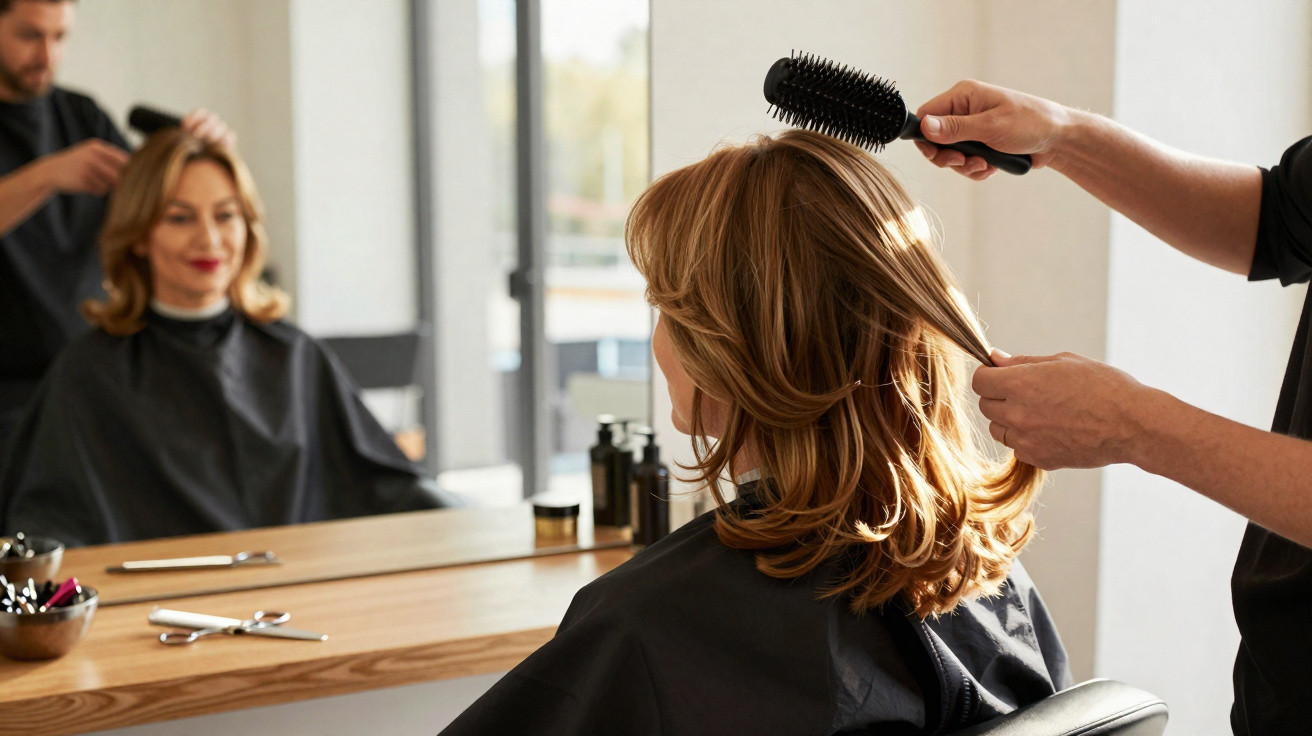
Charo García, a hairdresser, says that haircuts featuring volume at the crown and some softness around the face can often produce a balanced visual effect for round faces after 60. The aim is not to conceal facial features, but to distribute movement more effectively, avoid overly compact sides and tailor the shape to the hair type.
Why does volume at the crown alter the appearance of the face?
Concentrating volume on the upper section gives the hairstyle a more vertical line. For round faces, this direction can make proportions appear longer, particularly if the sides stay light and do not add too much width.
Charo García also advises taking forehead height, hair density and ease of upkeep into account. The same haircut can have different effects on straight, wavy, curly or very fine hair.
Which haircuts work with this approach?
There is no single essential style for everyone over 60. This principle can work at various lengths, provided the cut retains movement through the top and does not place all the volume at the sides.
- an extended pixie cut, with a textured crown and soft sides;
- a layered bob without a sharply defined line at cheek level;
- a mid-length cut with graduated front sections;
- a soft shag, with evenly distributed layers and natural movement;
- long hair with layers beginning below the chin.
How can softness be created around the face?
Softness around the face can be achieved with front sections, feathered ends and layers that do not all finish at the same point. These choices prevent a rigid frame and allow the hair to follow the facial features with greater movement.
Side fringes or curtain fringes can also be incorporated, as long as they are adapted to the hair’s texture. Similar recommendations for round faces include long layers, a side parting and volume in the upper area.
What details should be discussed with the hairdresser?
Before having the haircut, it is worth explaining how much time will be spent styling it and which products are already part of the routine. A shape requiring daily blow-drying may not suit someone who prefers to let their hair dry naturally.
- the hair’s natural texture and how it behaves once dry;
- density and areas with less volume;
- the length the person wishes to retain;
- whether a hairdryer, styling tool and finishing products are used;
- how often the haircut can realistically be maintained;
- a preference for a fringe, side parting or hair worn away from the face.
Should face shape alone determine the choice?
A round face is only one of the references used when planning a haircut. The neck, forehead, texture, density, daily routine and personal taste also affect the outcome, and age does not rule out short, medium-length or long hair.
Charo García’s guidance works as a starting point: create volume at the crown and remove excessive weight from the sides. The final choice should maintain the wearer’s identity and allow for upkeep that suits the hair’s actual behaviour.















Comments
No comments yet. Be the first to comment!
Leave a Comment