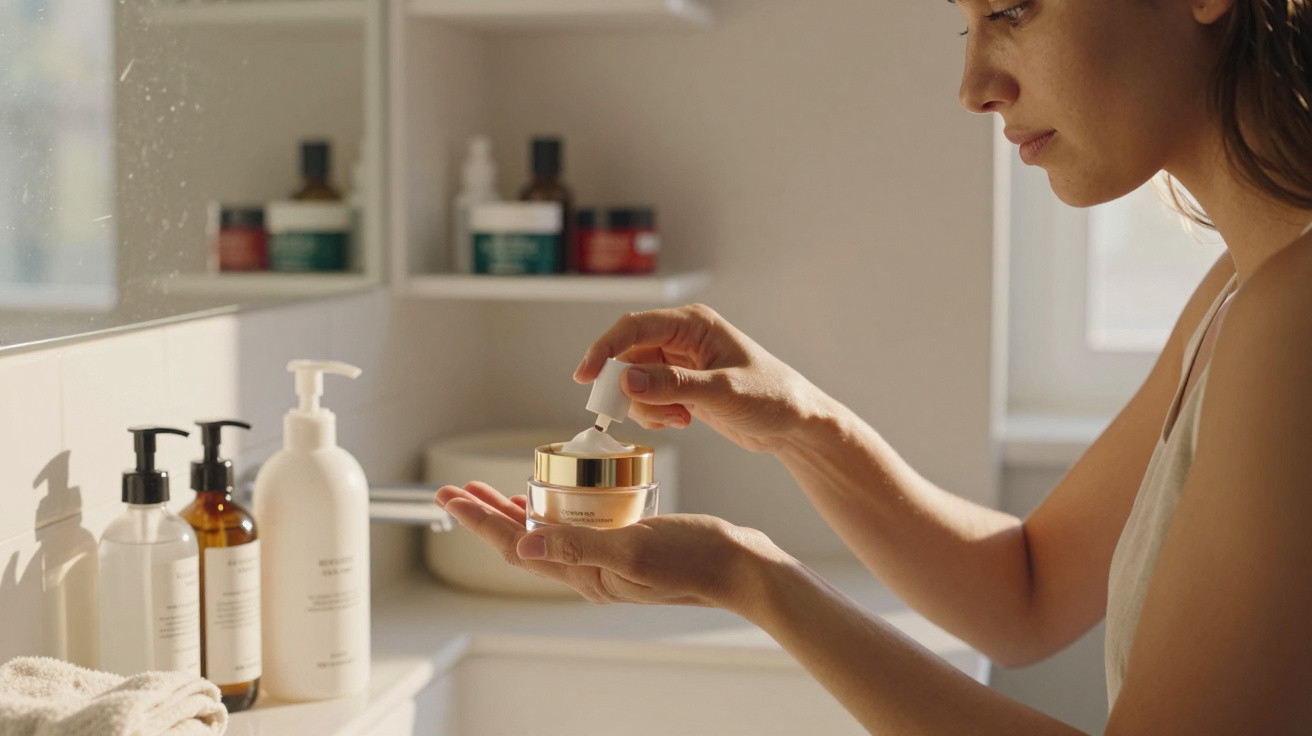
You know that hushed, slightly absurd optimism that appears when you unseal a new face cream?
There is the little spatula, the weighty glass pot and a fragrance that murmurs “luxury spa” and “this time it’ll work”. Standing beneath the bathroom lights, you press it into your skin as though you are starring in an advert, quietly imagining that you will wake up with a different face. Fewer lines, tighter-looking pores and the sort of soft-focus glow that does not exist off camera.
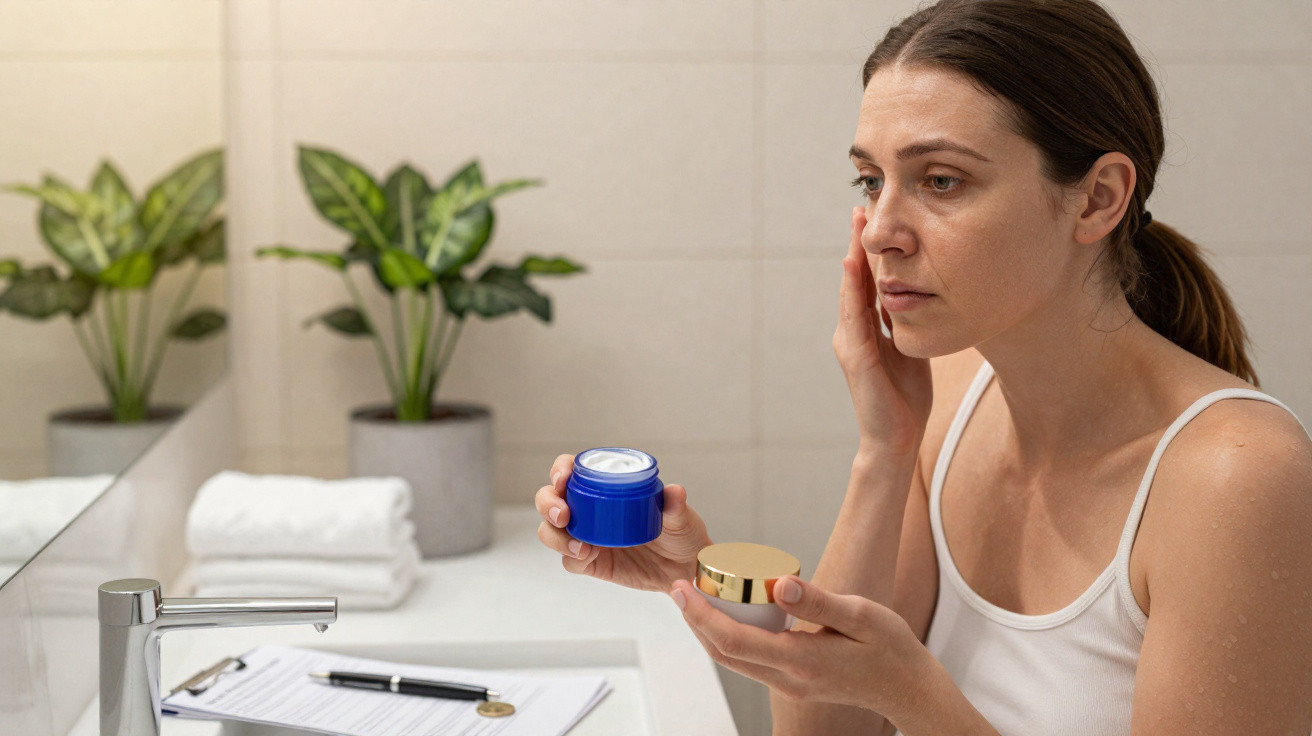
A week goes by, then another two. Your skin is… all right. It has not changed dramatically. The redness remains, fine lines are still gently marked out, and breakouts continue to appear with astonishing audacity. You begin to question whether you have applied it incorrectly, whether your skin is simply determined to resist, or whether that £80 cream is really just a costly dream inside a frosted jar.
That is when things become more interesting.
The intimate little lie in your bathroom cabinet
When an expensive face cream fails to deliver, it can feel strangely personal. It is not comparable to a jumper with an unflattering fit or a lipstick that proves too bright. You spent money on hope: the hope of appearing more rested, more put together and closer to the version of yourself you picture in your mind, preferably in flattering light.
Most of us know the moment: you glimpse yourself in the unforgiving mirror in a lift and think, “Hang on, I’ve been doing the serums, the masks, the ‘miracle’ moisturiser… why do I still look this tired?” Back at home, you carefully scoop out another portion, assuring yourself that you simply need “a bit longer” before the results appear. One month. Two months. Perhaps it is your food, perhaps it is hormones, or perhaps you have somehow been getting skincare wrong.
Or perhaps – and this is the part that hurts – the cream was never designed to provide what you believed you were purchasing.
Why that expensive cream feels lovely but does very little
The formula built to seduce, not transform
Luxury creams are exceptionally good at charm. Their textures melt like butter, their subtle scents evoke an upmarket hotel reception, and the jar makes a pleasing little clink as you lift the lid. That is deliberate: before the formula has achieved anything, your brain interprets these sensory cues as proof of effectiveness. Your senses are persuaded before your skin is.
Behind the polished presentation, a great many high-end creams prioritise comfort and enjoyment over meaningful change. They often depend on emollients, which make skin feel soft, alongside silicones that immediately smooth its surface. Will your skin feel silky? Certainly. Does that automatically mean it is reversing sun damage, restoring collagen or soothing persistent redness deep down? Not especially. That impressive sensation immediately after application is frequently the result of skilful formulation texture.
Skincare scientists will often admit that ingredients capable of making a genuine difference are not always glamorous. They may feel grainy, smell somewhat unpleasant or cause mild irritation initially. In reality, anti-ageing does not always arrive in a rose-scented cloud.
The nice things that don’t do the heavy lifting
Turn over the packaging and you may find a long procession of botanical ingredients and reassuring phrases: algae, floral extracts, thermal water and unusual oils sourced from places you have never heard of. They sound indulgent and look persuasive in a press release. Some can offer benefits, but they are often included at concentrations too small to make a substantial difference.
The uncomfortable reality is that only a relatively short list of ingredients has robust, repeated evidence for concerns such as fine lines, pigmentation and uneven texture: retinoids, vitamin C, exfoliating acids including AHAs and BHAs, niacinamide, certain peptides and sunscreen filters. Most other additions have supporting roles: pleasant, perhaps helpful, but not the main event. If your costly cream does not make serious use of those established heavy-hitters, you are essentially buying a comforting blanket rather than paying for renovation work.
This does not make your cream pointless. Its purpose may be comfort, but comfort was never likely to remove ten years of sun damage or skin affected by ongoing stress.
The awkward mismatch: your skin vs its marketing
Your skin doesn’t know the price tag
Here is the mildly ruthless truth: your skin has no idea whether your cream cost £8 or £180. It does not recognise a “luxury brand” or a “cult favourite”. It responds only to molecules: their structures, what it can absorb and how it reacts to them. Your bank balance may notice the distinction, while your skin frequently will not.
So, if you have adult acne but lovingly massage in a rich, fragranced cream made for dry, mature skin, your skin reacts to the ingredient list rather than your good intentions. Occlusive oils over already congested pores can mean breakouts. A high level of perfume on sensitive cheeks can bring flare-ups. Neither the elegant pot nor the minimalist branding alters that.
There can be a quiet, faintly embarrassing sensation when you realise you have been buying creams for entirely the wrong purpose. That is not because you are foolish; marketing has encouraged you to believe something can be one-size-fits-all while also being “tailored to you”. Those claims seldom sit comfortably together.
The routine around it might be sabotaging everything
At times, the problem is not the cream at all, but what happens on either side of it. That gel cleanser leaving your face squeaky-clean may be stripping your skin barrier each evening. The rough physical scrub used “for a deep clean” may be causing tiny, repeated injuries. Then the expensive cream turns up and is expected to repair all the disorder.
Honestly, almost nobody manages this perfectly every day: double cleansing properly, layering actives in the right sequence, allowing them time to absorb and applying sunscreen with unwavering dedication. Everyday life intervenes. Children, delayed trains, hungover mornings and evenings when you fall asleep on the sofa with your make-up still on all happen. The cream is then applied as a final gesture, like a firefighter entering a house you repeatedly keep setting alight.
When your skin barrier is perpetually irritated, hardly any cream can “work” as promised. It is like watering a plant while keeping it in a dark cupboard. Something else needs to change first.
The quiet heroes that actually change skin
One word that keeps coming up: consistency
Skincare’s least exciting truth is that a cheaper product used every day will beat a luxury product used twice before being abandoned in a drawer. The skin renewal cycle moves slowly: around 28 days when you are young, and longer with age. Any ingredient that truly influences it therefore requires time, repetition and, frankly, patience.
That is why dermatologists can sound a little dull. They repeatedly recommend daily sunscreen, retinoids at night, gentle cleansing and a moisturiser that does not irritate your face. They understand that, when you get those four things right, the rest is detail. They also understand that you would probably prefer to hear about a crushed pearl-infused marine concentrate from a rare island, because it is far more thrilling than “wear SPF every morning”.
Still, if you speak to people with the clear, calm skin you secretly admire, they often follow a remarkably uncomplicated routine and stick to it as reliably as brushing their teeth.
The ingredients that deserve your money
So, rather than spending another £100 on a moisturiser that mainly feels pleasant, what should you choose? Create a compact, purposeful set of products based around proven ingredients, and allow your moisturiser to be… simply a moisturiser.
Begin with sunscreen: broad-spectrum SPF 30 or higher, every day. No fuss and no excuses. UV damage drives much of what we describe as “ageing”, including fine lines, sun spots, dullness and that crepey appearance around the eyes. Even the finest anti-ageing cream cannot counteract what an unprotected daily lunchtime walk is steadily undoing.
Next, use a retinoid at night, whether retinol or a prescription-strength alternative. This ingredient category has the strongest evidence for refining texture, softening fine lines, improving pigmentation and supporting collagen production. It is not an overnight solution and it may irritate at first, but gentle, consistent use makes it a true game changer. A moderately priced, fragrance-free retinol can do more for your skin than a very expensive cream packed with vague “rejuvenating complexes”.
If your skin tolerates it, add a straightforward vitamin C serum in the morning. If redness or visible pores are concerns, consider a basic niacinamide serum. Follow with a moisturiser intended to soothe and support rather than perform miracles. It does not require gold particles, crushed gemstones or sap from rare vines. It needs humectants such as glycerin and hyaluronic acid, plus barrier-supporting lipids including ceramides and fatty alcohols.
Why “boring” moisturiser might be your skin’s best friend
The unsexy truth about barrier repair
If your skin is reactive, flaky, tight or simply feels permanently unsettled, it is often requesting not “more active ingredients” but less fuss. Fewer fragrances, less alcohol, fewer essential oils and fewer complicated actives layered into every step. It needs something plain, gentle and dependable that appears daily without making matters worse.
That is when a well-formulated, no-frills moisturiser becomes the overlooked hero. It locks in hydration after your serums, protects skin from winter central heating and summer air conditioning, and quietly reduces micro-irritation so the actives you do use can properly do their work. A good cream resembles a soft jumper on a difficult day: it does not solve your life, but it makes coping easier.
If your current expensive cream is strongly fragranced, loaded with essential oils or makes your skin tingle for reasons unrelated to a recognised active such as glycolic acid or a retinoid, it may simply be doing too much. Your face is not a scented candle. It has no need for all of that.
The freedom of spending less on the jar
There is a small, wonderfully rebellious pleasure in deliberately choosing a mid-range or budget moisturiser, then putting the savings towards an excellent sunscreen and retinoid. Alternatively, if money is limited, buy the gentlest, best-value essentials available and release the guilt of not owning the season’s “it” cream.
Your worth is not measured by the brand name on your bathroom shelf. There is a quiet strength in getting off that treadmill and deciding, “My skin needs reliability, not prestige.” You stop pursuing the fantasy that the next jar will finally be the one, and instead give your face the consistency it has been waiting for.
After a few months of doing this, something interesting can happen. Breakouts settle. Redness eases. Your reflection in harsh lighting stops catching you off guard, because it looks… familiar, steady and a little kinder. It is not a new face, merely your own face with better support.
How to reset your routine without panicking
The gentle reset
If you are looking at a collection of products and wondering which item is the hidden culprit, pare everything back. Try two or three weeks of skincare minimalism: a mild cleanser, a simple moisturiser and daytime sunscreen. Nothing more. No peels, no scrubs and no seven-layer “glass skin” routine watched on TikTok at 1am.
Over that period, your skin may reveal quite a lot. If it becomes calmer, less red, less itchy or less tight, your barrier is likely breathing a sigh of relief. Once it has settled, gradually introduce one active at a time: retinol on a couple of evenings each week, a niacinamide serum or a gentle exfoliating acid. Do not introduce everything simultaneously in a chemical soup.
Whenever you add a product, allow at least two weeks before judging whether it is friend or foe. It is slower than purchasing another miracle pot, but it is also the only real way to identify what works for your actual, individual face.
What to do with that expensive cream now
What, then, should you do with the pot already on your shelf: the one you are partly devoted to and partly doubtful about? You do not need to throw it away dramatically unless it clearly stings, causes breakouts or smells unpleasant. You could turn it into a neck and chest cream, or keep it for evenings when your skin is settled and you simply want the ritual.
Treat it more like a luxury candle than medicine. Enjoy it, but do not place all your expectations on it. Let the serious work come from the understated retinoid tube, the dependable SPF bottle and the plain moisturiser you nearly forget exists because it never creates problems.
The real shift isn’t swapping one expensive cream for another – it’s changing what you expect a cream to do for you. A moisturiser offers support. The science is found in the actives and the habits.
The uncomfortable, liberating truth
There is a small sense of loss in accepting that your cherished luxury cream was largely a beautifully marketed hug. You were not silly to buy it. You were offered a story about youth, control and a life in which you wake up naturally radiant and everything else seems more manageable. Skincare advertising does not truly sell molecules; it sells a feeling.
Yet stepping back and selecting another story can be deeply freeing. In that version, your bathroom shelf is not a museum of half-finished jars and let-downs, but a small collection of products that work quietly and steadily with your skin rather than against it. You can still enjoy an appealing texture or lovely scent occasionally, while understanding where the genuine magic lies.
Perhaps your expensive face cream is not working because it was never supposed to carry all that hope by itself. Give it an easier role. Leave the demanding work to the ingredients that have earned it. The next time you stand under unforgiving bathroom lighting, you may discover that you do not want a new face at all, only a gentler relationship with the face you already have.










Comments
No comments yet. Be the first to comment!
Leave a Comment