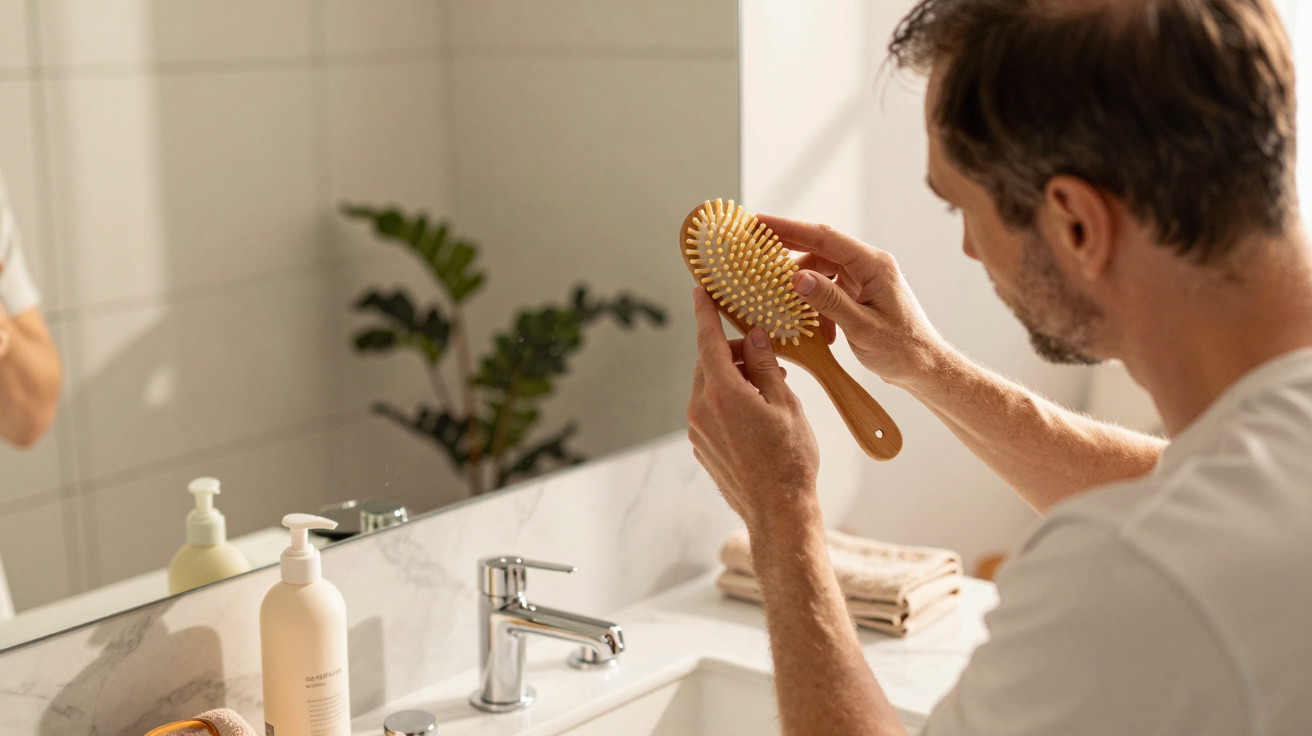
The man staring back from the mirror is doing everything “right”: caffeine shampoo, sweet-like-candy gummies and a pricey tonic in a bottle designed to resemble cologne. Yet each time he runs his hands through his hair, he notices the same thing – more visible scalp, less thickness.
In a coffee shop, he notices another man with a thinning crown quietly running a strange, flat brush through his hair. It has no sharp points and causes no scratching, only slow, purposeful passes over the scalp. There is something unexpectedly calming about the sight, like a modest ritual he never knew he needed.
That evening, his Google search history fills up: “best brush for thinning hair”, “how to stimulate scalp without damage”, “do scalp brushes help regrowth”. Among the adverts and miracle claims, one particular tool appears again and again.
It is an ordinary-looking brush. Just not the kind you might expect.
The one brush thinning hair actually tolerates
In most bathrooms, you are likely to find two things: a partly used styling product and some random plastic brush with hard, pointed bristles. For men with thinning hair, that standard brush may be quietly worsening the problem.
As the scalp becomes more exposed, it can also become more sensitive and reactive to each pull of plastic. Rigid pins can scrape the skin, create micro-irritation and snap strands that are already fragile.
This is where a paddle brush with flexible, rounded bristles can make a meaningful difference. It has a broad surface, a soft cushioned base and gentle nylon or boar bristles with rounded ends that flex rather than assaulting the scalp. It is the same action as brushing before, but with an entirely different result.
Consider Marc, 38, whose hair began thinning around his temples just as his first child was born. He would scrub his scalp with a spiky vent brush “to really feel something happening”, as he puts it.
A few months later, his dermatologist noticed red areas and fine flakes across his hairline. It was not dandruff, but ongoing mechanical irritation.
She replaced his preferred tool with a paddle brush fitted with soft, ball-tipped bristles, telling him to use it for two minutes each day. After three months, his hair had not miraculously returned, but the redness had cleared, fewer hairs were ending up in the sink and his scalp felt “like skin again, not sandpaper”. One minor adjustment, one noticeable change.
There is a straightforward reason this brush type is better suited to thinning hair. Blood flow in the scalp supports follicles that still have potential, whereas aggressive scratching simply puts them under stress.
A cushioned paddle brush moves smoothly across the surface, flexes slightly to follow the contours of your head and applies micro-pressure instead of scraping. The bendy bristles shift the skin enough to encourage circulation, without pulling apart the fine, vulnerable hairs still hanging on.
Many men assume that greater pressure delivers better results. In reality, extra force often brings more breakage, more inflammation and more frustration.
The best brush for thinning hair does not “attack” your scalp. Instead, it gently supports the last line of defence: the follicles you have not yet lost.
How to use a paddle brush to stimulate your scalp
Begin with hair that is dry or only very slightly damp. Set the paddle brush flat against the scalp at the front hairline.
Rather than dragging it down quickly as though you are late for work, take your time. Use short, measured strokes from front to back, allowing the bristles to flex and apply light pressure to the skin.
Next, work along the sides, brushing from each temple towards the crown and following the natural curve of your head. You are not trying to detangle wildly; the aim is to give your scalp a gentle, steady massage.
Two minutes once or twice daily is enough to give your circulation a clear message: “Hey, we’re still here.” You should notice warmth spreading beneath the skin. That is what you are looking for.
Men with thinning hair tend to make the same two brushing mistakes. They either go at their scalp as if scouring a burnt pan, or avoid brushing completely “to not lose more hair”.
Both reactions make sense when you spot more hairs on your hands or in the basin. On a difficult day, every single strand can seem like evidence that you are losing the battle.
Brushing gently with an appropriate tool does not pull out hairs that are firmly rooted. It mainly releases hairs already in the shedding stage, helping them come away more cleanly and with less trauma.
Psychologically, this routine can feel surprisingly stabilising. Physically, it helps carry natural oils from the scalp through the lengths, so the hair you have left appears healthier rather than defeated.
“I can’t say my hair grew back, but my scalp stopped screaming. And weirdly, once I changed my brush, I stopped obsessing about every hair I lost in the shower.”
- Choose the brush
Find a paddle brush with a cushioned base and flexible, ball-tipped bristles, either nylon or a nylon-and-boar-bristle blend. - Test the pressure
Press it against the inside of your forearm. The bristles should flex and feel comfortable, never rough or scratchy. - Keep it clean
Clear away shed hairs frequently, then wash the brush with a mild shampoo every couple of weeks to prevent build-up reaching your scalp. - Pair it smartly
Use the brush after applying a lightweight scalp serum or tonic, so it distributes the product evenly without digging into the skin.
More than a brush: a small daily truce with your hair
There is an unspoken side to this story that no product listing will explain. Thinning hair is seldom only about hair; it can also be about getting older, confidence, dating and photographs you suddenly cannot stand.
A paddle brush can become a small daily agreement with yourself. It is a moment when you are not scrolling through forums at 1 am, zooming in on your crown with a phone camera or comparing yourself with old photographs.
You are simply in front of the mirror, breathing, noticing the soft pull of the bristles and the gentle warmth they leave behind. No drama and no miracle claims. Only care.
From a practical perspective, the right brush may also improve the way your hair is styled. Soft, widely spaced bristles distribute volume more evenly, particularly when hair is beginning to part around the crown.
Rather than using too much gel to force the strongest remaining hairs into hard, sticky lines, a paddle brush can lift them at the root before laying them in a way that conceals thinner patches. The effect is understated: not fuller hair, but better used hair.
And yes, let us be honest: nobody truly follows this every day with religious discipline. You will miss days, forget or be in a rush. That is fine. The benefit comes from returning to the habit, not from never skipping a session.
The most compelling part is what this habit may do over time for your relationship with your hair. You shift from a mentality of war to one of stewardship.
You stop attempting to force your scalp into submission using harsh products and aggressive tools. You begin to prioritise comfort, calm and longevity.
Perhaps you will pair it with proven treatments, or eventually choose to shave your head and move on. But in the years in between, a soft, flexible paddle brush may make the process feel less stressful and easier to live with.
On a bad morning, when the light catches your crown in the least flattering way, this uncomplicated tool is a reminder that you still have agency in this story.
| Key point | Detail | Benefit for the reader |
|---|---|---|
| Ideal brush type | Paddle brush with a cushioned base and soft, rounded bristles | Reduces micro-irritation and protects fragile hair |
| Technique to adopt | Slow movements from the forehead towards the back, then from the temples to the crown | Stimulates circulation without scratching the scalp |
| Realistic routine | 1 to 2 minutes, once or twice a day, on dry or slightly damp hair | A sustainable habit that fits easily into daily life |

Comments
No comments yet. Be the first to comment!
Leave a Comment