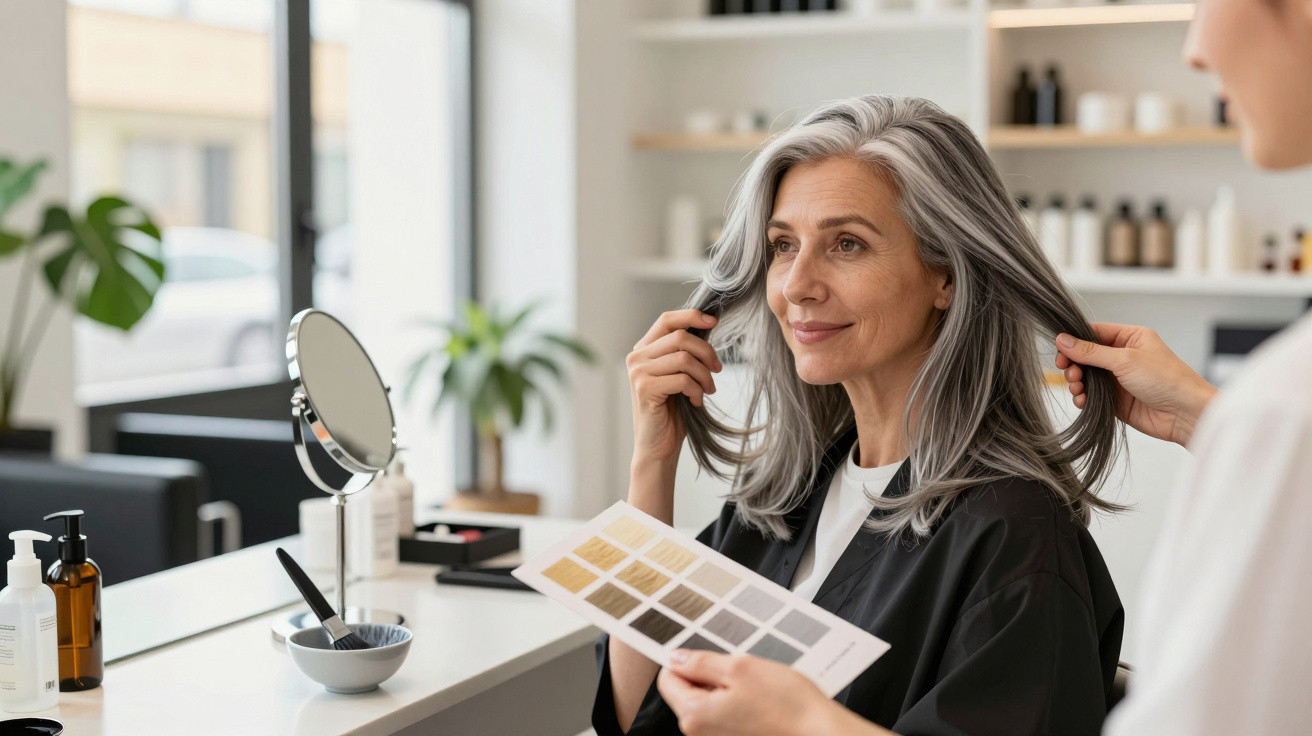
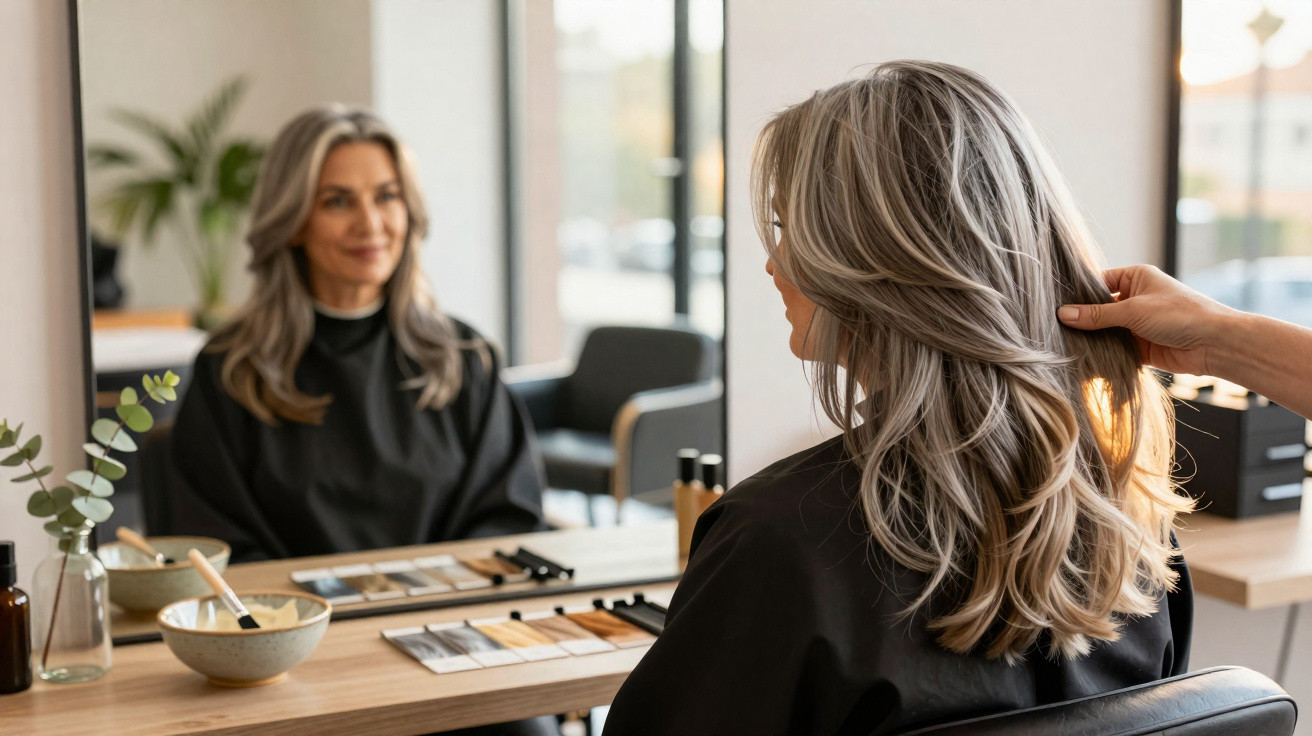
The woman sitting in the salon chair does not raise her eyes when the hairdresser says, slightly too brightly, “So… lots of silver coming through here.”
Instead, she studies the mirror: fine white regrowth draws a stark line through what used to be flawless balayage. The foils, three-hour appointments and bills quietly edging beyond the grocery budget are all for a colour that scarcely lasts six weeks.
Her phone vibrates in her lap. A friend has sent a message: “You HAVE to see this. Permanent grey, no upkeep.” She opens the link, and photos immediately fill the screen: women abandoning highlights in favour of metallic, even grey. Some describe it as a miracle; others see it as madness.
Somewhere between those descriptions, a subdued revolution is taking shape.
From trendy balayage to bold permanent grey: what’s really going on?
Visit a major-city salon on a Saturday and you will still find rows of women beneath foils, pursuing the soft balayage look polished by Instagram filters. Yet, more quietly, another service is being booked through private messages and in back rooms: the “full grey conversion”.
This is not about a handful of silver strands or letting the natural colour grow through gracefully. It is an intentional, permanent move to grey, often in an all-over slate, steel or icy shade from root to tip.
Stylists report hearing the same words repeatedly: “I’m tired.” Tired of trying to look younger. Tired of root appointments every four weeks. Tired of acting as though the white hairs at the temples do not exist. Grey was once viewed as surrender; now, some women want it to make a statement.
The hashtag #goinggrey has accumulated hundreds of millions of views on TikTok. A scroll through the posts brings up everything from corporate lawyers unveiling freshly coloured gunmetal bobs to people in their thirties documenting a transition from box-dye chaos to carefully tailored silver, alongside grandmothers wearing exceptionally stylish chrome pixie cuts.
One viral video features a French teacher in her forties who had maintained balayage for ten years. It begins with a familiar image: faded caramel lengths, a pronounced white root line and a diary alert for another €180 appointment. The following shot shows her leaving the salon with cool, even grey hair resembling polished steel. Its caption says: “Goodbye balayage, hello freedom. No more hiding.”
Her comments are fiercely divided. Supporters post “ICONIC” and “This is the future!”, while critics respond, “You’re crazy to put that much chemical on your scalp” and “You’ll regret this in five years.”
The forces behind the shift are straightforward but complicated. There is the expense and exhaustion of maintaining a manufactured youthful look, but there is also a genuine concern about prolonged, repeated contact with powerful dyes and bleach, particularly for a shade some manufacturers promote as “permanent grey”.
A grey conversion is not simply a rinse. It commonly requires intensive lightening across the entire head, sometimes over several rounds, followed by toning with pigment intended to stay put. It may take six hours or longer, and formulas can contain ammonia, peroxides, plus metals or direct dyes. Supporters say, “One big jump, and I’m done with monthly color,” and the prospect can feel magical.
Critics, however, examine the ingredients and see a health gamble whose consequences may not become apparent for years.
How permanent grey really works and how to avoid the biggest traps
The proposition is tempting: one dramatic salon session, a consistent grey shade and then peace. No more root chasing and no more balayage “refresh”. The reality is considerably more technical.
Most people do not naturally develop a neat, luminous grey. Natural grey tends to appear unevenly, with white around the temples, darker areas at the back and remaining pigment stubbornly clinging to the lengths.
For that reason, stylists generally begin by removing colour. Depending on the initial shade, hair is lightened to pale yellow or nearly white. Next comes a toner or direct dye that lays down the cool metallic grey. Although some salon brands call their result “permanent”, many professionals privately acknowledge that it performs more like a durable stain that will still fade, particularly on porous hair.
The sense of a “miracle” comes from seeing the real self, but edited: nature made uniform and deliberately curated.
A London colourist recounts a scenario that, almost word for word, is repeated in cities elsewhere. A client in her mid-fifties arrives with immaculate honey balayage and an appointment reminder scheduled every five weeks. On paper, her hair is “goals”. Yet every new cluster of white hairs along her parting sends her into a quiet panic.
She spends seven hours in the chair. First, years of warm pigment are lifted away. Second, bond protectors are used to rebuild the hair’s structure. Third, a cool smoke-grey formula is applied to match her rapidly emerging natural roots.
When she looks in the mirror, she begins to cry, not with sadness but with an unfamiliar blend of relief and shock. “I look like me,” she whispers, “but also like my mother.”
A video of the transformation attracted millions of views, and brands were quick to market “permanent grey kits”. This is where the picture becomes less clear.
Biologically, greying hair is already undergoing changes. Follicles produce less melanin, while the fibre may become drier, more delicate and, at times, harder to colour. Grey conversion must work against all of this.
More powerful products, longer development periods and repeated bleaching sessions can have a cumulative effect. Dermatologists regularly encounter accounts of scalp irritation, breakage, allergic reactions and delayed sensitivities to ingredients such as PPD (paraphenylenediamine).
When critics call the process a health gamble, they are not necessarily exaggerating. A single colouring service will not destroy your future. However, years of intensive chemical exposure on a scalp with micro-irritations, in a body already navigating pollution, stress and hormones, create a different calculation.
Honestly, hardly anyone reads every word of the leaflet enclosed with a home-colour kit on every occasion.
Choosing grey on your own terms: smart steps, red flags and real talk
If you feel drawn to leave balayage behind for grey, the most sensible first move is not to buy a box dye. It is to slow down. Begin with a consultation rather than a colour appointment, and make it a proper one.
A stylist or colourist experienced in grey transitions will ask about your colour history, allergies, budget and even your level of patience. They may recommend a more gradual route, using lowlights to blend the transition, reducing the contrast between roots and lengths, and slowly cooling the overall shade.
One targeted approach used by many professionals is “grey blending”. Very fine highlights and lowlights in ash tones close to the natural base are added, before the whole head is toned cooler. You do not become fully metallic silver overnight, but the root line no longer demands attention.
This gradual method involves fewer harsh processes and allows the scalp time to signal if it reacts badly to anything.
The greatest danger is making an all-or-nothing decision without a fallback plan. You see a remarkable before-and-after online, order a strong lightener and devote Saturday to replicating a result that required a professional eight hours, three products and twenty years of training.
Most of us recognise the thought: “How hard can it be?” Grey is unforgiving when it goes wrong. It may take unevenly, fade greenish or leave hair with the texture of wet cotton. The emotional aftermath of a poor colour result is real, particularly when ageing and identity are bound up in it.
A gentler route is to approach grey as an experiment rather than a permanent commitment. Semi-permanent toners, low-volume developers and strand tests carried out days before a major change are not needless fuss. They distinguish a managed risk from an uninformed leap. Going slow is not the enemy of courage.
“Grey is not a trend color, it’s a life color,” says one Paris-based colorist who now refuses to do full grey conversions in a single session. “When you alter it, you’re not just shifting shade. You’re rewriting the story your hair tells about you. That deserves more than a quick viral transformation.”
- Ask for a patch test at least 48 hours before any major colour service, especially if you have never previously reacted to dye. Sensitivities may develop over time.
- Choose a grey-blending strategy before opting for complete coverage. It leaves your options open if you later change your mind.
- Build in “rest” months between intensive chemical services, allowing the scalp and hair to recover while you watch for delayed reactions.
- Use gentle, sulphate-free products and UV protection for new grey hair. The more fragile the fibre, the less able it is to tolerate harsh cleansing.
- Discuss maintenance candidly: even products described as “permanent grey” need toning or glossing. Completely maintenance-free colour is a myth.
The quiet question behind the permanent grey trend: what are we really chasing?
The movement towards permanent grey is not merely about hair colour. It reflects both fear of ageing and fatigue with pretending. Fans call it miraculous because their exterior finally reflects how they feel: yes, they have grey hair, and yes, they chose it. Critics look at the same treatment and question why accepting a natural process requires so much chemistry when waiting would eventually achieve it.
Between these viewpoints is an untidy reality. Some women feel empowered by chrome hair and say their self-esteem has finally caught up with the person in the mirror. Others try it, dislike it and return to balayage, with a renewed understanding of what comfort means to them. Neither response is wrong.
The straightforward truth that no brand prints on its packaging is that no hair colour is morally superior. There is only the choice that allows you to live with less noise in your mind. That may be striking, uniform grey, or a softer, lived-in balayage that you are not yet ready to abandon.
The genuine revolution is not the shade itself. It is granting yourself permission to reconsider, asking more difficult questions about what comes into contact with your scalp and discussing openly the emotional and chemical cost of pursuing a certain look. Next time you see silver threads in your reflection, the most important question may not be “dye or don’t dye”, but “how much of this story do I want to rewrite, and at what price?”
| Key point | Detail | Value for the reader |
|---|---|---|
| Grey conversion is a process | It often requires full-head lightening, toning and several hours in the chair | Creates realistic expectations around time, cost and the effect on hair |
| Chemical exposure has trade-offs | Strong dyes and bleaches may irritate the scalp, weaken hair and trigger sensitivities over time | Helps balance the “miracle” outcome against possible long-term health risks |
| Slow transitions are safer | Grey blending, patch tests and rest periods between services | Provides a safer, more adaptable way to embrace grey without severe damage |










Comments
No comments yet. Be the first to comment!
Leave a Comment