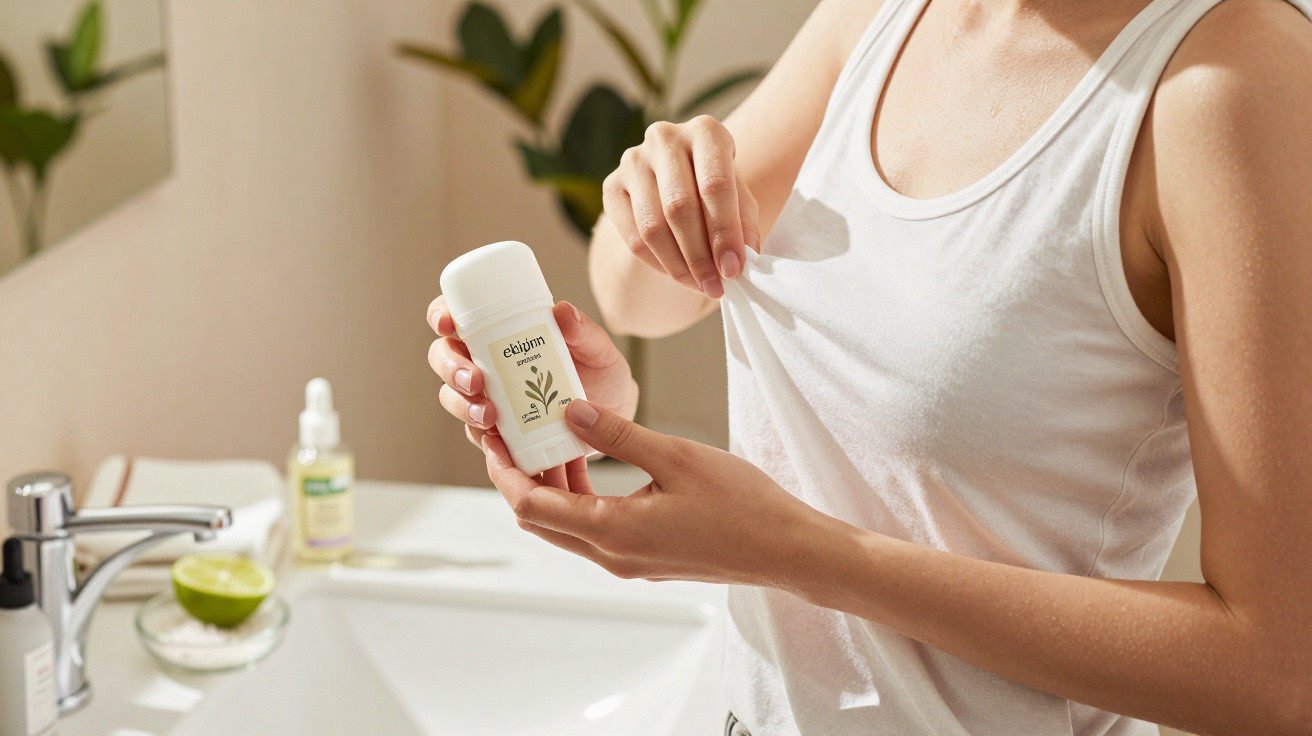
Your sweat has no smell, so why make life difficult by choosing between the two? In fact, your skin can tell the difference perfectly well.
If you feel utterly lost when you reach the deodorant and anti-perspirant aisle at the supermarket, rest assured: that is entirely normal. Manufacturers do just about everything they can to make the choice harder: pseudo-scientific marketing, questionable labels, claims of “extreme freshness for 172 hours”, misleading packaging and attention-grabbing slogans often leave us picking a stick or spray blindly.
That means choosing without understanding the real distinction between these two product categories, which do not interact with your body in the same way at all. You would not buy food without knowing whether it was sweet or savoury, or medicine without knowing what it does; so why tolerate that confusion with cosmetics applied to your skin every day? Here is what you need to know.
Why do we sweat, and why does it smell unpleasant?
Before looking at how to stop it, sweating deserves some credit: without it, we could not survive. It is nothing less than a highly effective evaporative cooling system. Under normal circumstances, the body releases around half a litre of water each day to maintain its internal temperature, and considerably more during exercise or a heatwave.
Perhaps most surprisingly, sweat itself is initially completely odourless. The issue lies in the different roles of our “sweat factories”, the sweat glands, which fall into two main groups. First, eccrine glands cover most of the body and produce a fluid made primarily of water and electrolytes for temperature regulation. Second, apocrine glands, located mainly in the armpits and groin, become active at puberty and release a much richer cocktail.
This oily mixture, packed with proteins and lipids, is a feast for the bacteria living on our skin. It is therefore not sweat that “stinks”, but the digestive process of those bacteria, which releases particularly pungent volatile molecules.
Deodorant: the chemical counterattack
When you use deodorant, it does not regulate your sweat flow in any way: sweat will continue to be released freely despite its application. Instead, it acts afterwards, neutralising odours or preventing them from being picked up by our nose. In this sense, it is a surface treatment that combines several compounds.
First, most-if not all-deodorants contain antimicrobial agents. As bacteria are responsible for turning sweat into an unpleasant smell, reducing the number beneath your arms can drastically limit the production of malodorous molecules. Manufacturers also often add synthetic fragrances to conceal any lingering smells, so that neither you nor the person beside you on the Tube faints when you lift an arm.
Some deodorants additionally contain odour absorbers, such as zinc ricinoleate, talc, perlite and bicarbonate of soda, which physically trap volatile molecules before they can evaporate into the air. Others work by altering the pH of your skin with alkaline or acidic substances. In doing so, they turn your armpits into an environment hostile to bacteria, where they can no longer multiply efficiently.
Anti-perspirant: a temporary plug
Unlike deodorant, which masks odours, anti-perspirant tackles the problem at its source by physically preventing sweat from reaching the surface of the skin. To do this, manufacturers use a highly effective family of active ingredients: metallic salts, including aluminium chlorohydrate, aluminium chloride and aluminium-zirconium compounds.
Once applied, these salts come into contact with moisture in the ducts of your sweat glands. As they dissolve, they combine with molecules in your sweat to create a dense gel-like substance, forming a temporary plug that blocks the pores. Sweat flow is interrupted, while bacteria at the surface are deprived of their protein-rich meal. Without their fuel, they no longer produce odours.
This is also the area in which marketing and science clash most fiercely. You have probably seen “aluminium salt-free” claims displayed proudly on packaging. Yet this widespread distrust began with an unfounded rumour, originally spread by an internet hoax-an email hoax launched in the early 2000s. Contrary to popular belief, evidence-based scientific research indicates that aluminium-based anti-perspirants are safe and carry no proven health risks.
Are “natural” alternatives a false good idea?
In response to the unjustified poor reputation of aluminium salts, the market for “natural” deodorants has grown dramatically. But beware: in science, natural does not automatically mean harmless. These products generally use the same mechanisms as synthetic versions: they aim to conceal odour, absorb moisture or eliminate bacteria, but use different active ingredients.
The star ingredient in these formulas is most often bicarbonate of soda. Although it is extremely effective at absorbing moisture and changing armpit pH to make the area less welcoming to bacteria, it is not entirely benign. Its abrasive nature and very alkaline pH can cause severe skin irritation in people with sensitive skin.
Similarly, essential oils used in some deodorants for their antimicrobial properties and fragrance are concentrated sources of powerful bioactive molecules that can be highly allergenic.
Today, scientists are highlighting another risk that often goes unnoticed: antimicrobial resistance, the same phenomenon associated with antibiotics. When repeatedly exposed to antibacterial agents-whether made in a laboratory or extracted from an “organic” plant-the bacteria under your arms learn to defend themselves. They mutate, adapt and, eventually, your product becomes ineffective.
We have unfairly put aluminium salts on trial, despite their being closely monitored since the 1960s and their safety being reaffirmed by health authorities in March 2024. At the concentrations currently used in deodorants sold today, they pose no danger.
Conversely, we welcome “natural” alternatives with open arms. Their apparently harmless image benefits from positive associations, even though they have not always undergone rigorous studies lasting long enough to give us sufficient perspective on their supposed safety.
This is known as the naturalness bias: it leads us to believe that anything from nature is inherently good, while anything “chemical” or synthetic must be suspicious. As though nature were a kind, benevolent grandmother, despite effortlessly producing some of the most lethal poisons known to humanity, including hemlock, aconite, ricin and mycotoxins. Scientifically, there is no opposition between “chemical” and “natural”: toxicity depends on a substance’s properties, not how it was produced.
If you want to stay dry during an important presentation or a date, anti-perspirant remains your best ally, with no need to fear for your health. It is the option supported by decades of scientific evidence. If your priority is allowing your body to breathe while keeping odours under control, conventional deodorant will work wonders without causing problems. Finally, consider natural products for what they are: an ethical or sensory preference, nothing more and nothing less. It is also entirely possible to go without either product, as the human body is biologically equipped to manage its regulatory functions by itself. Homo sapiens managed perfectly well without them until the 1970s, before body odour became an advertising selling point.











Comments
No comments yet. Be the first to comment!
Leave a Comment