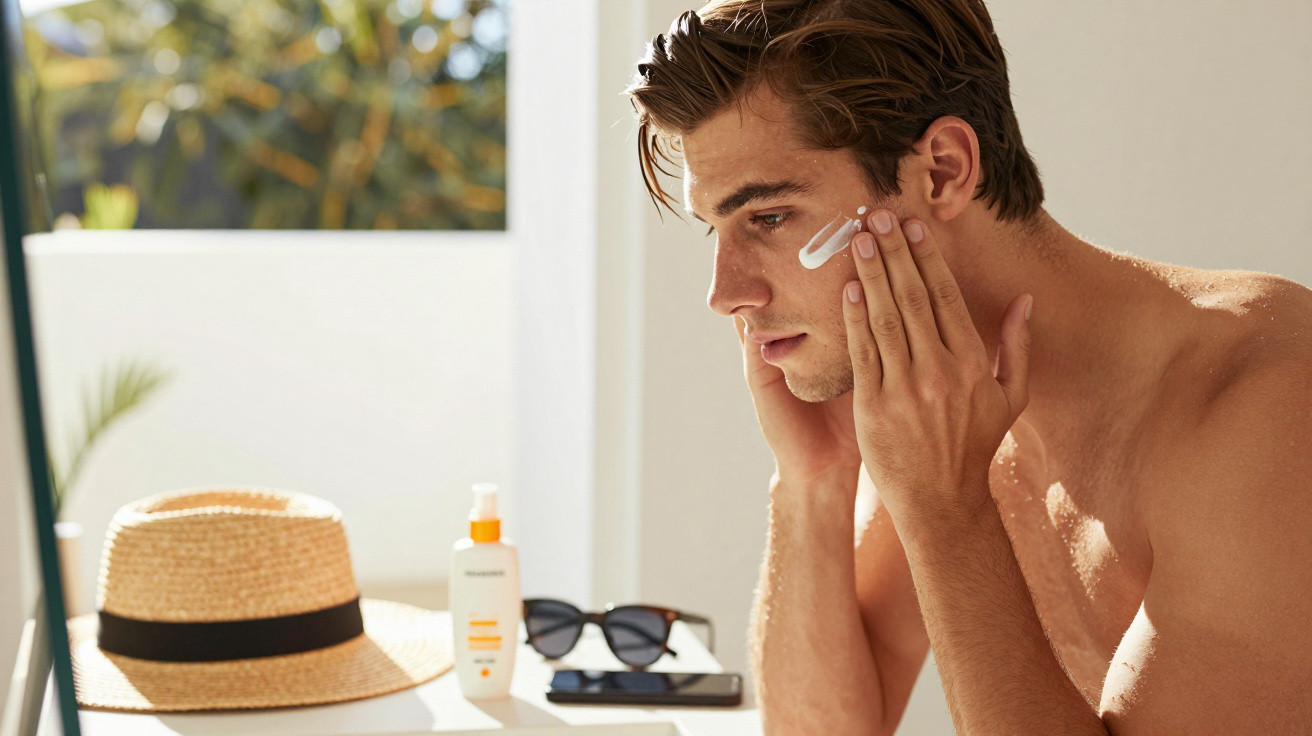
The beach was already busy when the first reddened shoulders began to appear.
Children were still playing in the surf and parents were still looking at their phones, but the gradual, unseen damage was easy to spot. People added a little more sunscreen to their noses and swept a line across their arms before returning to their towels, convinced they were protected. Two hours later, the picture was different: pink marks where straps had shifted, pale areas where the lotion had actually done its job. One man in his thirties looked at himself in his phone screen, incredulously tracing the vivid outline left by his sunglasses. He had used sunscreen. He had followed what everyone says you “should” do. So why did his skin resemble a contour map of errors?
Why your sunscreen isn’t working the way you think
Most people assume sunburn happens only when someone forgets sunscreen entirely. The truth is more subtle. Many burns affect people who have used SPF, but have applied it in ways that quietly undermine its protection: a hurried rub, an overlooked area around the ears, or a small dab instead of a proper coating.
On a sunny day, there can be a painfully large difference between “I put some on” and being properly protected. We are drawn to shortcuts, and sunscreen can feel like one product, one action and one completed task. Skin does not follow that reasoning. UV light is unconcerned by how certain you felt when you put the lid back on the bottle.
A dermatologist told me that she encounters the same summer pattern every year: burnt noses, temples, tops of feet and isolated red marks around the hairline. It is almost a chart of the areas people forget are there when they are rushing. These mistakes are minor and nearly invisible in the mirror, yet they can mean hours of unfiltered exposure for the thinnest and most vulnerable skin.
During a family holiday in Spain, I watched a mother apply lotion carefully to her children each morning. She was thorough, almost worried, spreading the cream over their shoulders, backs and chubby legs. By midday, the children were fine. She was not. Her chest and the back of her neck had turned a vivid, angry pink. She had concentrated so much on them that she hurried through her own application, missed the awkward areas and assumed the previous day’s layer would last a little longer.
She was neither careless nor uninformed. Like many adults, she treated sunscreen as a single morning ritual rather than a shifting, wearing barrier altered by sweat, water and friction. Later, she laughed about “always burning in the same place”, as though it were unfortunate chance. It was not chance. It was a repeated pattern of small mistakes, made summer after summer.
SPF numbers can create another psychological trap. Applying SPF 50+ can feel like an armour upgrade, as though you have unlocked a cheat code against the sun. You then stay outside for longer, miss a reapplication and overlook places where the coat was never even. UV does not check your confidence: it passes through thin patches, rubbed-away areas and places exposed when a hat or T-shirt moves without you realising. Most burns begin in that gap between what a label promises and how we actually use the product.
Applying sunscreen smarter: coverage that actually protects
The most useful sunscreen tip is not remotely glamorous: use enough of it. Most adults require roughly a shot-glass amount for the body and two full finger lengths for the face and neck. That does not mean a modest dab or a pea-sized dot worked into the skin until nothing remains. It means a visible, slightly generous layer that can still be seen before it is blended in.
Many dermatologists recommend the “two-finger rule” for the face: dispense a line of sunscreen along your index and middle fingers, then apply that amount from the hairline to the jawline, including the ears and neck. It can seem excessive initially. However, that is the quantity needed to achieve the SPF stated on the bottle. Using less is like buying a helmet but wearing only half of it.
One understated but effective adjustment is to apply sunscreen in sections rather than in one frantic sweep. Begin with the face and ears, followed by the neck and chest, then the arms and legs. Finish with the smaller high-risk areas: hands, tops of feet, behind the knees and the strip exposed where your T-shirt lifts as you sit. On that same beach in Spain, I saw a man stop after spraying his arms and thoughtfully lift his shorts slightly to mist his upper thighs. It took an extra five seconds and probably spared him three days of wincing whenever he sat down.
Partings and thinning areas of hair are especially prone to sunburn on the scalp. People often miss them because lotion can feel greasy in their hair. A spray or powder SPF made for the scalp offers a practical alternative. Is it stylish? Not exactly. But peeling skin on your head a week later is not stylish either. Targeted products like these can make the difference between “I tried” and “I’m covered”.
Timing matters too. Most sunscreen should be applied to dry skin around 15–20 minutes before you go into strong sunlight. Almost everyone rushes this step. At the pool, parents often coat their children while they are already running towards the water, with droplets of lotion sliding away in the first splash. Let’s be honest: hardly anyone does this every day, exactly as the instructions say.
Miss that waiting period and you are effectively exposed without protection during the first stage of your time outdoors. If you burn “even with sunscreen”, those opening minutes may well have been bare-skin time. Reapplication is important too. Sweat, sand, towels, straps and hugs can all remove that carefully applied first layer.
Long lunches on a terrace, cycling trips and walks through the city between meetings are all occasions when people forget they are still being exposed to UV. That is how a perfect T-shirt outline appears despite your certainty that you did everything correctly at 9 a.m. The sunscreen did not simply disappear by magic. Everyday life gradually wore it away.
One of the kindest things you can do for your future self is make small, automatic habits part of your routine. Keep a travel-sized tube in the bag you genuinely carry. Set a late-morning phone reminder during summer. Do a quick “top-up round” whenever you refill your water bottle. They may be unexciting, but they quietly protect your skin.
“Sunscreen isn’t a one-time decision in the morning,” says one London-based dermatologist I spoke to. “It’s a series of tiny choices throughout the day: where you put it, how much you use, and whether you respect that it wears off like perfume or makeup.”
- Avoid rubbing sunscreen in until it vanishes immediately. Allow a light film to sit for a few seconds before blending it.
- Make separate passes over delicate areas: around the eyes, ears, lips and the back of the neck.
- Change the texture if you dislike how it feels. Gel, milk, stick or spray - the best option is the one you will actually use.
- Bear in mind that make-up containing SPF is usually insufficient on its own in strong sunshine.
- Reapply every two hours when outdoors, as well as after sweating or swimming, including when using “water resistant” formulas.
Beyond SPF: small habits that change everything
There is real reassurance in recognising that sunscreen does not have to do all the work by itself. Shade, clothing, hats and good timing can share the responsibility. A wide-brimmed hat protects the areas we routinely forget, including the ears, hairline and temples. A loose linen shirt means you are not depending solely on the coat applied at breakfast while sitting on a café terrace at 11 a.m.
We have all had that moment in the evening when we remove a top and notice the bright outline of a vest strap that we had not even realised had moved during the day. This is where thoughtful layering is useful. Start with sunscreen, add fabric where possible and move your longest periods outdoors away from the unforgiving midday hours, when the sun is not only bright but directly overhead.
It is striking how quickly your body responds once you begin adjusting these details. Reapply at lunchtime for a week. Wear a hat on longer walks. Deliberately check your ears and feet. The belief that “I burn no matter what” begins to fall apart. Skin that once stung in the shower after a sunny day may simply feel warm, then return to normal. You may still develop some colour, of course, but without the throbbing, tight and restless heat at night.
Some readers describe the shift as moving from guesswork to a quiet system. You do not turn into a sunscreen robot. Instead, you go through the day making small, almost invisible choices that build on one another. That is the real benefit: not pursuing a perfectly even glow, but knowing that in ten years’ time you may have fewer rough patches and fewer deep lines precisely where the sun has always hit hardest.
| Key point | Detail | Benefit for the reader |
|---|---|---|
| Sufficient quantity | Two fingers for the face, one “shot glass” for the body | Achieve the stated SPF instead of weakened protection |
| Forgotten areas | Ears, neck, scalp, feet, hands | Prevent sunburn in the same places time after time |
| Application schedule | Wait 15–20 min and reapply every 2 hours | Reduce apparent failures such as “I burnt despite using sunscreen” |












Comments
No comments yet. Be the first to comment!
Leave a Comment