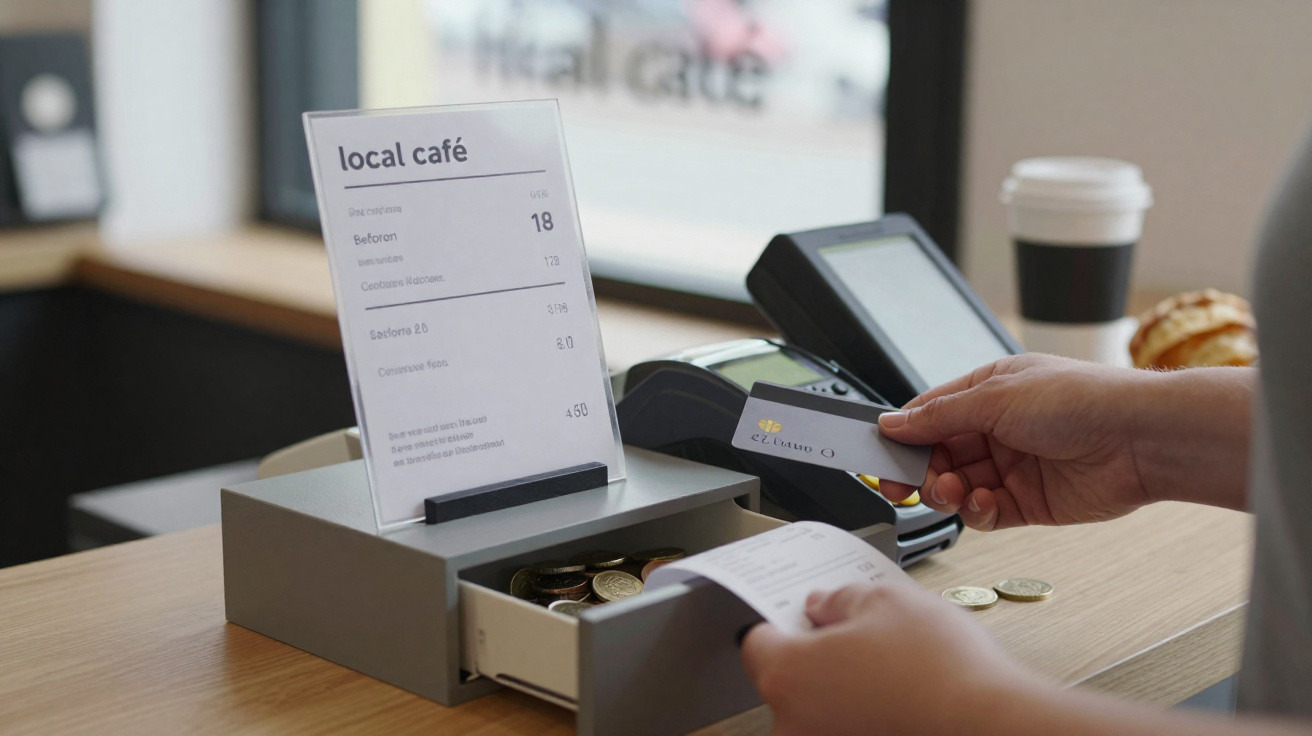
Card terminals are so routine that a sign saying “cash price” or “cash only” can catch shoppers off guard. The useful rule of thumb is this: a business can choose which payment methods it accepts and can offer an upfront cash discount, but you should be able to see the real price and any conditions before agreeing to buy.
That is different from being presented with a higher bill simply because you have used a card. UK rules generally prohibit businesses from adding a surcharge for many consumer debit and credit card payments. The wording on the sign matters less than whether the arrangement is clear and whether the price changes only at the till.
Cash discount or card surcharge?
A cash discount is a reduction from a clearly stated price for customers who pay with notes or coins. For example, a café may state that a meal is £10, or £9.50 when paid in cash.
A card surcharge is an additional amount added because the customer has chosen to pay by card. Since 2018, businesses have generally been prohibited from charging consumers extra for using most common consumer debit and credit cards under the Consumer Rights (Payment Surcharges) Regulations 2012.
The distinction can be less tidy in real life than it sounds. A business should not use the label “cash discount” to obscure the fact that nearly every customer is being charged more than the advertised price when they pay by card.
The total and the payment conditions should be clear before you order, book or hand over your card.
If an item is displayed as £10 but becomes £10.50 only when the card terminal is produced, ask why. A charge that was not made clear in advance may be a card surcharge or misleading pricing.
Can shops refuse cash or cards?
In most ordinary retail situations, yes. A private business can usually decide whether it takes cash only, cards only, or both. There is no general rule requiring every café, salon, shop or tradesperson to accept card payments.
The same applies to cash. Despite what is often claimed, “legal tender” does not mean a business must accept every note or coin for every purchase. The term has a narrower legal meaning, mainly connected with settling certain debts. Before a sale is agreed, a retailer can normally set reasonable payment terms.
A small shop may decline a £50 note if it cannot safely give change. Equally, a cash-only business should make that policy obvious before a customer has chosen goods, eaten a meal or had work carried out.
Some organisations operate under different arrangements. Transport providers, local authorities, public bodies and regulated services may set particular payment methods. For fines, taxes, rent or other formal bills, check the organisation’s own payment information rather than relying on the usual rules for shops.
What clear pricing looks like
The key consumer issue is transparency. A shopper should not have to guess what they will pay, or discover an important payment restriction after the service has been provided.
Clear notices might say:
- “£25, or £24 when paid in cash”;
- “Cash only” at the entrance, on the menu and by the till;
- “Minimum card spend £5” before an order is taken;
- the full payment terms at an online checkout before payment is authorised.
A minimum card spend is not the same as a card fee. Businesses can generally set a minimum transaction value, provided customers are told in advance.
Less helpful practices include hiding a notice behind the counter, mentioning a cash requirement after completing work, or using vague labels such as “terminal fee” and “card handling” for an ordinary consumer card payment.
Consumer protection rules require traders not to mislead customers about pricing. If a lower headline price is available only to cash customers, that condition should be prominent enough for people to understand what they are being offered.
Why some small businesses prefer cash
Taking card payments can involve transaction charges, terminal costs and administration. For an independent business with narrow margins, those costs can matter.
Cash, however, is not free to handle. It has to be counted, stored, reconciled and banked. Businesses may need a float, secure storage and appropriate insurance, while also managing the risk of theft or counterfeit notes.
For shoppers, card payments can be convenient and create a record of the transaction. Cash can help some people keep to a spending limit and remains important for people who do not use cards, smartphones or online banking. Where possible, a genuine choice between payment methods can be helpful.
A clearly advertised cash saving gives the customer a choice. A surprise card charge does not.
A shopper’s checklist before paying
Different payment prices do not automatically mean something is wrong, but they are a reason to pause before completing the transaction.
1. Check the final total
Look at menus, shelf labels, service price lists and checkout screens. If anything is unclear, ask: “What is the total if I pay by card?”
This is especially useful for beauty appointments, repairs, trades and hospitality, where there may not be a single shelf price to compare.
2. Ask how the lower price works
A simple question is often enough: “Is this a cash discount, or is there an additional charge for paying by card?”
Staff do not need to use legal terminology, but they should be able to tell you the final amount before taking payment.
3. Keep proof of the transaction
Save the receipt, invoice, booking confirmation or relevant screenshot. For a cash payment, ask for a receipt rather than relying on memory alone.
Proof of purchase may be useful if goods are faulty, a service has not been delivered as agreed, or you need to challenge an unexpected charge.
4. Do not feel pushed towards a cash machine
If you learn about a cash-only policy only after selecting an item, ask whether you can cancel the purchase. Before a contract is made, you may be able to walk away.
Take more care where a bespoke item, urgent repair or booked service has already begun. Cancellation charges or agreed terms may apply, so ask for an explanation before making a decision.
Common mistakes to avoid
Assuming all card-related charges are banned
The rules cover many consumer card payments, but not every possible payment arrangement. A business may set its prices, offer a genuine cash discount or charge for a separate optional service. What matters is whether the charge is lawful, transparent and genuinely separate from simply paying by card.
Treating legal tender as a right to buy anything with cash
A retailer can usually decide payment methods before a sale is agreed. Carrying a £50 note does not oblige a small business to accept it or provide change.
Ignoring a minimum-spend notice
A minimum card spend may be inconvenient, but it is different from adding a percentage or flat fee to a card payment. Check the notice before ordering, particularly in small independent businesses.
Paying an unexplained extra amount
If the price rises at the till, ask politely for a breakdown. It may be an error, or the business may be able to explain a separate charge. If it cannot explain the difference clearly, consider declining the purchase where that is still possible.
Assuming cash leaves no paper trail
Cash is a valid payment method, but a receipt still matters. Keep it somewhere safe, particularly for expensive goods, repairs or services booked in advance.
What to do about a suspected card surcharge
Start by raising the issue with the business. Explain the advertised price, show any relevant evidence and ask for the additional amount to be removed or refunded.
Keep a photo of the price display where appropriate, along with receipts, online listings, booking confirmations and a note of when you spoke to staff. Be discreet when taking photographs in a business and do not photograph other customers or payment details.
If the matter is not resolved, Citizens Advice can provide consumer guidance and may pass information to Trading Standards where appropriate. Trading Standards services do not usually deal directly with individual disputes, but reports can help identify potentially misleading practices.
If you paid by card, contact your card provider to ask about its dispute process. The options will depend on the transaction and the evidence available, so a refund is not automatic.
The practical takeaway
A business can be cash-only, card-only or offer a properly advertised saving for cash. The important point for shoppers is that the total price and payment conditions should not be a surprise.
Before you buy, check the notice, ask for the card total if necessary and keep your receipt. A genuine cash discount can be a straightforward choice; an unexplained extra charge at the till is worth questioning.















Comments
No comments yet. Be the first to comment!
Leave a Comment