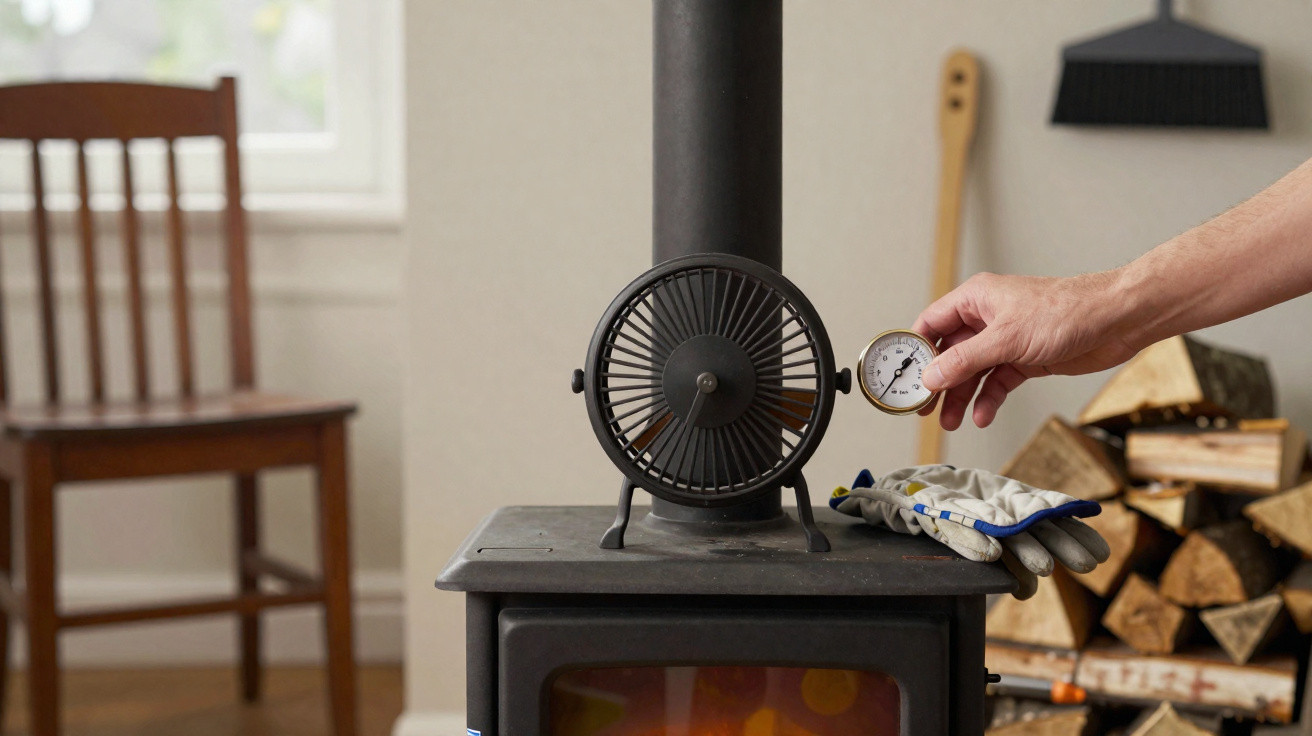
A stove fan can seem like an easy answer to a familiar winter problem: the chair nearest the wood burner feels far too hot, while the other side of the sitting room remains cool. These small fans sit on the stove top and use its heat to turn their blades, with no plug, battery or charging required.
The useful reality is more modest than the sales pitch often suggests. A heat-powered fan may help move warm air around a suitable room, but it will not make the stove produce more heat, fix a draughty house or solve a poorly performing appliance. Before being tempted by a €20 deal, check that the fan is compatible with your particular stove and that it can be used safely.
What a heat-powered stove fan does
A product described as a chimney fan is usually a heat-powered stove fan. It is designed for the flat top of a freestanding wood-burning or multi-fuel stove, rather than for the chimney or flue.
The base contains a thermoelectric unit. When one side is heated by the stove and the upper part remains cooler, it creates a small electrical current to power the motor. The blades should begin turning gradually as the stove top warms up.
Its purpose is to move some of the warm air that collects around the stove into the room. This can slightly reduce the feeling that all the warmth is concentrated immediately in front of the fire.
A stove fan can redistribute existing warmth. It cannot increase the stove’s rated heat output or improve a faulty flue.
It is not an extractor, and it does not draw smoke or fumes through the chimney. It should never be treated as a solution for smoke entering the room, poor draw, or a carbon monoxide concern.
Why the effect can be modest
A stove warms a room in several ways. Its hot surfaces give off radiant heat, which is why you can feel warmth when sitting near it. It also warms the surrounding air, which then circulates through the room.
A fan can influence that second part by nudging warm air away from the appliance. In a small enclosed room, this may make a seating area feel more comfortable. The effect varies considerably, however, and it is usually gentle rather than dramatic.
Results are often less noticeable in:
- large open-plan rooms;
- rooms with very high ceilings;
- houses with open staircases, where warm air rises away;
- draughty properties with gaps around floors, windows or doors;
- rooms where bulky furniture blocks air movement;
- spaces with doors open to colder halls or adjoining rooms.
The fan will not push useful amounts of heat round corners, upstairs or through closed doors. If your sitting room remains cold, draught-proofing, suitable curtains, better use of internal doors and an assessment of the stove’s output may matter more.
Why stove professionals may be cautious
A correctly specified and properly installed stove should be capable of heating its intended room without an accessory on top. That does not mean a fan is always unsuitable, but it does mean that persistent comfort problems are worth investigating rather than covering up with a gadget.
For example, the stove may be too small for the space. Equally, an oversized stove can be run at too low a rate, leading to inefficient burning and a dirtier flue. Ventilation, fuel quality, chimney condition and insulation can all affect how a stove performs.
There are practical downsides too:
- A fan takes up space on the stove top.
- Its moving blades and faint mechanical sound may be unwelcome in a quiet room.
- Air movement can disturb dust, pet hair or loose ash around the hearth.
- Cheap models may have unclear temperature limits or poor instructions.
A low price is not automatically poor value, but it should not replace checking the product specification and the stove manual.
Check your stove before buying
Not every appliance maker allows objects to be placed on the stove top. Some stoves have vents, cook plates, convection openings or surfaces that can exceed the safe operating range of a fan.
1. Read the appliance manual
Look for instructions on the top plate, maximum surface temperatures and whether accessories may be placed on the stove. Follow the stove manufacturer’s guidance over any general advice supplied with a fan.
If the manual is missing, try the manufacturer’s website or ask the retailer or installer for the correct document. Do not guess from photographs of similar models.
2. Check the fan’s stated temperature range
A suitable fan should clearly state its operating range and maximum temperature. Some have an overheating device, but this is not a reason to run a stove beyond its recommended temperature.
A stove-top thermometer can be useful for understanding how the appliance normally runs, provided it is intended for that purpose and used according to its instructions.
3. Check the surface and position
The fan needs a level, stable metal surface. Do not balance it on a curved lid, loose decorative panel, warming shelf or uneven area.
Keep it away from the flue collar, vents, controls and any area needed to load or operate the stove safely. Never drill into the appliance, add brackets or modify a fan to force it to fit.
4. Ask a competent person if uncertain
A qualified solid-fuel installer or chimney sweep can help with questions about clearances, ventilation, stove operation and the appliance manual. This is especially sensible if the stove has recently been installed, behaves unusually or is used as a main source of heating.
Use it safely around a hot stove
Even a small fan becomes extremely hot in use. Its blades can also continue spinning while the stove is cooling down.
- Place and remove the fan only when the stove is fully cold, unless its instructions explicitly say otherwise.
- Keep children and pets away from the appliance and fan.
- Do not touch the fan’s base, casing or blades during use or while cooling.
- Stop using it if the base warps, blades wobble, the motor becomes unusually noisy or any part is damaged.
- Keep kindling, paper, oven gloves and other combustible items away from the stove top.
- Never burn the stove harder simply to make the fan run faster.
- Use only the fuel approved for your stove and follow local smoke-control rules where they apply.
Homes with solid-fuel appliances should have a suitable carbon monoxide alarm in the same room, installed, tested and replaced in line with the alarm manufacturer’s instructions and current UK guidance. A fan does not remove the need for regular chimney sweeping, maintenance or adequate ventilation.
Smoke in the room, an alarm activation or an unusual change in the stove’s behaviour calls for the appliance to be stopped and checked - not for a fan adjustment.
Common mistakes with stove fans
The most common disappointment is expecting the effect of an electric desk fan. Heat-powered models normally turn slowly and quietly, especially while the stove is coming up to temperature.
Other mistakes include:
- Buying by blade count alone: more blades do not necessarily mean better airflow, less noise or safer operation.
- Putting the fan beside the flue: this may expose it to excessive heat and interfere with intended clearances.
- Ignoring the instructions: fan temperature limits and placement guidance vary between models.
- Using it on a stove with a non-flat top: an unstable fan can fall or damage the appliance.
- Treating it as a cure for a cold home: a fan cannot compensate for serious draughts, unsuitable stove sizing or chimney problems.
- Neglecting hearth cleaning: carefully remove dust and ash when everything is cold, particularly if anyone in the household is sensitive to airborne dust.
Is a €20 Netto fan worth considering?
If you have seen a €20 stove fan at Netto, regard it as an optional accessory rather than a heating upgrade. Retail promotions, stock and specifications can change, and an offer advertised outside the UK may not be available in British branches or online.
For a compatible stove in a small room, a low-cost fan may be worth trying if the packaging gives clear temperature limits, dimensions, safety instructions and return details. It may provide a little more even air movement, particularly where the stove sits in one corner of a closed sitting room.
Before buying, compare the stated maximum temperature, footprint and warranty with alternatives from UK stove retailers. Most importantly, check your stove manual first. If the room still feels uncomfortable after sensible use of the appliance, spend money on identifying the cause - from draughts to stove sizing or chimney performance - before adding more accessories.
A stove fan can be a pleasant extra in the right setting. It is not a substitute for a safe installation, dry fuel, routine maintenance and a stove that suits the room it is meant to heat.
















Comments
No comments yet. Be the first to comment!
Leave a Comment