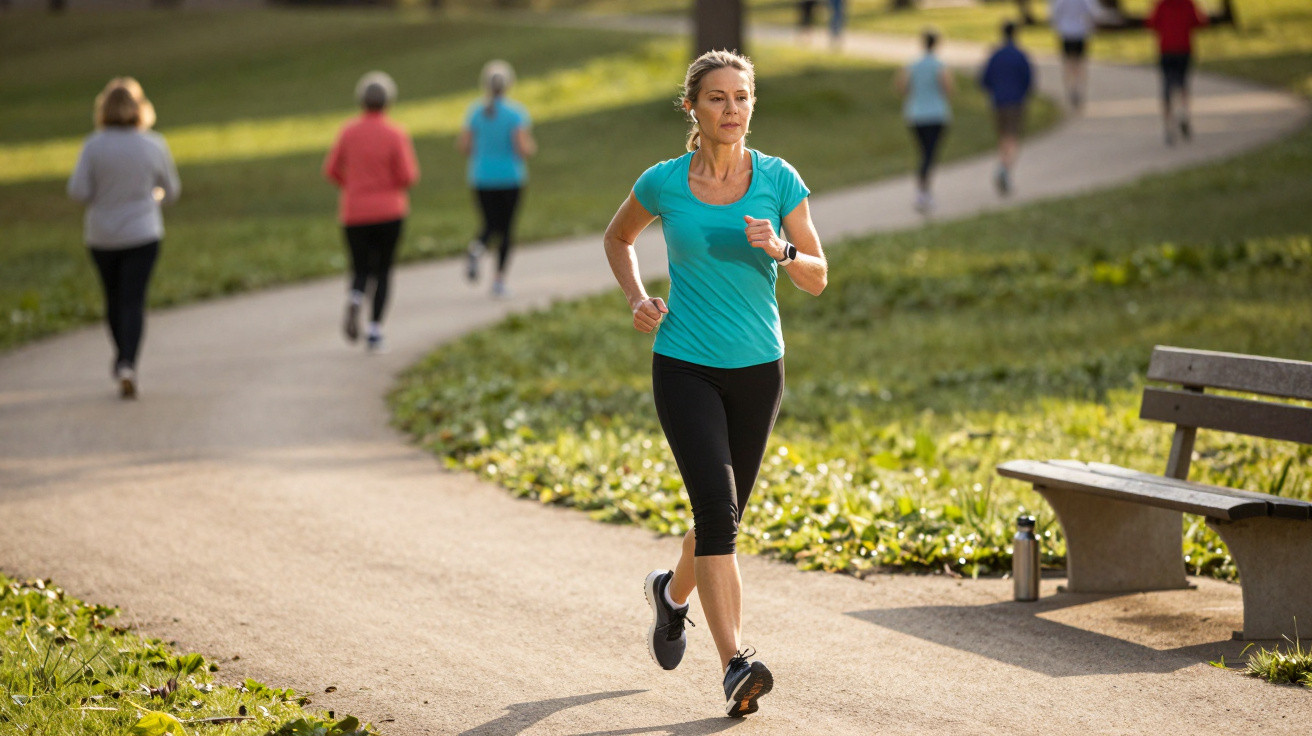
Gyms may promote weight stacks and elaborate equipment, yet an increasing number of trainers are returning to one straightforward practice: walking. When approached deliberately, walking can strengthen the legs in ways fixed machines cannot fully replicate, particularly for people in their 50s, 60s and later life.
Why walking can beat gym machines after 50
Leg-press and leg-extension machines can seem comforting. They hold your back in place, restrict your position and direct the movement for you. Although this can feel secure, the machine takes on much of the stabilising work that your muscles and joints must perform in everyday situations.
Walking is a full-body, weight-bearing exercise that forces your hips, knees, ankles and core to work together with every single step.
As you walk, your body must both support and move your full bodyweight. Your feet hold the ground, the calves and thighs manage the push-off, the hips and glutes control the leg swing, and the core maintains an upright position. This “closed-chain” movement mirrors the pattern used when climbing stairs, carrying shopping or recovering from a trip.
For people aged over 50, this sort of coordinated strength is more valuable than simply demonstrating maximum force on a leg press. The objective is not only to gain muscle; it is to remain stable, mobile and self-assured during daily activities.
How to turn a normal walk into leg training
What separates “just a stroll” from a proper strength session is the way you walk, rather than simply the distance or duration. The six methods below can be incorporated into a typical walk around your local area, without needing a gym membership.
1. Intentional pace walking: waking up sleepy leg muscles
Many of us walk on autopilot, moving along with little awareness and a shuffling gait. Intentional pace walking requires you to pay slightly closer attention to every step.
Stand upright, raise your chest and keep your shoulders loose. Begin at a moderate speed that feels purposeful rather than sluggish. Whenever your rear foot leaves the floor, picture yourself actively driving the path backwards.
Think: “push the ground back” rather than “reach the foot forward.” This small shift recruits the glutes and thighs far more intensely.
Maintain that driving feeling through each stride for 10 to 20 minutes. You are showing your body that walking is active effort, rather than passive movement. Within a few sessions, many people feel their buttocks and hamstrings “switch on”.
2. Hill walking: building power and ankle stability
Trainers frequently call uphill walking “strength training in disguise”. An incline makes the hips and thigh muscles work more intensely, while also giving the heart and lungs a worthwhile workout.
Choose a consistent slope, whether it is a short driveway or a hill in a nearby park. Tilt forwards gently from the ankles rather than bending at the waist, and use shorter strides to remain controlled. Push through your heels and contract your glutes as you walk upwards.
- Walk uphill for 30–90 seconds at a steady, challenging pace.
- Rest or walk slowly on flat ground for 90–120 seconds.
- Repeat three to six times, depending on your current fitness.
This uncomplicated structure develops the quadriceps, glutes and calves, while teaching the ankles and feet to stabilise on an incline. Hills can be especially helpful for anyone concerned about their ability to climb stairs in future.
3. Extended stride push-back walking: targeting the backside chain
With age, the muscles at the back of the body often lose strength: the glutes, hamstrings and lower back. Extended stride push-back walking offers a simple way to place greater focus on these areas.
On level ground, start with short, controlled steps. Slowly extend the rear portion of the stride, as though lengthening your leg behind you instead of reaching forwards. Concentrate on forcefully pressing the ground away with the trailing leg and tightening the buttock during push-off.
This shift from “step forward” to “push back” builds strength in the hips, a key area for balance and fall prevention.
Keep your upper body upright and stable. Just a few minutes of this technique during a walk is generally sufficient for the muscles along the backs of your legs to feel the difference.
4. Speed interval walking: short bursts, big returns
Speed intervals are rather like a milder form of sprint training. They involve alternating comfortable walking with brief spells of moving faster and driving harder through the legs.
First, walk easily for several minutes. Next, increase your pace for 30–60 seconds. Stay tall, allow your arms to swing naturally and concentrate on pushing off the ground more powerfully. Afterwards, reduce your speed to recover.
| Phase | Duration | Effort level |
|---|---|---|
| Warm-up walk | 5 minutes | Comfortable, conversational |
| Fast interval | 30–60 seconds | Breathing deeper, still in control |
| Recovery walk | 1–2 minutes | Easy, steady |
Complete the fast–slow sequence three to six times. These short efforts test the leg muscles and cardiovascular system alike, developing the strength needed for practical demands such as rushing for a bus or walking uphill while carrying shopping bags.
5. Slow downhill walking: training brakes and joint control
Downhill stretches are commonly viewed as an easy break. Gravity takes over and you simply roll along. However, descending a slope slowly can be among the most effective exercises for leg strength and joint control.
When you walk downhill under control, your muscles act like brakes, working hard as they lengthen. This “eccentric” loading is crucial for resilience in knees and hips.
On a mild descent, reduce your stride length and travel more slowly than feels natural. Keep your chest raised, lightly engage your abdominal muscles and do not tip too far forwards. As each foot lands, place it carefully and notice your thighs and glutes preventing you from accelerating.
Use this approach on brief downhill sections, before recovering on flat ground for one or two minutes and repeating if desired. Many people find that, over time, it improves their confidence on stairs and uneven paths.
6. Posture-focused walking: finishing with quality
Tiredness towards the end of a walk can bring rounded shoulders and shuffling steps. Posture-focused walking reverses this tendency by asking you to finish the route with added focus on technique.
For the final few minutes, picture a thread lifting you from the top of your head. Lightly brace your core, as though drawing up a slightly tight waistband. Allow your arms to move freely at your sides, and look towards the horizon instead of down at the pavement.
Take smooth, purposeful steps. The goal is to finish feeling organised rather than crumpled. With time, this practice reshapes your habitual walking pattern, bringing greater stability and confidence to every trip out.
How these walking drills compare with machines
Gym machines generally isolate only one or two muscle groups at once. A leg-extension machine primarily trains the front of the thigh, while a seated leg curl targets the rear of the thigh. Both exercises are performed sitting down and eliminate the need to balance.
By comparison, these walking variations require several muscles and joints to work in coordination. The ankles provide stability, the knees follow your motion, the hips direct the leg swing, and the trunk prevents excessive rotation. This is much more similar to the way the body moves when dealing with real-life demands.
For adults over 50, strength that carries over into daily tasks matters more than the ability to move heavy weight while strapped into a machine.
Walking can also be gentle on the joints when increased sensibly. Its resistance is naturally limited by your bodyweight, your pace and the slope beneath your feet. There is no abrupt move from one stack of weight plates to the next.
Practical weekly plan for beginners over 50
For anyone returning to exercise or beginning with a comparatively low fitness level, these drills can fit into a straightforward week:
- Day 1: 15–20 minutes of intentional pace walking, ending with 3 minutes of posture-focused walking.
- Day 2: Rest or a gentle stroll.
- Day 3: Hill walking intervals: 4–5 short uphill efforts plus posture-focused walking at the end.
- Day 4: Rest or light activity at home.
- Day 5: 20 minutes including extended stride push-back walking and 3–4 speed intervals.
- Day 6: Walk with one or two slow downhill sections, keeping them controlled and short.
- Day 7: Easy walk as desired, focusing mainly on relaxed posture.
This schedule combines training stimulus with recovery, while providing enough variation to keep the body and mind interested.
Key terms and real-life scenarios
Two concepts frequently arise in this kind of training: eccentric loading and neuromuscular coordination. Eccentric loading means a muscle lengthens in a controlled way while under tension, as happens when the thighs slow you down during a downhill section. It is associated with improved strength, tendon health and resistance to injury.
Neuromuscular coordination describes how effectively the nervous system communicates with the muscles. Varied walking surfaces, pace changes and managing slopes all test this system, improving balance and reaction speed.
Consider three ordinary scenarios: stepping down from a high kerb, taking a suitcase downstairs or responding to an unexpected pull on a dog lead. In every case, the legs need to generate force, control motion and stabilise the joints rapidly. The six walking drills outlined here quietly practise those demands in a controlled environment, day after day, without a membership card or complicated equipment.
For many people over 50, this is the main appeal. The training takes place on the streets and paths they already travel, while the benefits emerge gradually: stronger steps, more secure footing and the sense that their legs truly belong to them again.














Comments
No comments yet. Be the first to comment!
Leave a Comment