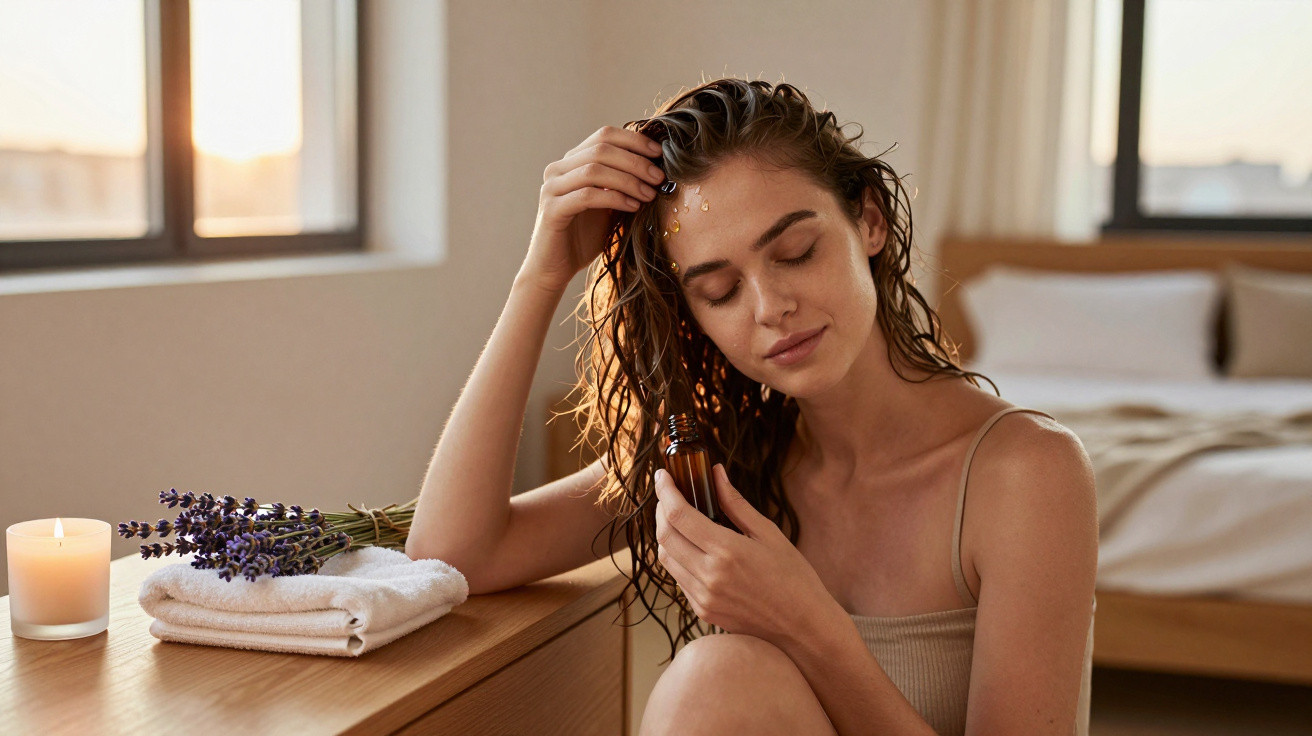
Tight after a day spent under headphones. Slightly itchy because of dry office air. Your thoughts tumbling when all you want is stillness. Lavender oil enters that noisy moment like a quietly reassuring friend. It is not a miracle; it is simply a small ritual that meets you where you are. Its effect is found in the details you can actually feel.
I first noticed the change in a dim bathroom, with the extractor fan humming and a towel draped over my shoulders. The bottle was small, and a few diluted drops left my fingertips glossy. I rubbed my hands together and the fragrance lifted: fresh, gently floral, subdued. As my hands moved over my scalp, something released. Nothing theatrical-just my shoulders lowering slightly and my jaw loosening. I inhaled, then exhaled more slowly. The room was unchanged, but I was not. The scalp pays attention.
Why lavender oil calms your scalp at night
Lavender oil is not magical. Its effects come through scent, touch and chemistry. Its key plant compounds-linalool and linalyl acetate-are recognised for their skin-soothing and mild antimicrobial properties. For your scalp, this can mean less prickly irritation and a more balanced surface for its natural oils. At the same time, the slow movement of your fingers gives your nervous system a signal. The scalp has a high concentration of nerve endings, and calm contact encourages them to settle. Your mind tends to follow.
Imagine a commute that has overrun, a hurried dinner and emails still flashing on the screen. Blend two drops with a teaspoon of jojoba oil, rub it between your hands and press from the hairline to the crown. That is all: three minutes. Sitting on the edge of the bed, your eyes close almost by themselves. Sleep comes less like a slammed door and more like the tide coming in. Small clinical studies have associated lavender fragrance with improved sleep quality and a shorter time to fall asleep compared with a neutral scent. That is not a spreadsheet boast. It is a real-life benefit.
The reasoning lies where skin and brain meet. A gentle massage increases microcirculation around the roots, helping to spread sebum so the scalp is not dry in one area and shiny in another. A stronger barrier sends fewer tiny discomfort signals into your thoughts. Breathing in lavender supports your parasympathetic system-the rest-and-digest side-allowing your heart rate to ease and your breathing to deepen. This combination explains why fragrance on your hands can soothe the body beneath your hair. It is modest, yet it builds over time.
How to use lavender oil without mess or guesswork
Keep it straightforward. Add 2–3 drops of lavender essential oil to one teaspoon of a light carrier oil, such as jojoba, grapeseed or fractionated coconut. Warm the mixture in your palms. Using the pads of your fingers rather than your nails, begin at the temples and work in slow circles from temples to crown. Give the nape of your neck a few soft passes too, as stress often gathers there. Take three measured breaths through your hands. Leave the oil in for 30–60 minutes, or overnight if your hair handles it well. Wrapping a warm towel around your head makes the ritual feel like an evening exhale.
We have all experienced a “self-care routine” that starts to feel like homework. Honestly, no one does this every single day. Try it two or three evenings each week instead. Typical mistakes include using too much oil-welcome to greasy hair-applying undiluted essential oil directly, which can sting, and scrubbing as though you are washing dishes. Your scalp will not thank you for that. If your skin is sensitive, first test a small amount behind your ear. Keep the blend away from your eyes and your cat’s curious nose. Gentle treatment wins, and regularity matters more than intensity.
Treat the ritual as a conversation rather than a task. Your hands ask, and your scalp responds. After several weeks, you may find fewer tight areas and a gentler transition into bedtime.
“Lavender isn’t a cure-all, but paired with calm touch, it can shift the whole evening mood. The body reads scent and pressure as safety signals.” - a trichologist I trust
- Two drops go a long way. More is not better.
- Patch test first. This is particularly important if you are prone to reactions.
- The best carrier oils for the scalp are jojoba (closest to sebum), grapeseed (light) and argan (nourishing).
- Timing: use it 30–60 minutes before bed, or leave it overnight with a light towel on your pillow.
- Wash with a mild shampoo if your hair feels heavy in the morning.
A small ritual with big evening returns
Rituals last when they are simple, sensory and a little indulgent. Lavender oil offers all three. There is no need to post about it, track it or get it perfect. You notice it with the first breath. Your brain begins linking the scent with slowing down, much like a familiar song that always relaxes your shoulders. Your scalp becomes an entrance to rest rather than one more item on the list. It feels like someone quietly turned down the volume on the day. The more often you do it, the quicker your mind recognises the signal. You can share the routine with a partner or keep it as your own quiet pocket. Either way, it is a small, dependable way to treat yourself more gently as daylight fades.
| Key point | Detail | Benefit for the reader |
|---|---|---|
| Evening calm through scent | Lavender’s linalool and linalyl acetate support relaxation and reduced sensory overload | A quicker wind-down and less mental churn before bed |
| Scalp comfort through touch | Light massage improves circulation and balances natural oils | Less tightness, fewer itchy flare-ups and roots that feel better |
| Simple routine | 2–3 drops in 1 tsp of carrier oil, 3 minutes of slow circles, 30–60 min before sleep | Easy to repeat without turning it into a project |










Comments
No comments yet. Be the first to comment!
Leave a Comment