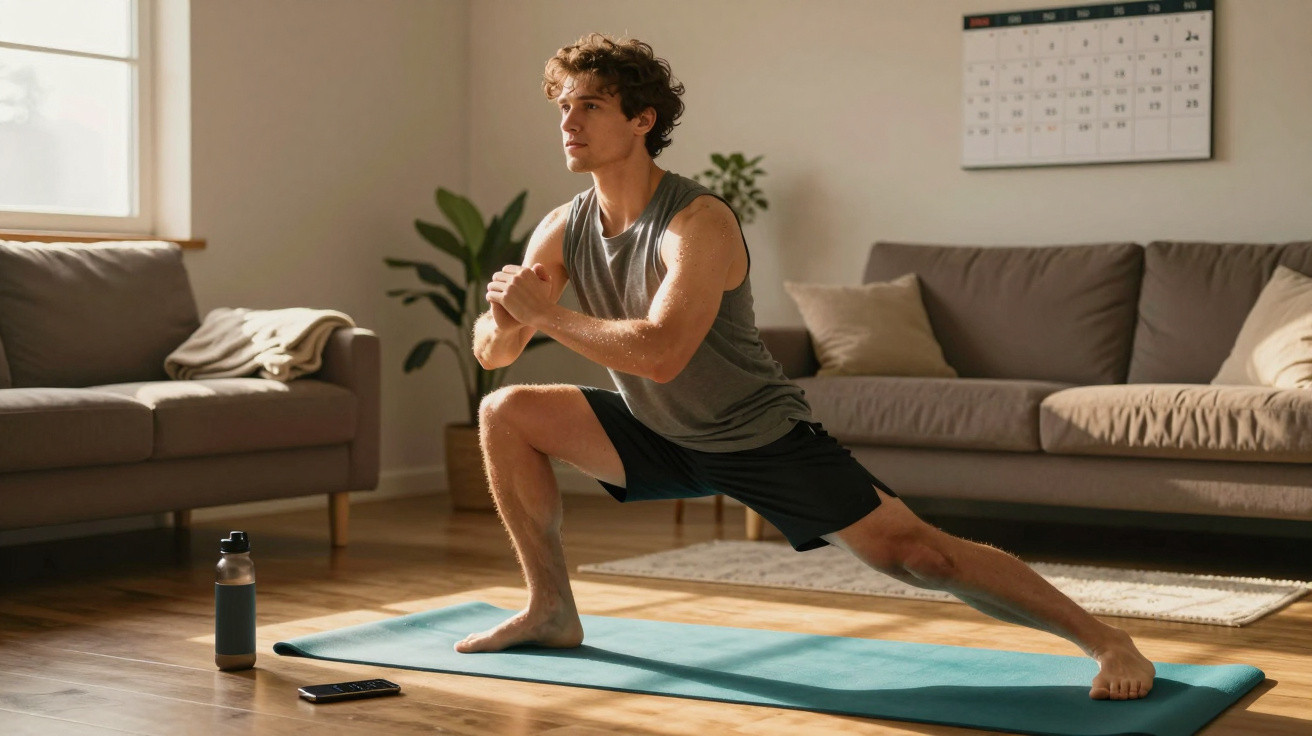
If your gym membership has become little more than a regular debit on your bank statement, you are far from alone. Between work, family and everyday chaos, exercise can easily feel like an optional luxury. The good news is that a clear plan, ten straightforward exercises and around twenty minutes a day can make a noticeable difference to your body in four weeks – right in your living room, with no equipment required.
Why home training works so well
The biggest benefit is obvious: no travel time at all. There is no changing in an unfamiliar changing room, no waiting for equipment to become available and no excuses that the journey is “too far”. The barrier to actually getting started becomes dramatically lower.
“Twenty consistent minutes at home beat every overambitious week at the gym that fizzles out again after two sessions.”
Moving your workouts into your own home gives you more than extra time; it also gives you control. You choose the music, pace, outfit and, above all, the time of day. Whether it is immediately after getting up, during a lunch break while working from home or in the evening after putting the children to bed, the key is making it fit your routine.
There is another point that is often underestimated: frequent short sessions achieve more than occasional all-out efforts. A moderate programme supports joint stability, gets the cardiovascular system moving and reduces everyday tiredness. Concentration can improve too, as oxygen supply and blood flow to the brain increase.
Four weeks that noticeably change your body
Why one month is a realistic fresh start
The body adapts faster than many people expect. It takes roughly three to four weeks before a new habit feels less like an obligation and more like a normal part of the day. Your first sessions may be awkward, unsteady and demanding – that is completely normal.
Those who stick with it will usually notice clear changes after around three weeks:
- Climbing stairs becomes easier, and your heart rate no longer races straight away.
- Sleep becomes more settled because your body has been active during the day.
- Your back feels more stable, particularly after long days at a desk.
- Your reflection looks more upright, while your shoulders and neck start to relax.
The key is consistency rather than perfection. An average workout still counts for more than the “perfect” session you skip because you are tired.
The ten most important exercises for your living-room workout
This programme focuses on functional movements: exercises that engage large muscle groups, challenge your circulation and practise movements used constantly in daily life – lifting, bending, extending and supporting yourself.
“Training your legs, core and cardiovascular system creates the foundation for almost every other sport – and for a resilient everyday life.”
Legs and endurance: five exercises that warm you up quickly
The leg muscles are among the body’s biggest users of energy. Working them naturally raises your heart rate and boosts calorie expenditure.
- Squats: Stand with your feet slightly wider than hip-width apart and turn your toes slightly outwards. Push your hips back and down as if you were sitting on an invisible chair. Keep your heels on the floor and your chest lifted.
- Reverse lunges: Take a large step backwards and lower the rear knee towards the floor. Keep most of your weight over the front leg, then push powerfully back up.
- High knees: While standing, alternately lift your knees towards your chest, increasing the pace according to your fitness level. Land softly on the balls of your feet.
- Jumping jacks: From standing, jump your feet apart while bringing your hands together above your head, then return to the start. Ideal for warming up and getting your circulation going.
- Lateral jumps (skaters): Leap sideways from one leg to the other, keeping the supporting leg slightly bent and your upper body leaning forwards a little. This works balance, hips and glutes.
Core and upper body: five exercises for posture and stability
A strong core protects the spine and makes everyday movement safer – whether carrying shopping bags or lifting children.
- Forearm plank: Place your elbows beneath your shoulders and extend your legs. Brace your stomach and glutes so that your body forms a straight line. Avoid both a hollow back and lifting your bottom too high.
- Press-ups: Set your hands a little wider than shoulder-width and lower your body as one straight line. Beginners can put their knees down or use a wall or the edge of a sofa for support.
- Mountain climbers: Start in the same position as a press-up. Then alternately draw your knees towards your chest, varying the pace from slow and controlled to running.
- Superman: Lie on your front with your arms stretched forwards, then lift your arms and legs a few centimetres at the same time. Hold briefly before lowering them again. This strengthens the lower back.
- Glute bridge: Lie on your back with your feet planted and knees bent. Drive your pelvis upwards until your knees, hips and shoulders form a line, squeezing your glutes firmly at the top.
What a typical 20-minute session could look like
| Duration | Content |
|---|---|
| 3 minutes | Gentle warm-up: easy bouncing, shoulder circles, jumping jacks |
| 12 minutes | Circuit of 8 exercises: 40 seconds of work, 20 seconds of rest for each exercise: squats, reverse lunges, high knees, forearm plank, press-ups, mountain climbers, glute bridges, Superman |
| 5 minutes | Gentle cool-down, with stretches for the legs, hips, chest and shoulders |
This basic programme is entirely sufficient on three to four days each week. If you start to feel fitter, add a second round or reduce the rest periods.
Adapting your training: make it easier or progress deliberately
When it feels too difficult
Many people struggle because they try to begin at the level they once had. It is wiser to make a conscious decision to start more gently:
- Perform squats only halfway down until your knees have adapted to the load.
- Begin press-ups against a wall or the edge of a sofa rather than on the floor.
- Instead of sprinting high knees, simply lift them at a brisk marching pace.
- Extend rests to 30–40 seconds if your heart rate climbs sharply.
“Adapting exercises is smart training – no one gains anything from heroics that end in an orthopaedic waiting room.”
When your body wants more
If, after two weeks, you feel you have more to give, you can make the programme more demanding in a targeted way:
- Take three seconds to lower yourself during squats and reverse lunges.
- Cut the breaks between exercises to 10–15 seconds.
- Increase the speed during mountain climbers and high knees.
- Complete a second circuit, bringing the total training time to around 25–30 minutes.
Motivation from the living room: how to keep going
Low-energy days are part of the process. There will be evenings when even putting on a sports top feels irritating. This is exactly when a minimum rule helps: five minutes of movement are compulsory, however tired you are. Quite often, those five minutes turn into a full workout.
Small everyday cues can help as well:
- Leave your exercise clothes where you can see them rather than hiding them in a wardrobe.
- Choose a fixed time that is unlikely to be blocked by appointments.
- Record progress: repetitions, time held in the forearm plank and fewer rest periods.
- Notice everyday achievements deliberately: carrying heavy bags, taking the stairs and playing with children.
What your body is doing behind the scenes
Regular exercise strengthens more than just your muscles. Your joints produce more synovial fluid, which nourishes the cartilage. Tendons adapt to pulling forces and become more robust. Blood pressure may become more stable, while insulin sensitivity improves – a benefit for metabolism and weight management.
A strong core takes pressure off the discs and lumbar vertebrae. Consistent training can significantly ease many typical desk-related complaints, such as tense shoulders or nagging pain in the lower back. If you are unsure or have pre-existing health conditions, seek medical advice before starting again to establish what level of exertion is appropriate.
How to combine the 30 days effectively
For beginners, a practical rhythm is three to four sessions a week. Leave at least one rest day, or a very light activity day, between them – for example, a walk or gentle stretching.
If you continue the programme after a month, vary the focus: one day with greater emphasis on legs and endurance, one on core and upper body, and one on mobility. This keeps the stimulus high for both your muscles and your mind without overloading your body.
“In the end, all you need is one clear square metre of floor, a dose of honesty with yourself and the willingness to start today – not ‘someday’.”
















Comments
No comments yet. Be the first to comment!
Leave a Comment