
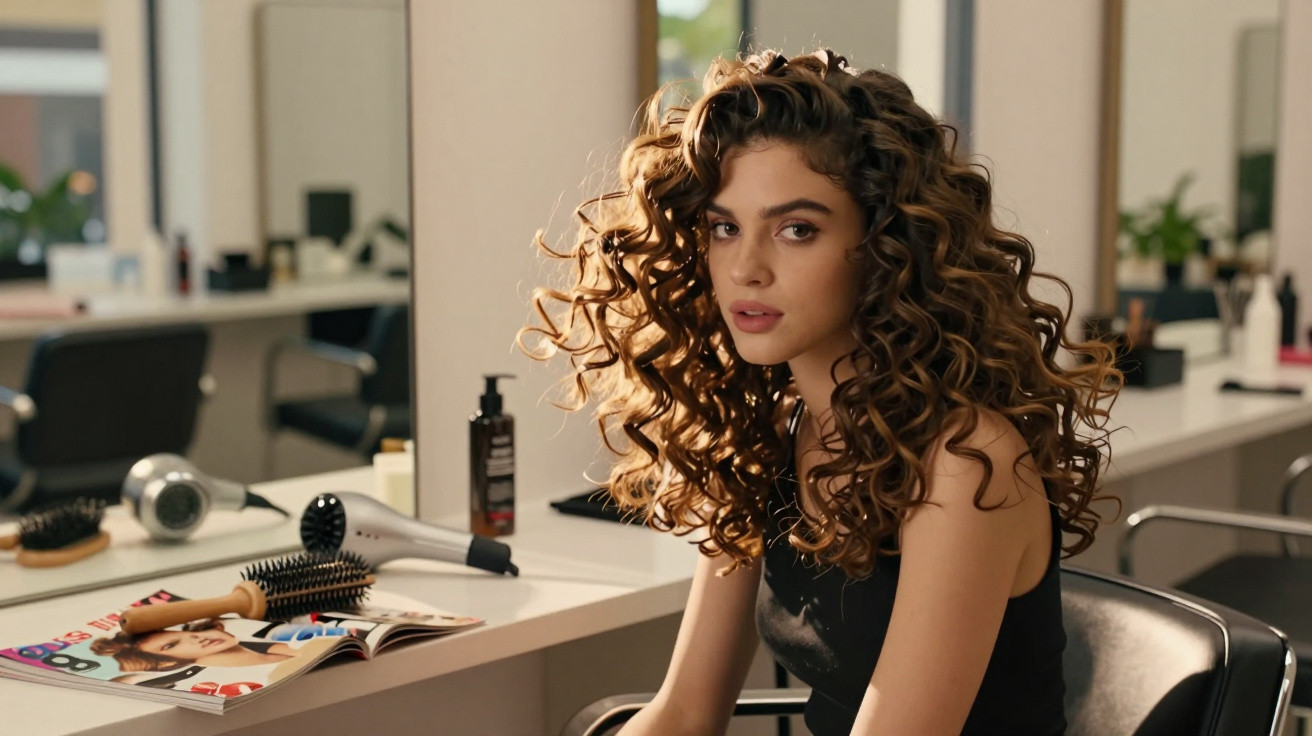
Her stylist had spent the previous twenty minutes blow-drying, curling and lifting the roots. Everything had been done. Yet as the final curl fell into place, her hair looked glossy… and was already flat. She squeezed her roots between two fingers, as though sheer determination could raise them.
“I don’t get it,” she said. “I use all the ‘nourishing’ stuff they tell you to use. My hair should be full of life. Why does it collapse before I even leave the house?”
The stylist looked towards the bottle of expensive conditioner on the counter and lifted an eyebrow. There was no need for a lengthy explanation. The actual culprit was in full view, sitting right at the scalp.
And the issue begins well before the hairdryer comes out.
The silent volume killer hiding in your shower
Because fine hair appears delicate, many people handle it as carefully as silk. They repeatedly use rich creams, heavy masks and “deep repair” treatments. It is a well-meaning approach: when you feel you have little hair, you want to cover it in protective care.
But after stepping out of the shower, the roots can already feel slippery. They are not hydrated or buoyant; they are simply slick. A styling brush glides straight over them. Hair cannot hold volume when conditioner has encased every strand in a soft, invisible layer.
By the time it has dried, the fight for volume has already been lost.
A London stylist told me that, during hectic Saturdays, she can nearly always identify clients who have put heavy conditioner on their roots. They arrive with shiny but flat hair, divided into limp sections rather than lifting as one. At the crown, it seems determined to cling to the scalp instead of rising away from it.
At a recent shoot, a model with naturally fine hair arrived with what she considered properly “prepped” hair. For “extra smoothness”, she had worked a thick, creamy conditioner from her scalp all the way to the ends. It appeared glossy in the bathroom lighting, but beneath the studio lights her roots lay in strips like wet ribbons. Before styling could begin, the stylist had to wash it again at the basin to remove the excess weight.
Heat damage and unsuitable brushes get plenty of attention. Far less often discussed is the number of good hair days that end quietly in the shower, suffocated by overly rich products applied too near the scalp.
Fine strands are physically narrower and have less internal structure, meaning that very little product is needed to overwhelm them. Heavy conditioners are made to fill gaps, smooth the cuticle and provide slip. On thick or coarse hair, this can work brilliantly. At the roots of fine hair, however, the same formula acts as an anchor.
When heavy emollients and silicones coat the cuticle at the base, strands slide against one another rather than creating grip and lift. The root zone, where volume begins, becomes burdened. You can apply as much volumising mist as you like afterwards, but if the base is slick, every product layered over it is fighting a losing battle.
So when someone with fine hair says, “Nothing works on me,” the problem is not always their styling method. It can be the way the hair was prepared and conditioned from the very beginning.
How to condition fine hair without killing the lift
Treat conditioner as you would buttering toast: you would not begin around the outer crust. For fine hair, your roots are that “crust”. Begin at the mid-lengths and work towards the ends, where hair is older and truly needs more nourishment.
Use a modest amount and distribute it with your fingers or a wide-tooth comb, stopping two or three finger-widths short of the scalp. That space is important: it is your “volume zone”. Rinse for longer than you think you need to, particularly at the crown and nape. A tiny film of residue at the roots is often the quiet reason your hair falls flat by lunchtime.
If you want softness nearer the top, opt for a lightweight volumising conditioner or a spray conditioner applied only to the lengths.
One Monday morning in a small Paris bathroom, a 29-year-old graphic designer called Léa made this change for the first time. She had always dragged her rich conditioner from roots to ends, copying the routine her mother used for thick Mediterranean hair. That morning, she stopped at her cheekbones and concentrated on the lower half of her hair instead.
After rinsing for longer than normal, she wrapped her hair in an old cotton T-shirt and made herself a coffee. When she unwrapped it twenty minutes later, she spotted a subtle but unfamiliar difference: the hair around her scalp was not stuck to her head. It had a little lift even before blow-drying. Her familiar “helmet” effect had eased.
Once she had blow-dried with her head tipped forwards, she sent a brief voice note to a friend: “I swear my hair has more air in it. I didn’t change anything else. Just where I put the conditioner.” With fine hair, a minor adjustment to product placement can make an enormous difference in the mirror.
People with fine hair often assume that they need “extra care” everywhere because it tangles, breaks or appears frizzy. The tendency is to compensate too much: a thick mask at every wash, leave-in cream afterwards, oil on the ends and then… a little at the roots “for shine”. Then they are left wondering why their hair seems as though it has been politely pressed against their skull.
The reasoning changes once you understand the principle. You do not need more product; you need to use product more intelligently. Lightweight formulas used only where necessary leave space for air and movement. Rich treatments should be occasional rather than part of a daily routine. Let’s be honest: nobody really does that every day, even if the bottle says “daily treatment”.
Over-conditioning at the roots creates another unwelcome effect: it may cause dirt to cling more quickly. An oily scalp, slick product and urban pollution can form a film together. Hair then looks “dirty” sooner, prompting more frequent washing and continuing the cycle. Breaking it begins by changing what happens in the two-centimetre area nearest the scalp.
“For fine hair, volume is created in the first two centimetres from the scalp,” explains a London trichologist I spoke to. “If that zone is coated with heavy ingredients, you’re asking gravity to win. Condition the ends like silk, but treat the roots like feathers.”
To put this into practice, here is a straightforward routine adjustment that many hair professionals quietly use with fine-haired clients:
- Use a lightweight volumising shampoo, concentrating on the scalp.
- Put conditioner only on the mid-lengths and ends, never directly onto the scalp.
- Spend an additional 30–60 seconds rinsing around the crown and hairline.
- Blot hair with a towel or T-shirt rather than rubbing it, so the roots are not flattened.
- Before drying, apply volumising spray or mousse only at the roots of damp hair.
Living with fine hair without fighting it
There is a subtle sense of relief in no longer trying to make fine hair behave like thick hair. The aim changes: rather than pursuing enormous, immovable volume, you seek lightness, air and movement that lasts beyond the front door.
It starts with accepting that roots require less rather than more: less product, less weight and less “repair”. Fine hair often looks best with a slight texture at the base, created by clean, thoroughly rinsed roots and conditioner placed deliberately through the lengths.
You can still enjoy rich masks and buttery creams. Simply keep them away from the scalp, or save them for the occasional indulgent evening when styling is not important.
On a busy Underground train or in a packed lift, you can often recognise those who have found this balance. Their hair does not necessarily look huge; it looks alive. The roots are not stuck to the head, while the ends still avoid looking dry. They have discovered a simple truth: volume depends less on what you add than on what you stop doing at the roots.
Most of us know the moment when we catch our reflection at 3 p.m. and find that our hair has deflated into a soft, lifeless curtain. The disappointment is genuine. It is not simply vanity, but the feeling that you do not quite look as you hoped to present yourself that day.
Perhaps the first move, then, is not purchasing another styling product or pursuing the latest “root lifter” serum on social media. It may begin under warm water, when your hands stop slightly higher than usual as you reach for conditioner. A few centimetres of restraint in the shower can create several additional hours of lift later on.
You may discover that giving your roots a rest makes your entire routine feel lighter. There are fewer products, less time spent battling your hair and more mornings when the style you create actually lasts until the evening. That small everyday win feels far better than constantly fighting with your own reflection.
| Key point | Detail | Benefit for the reader |
|---|---|---|
| Avoid conditioner at the roots | Do not apply conditioner within 2–3 cm of the scalp | Protects the volume zone and limits the “hair stuck to the head” effect |
| Choose lightweight formulas | Prioritise “volumising” or liquid treatments for fine hair | Provides softness without weighing down the roots or disrupting movement |
| Rinse for longer | Pay particular attention to the crown and nape | Reduces residue that weighs on roots and dulls the styling result |












Comments
No comments yet. Be the first to comment!
Leave a Comment