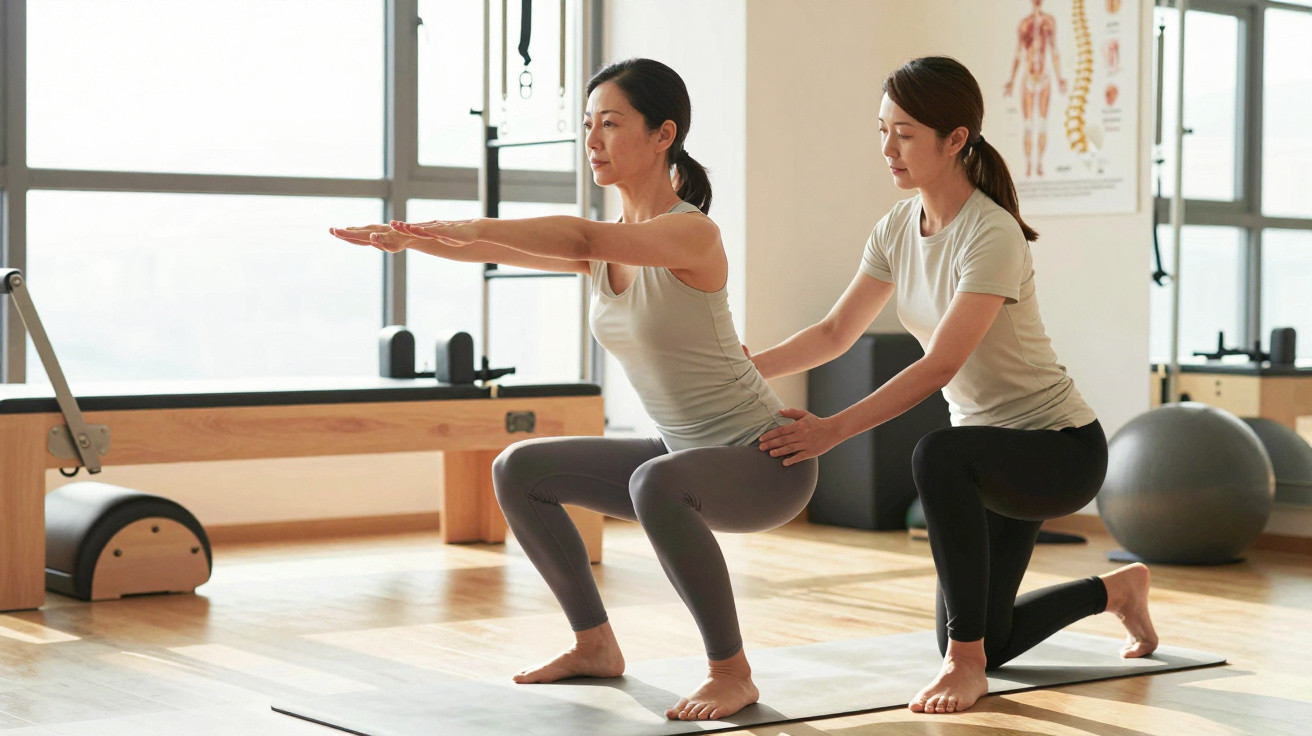
Many people over 50 suddenly notice how difficult it can become to get up from an armchair. Doctors refer to declining muscle strength, while physiotherapists speak of reduced mobility. This is why a fundamental Pilates movement is receiving increasing attention: the bodyweight squat. Performed properly, it can help slow age-related changes and preserve independence well into later life.
Why a simple squat matters so much for healthy ageing
Everyday life is full of movements that resemble a squat, often without us noticing: sitting down on a chair, getting back up, climbing out of a car, using the toilet or crouching in front of a low cupboard. At their core, these are all the same movement pattern.
The point at which older people often lose their independence is precisely this moment: being able to rise from a seated position under their own power.
Training this movement regularly strengthens not only the legs and glutes, but above all the ability to move without assistance. For people over 50, and especially those over 60, this becomes a crucial factor in maintaining health.
Functional exercise rather than high-performance sport
Many people associate fitness with sweaty workouts, heavy weights and complicated machines. Yet healthy ageing generally does not require any of these. Sports medicine specialists increasingly recommend what are known as functional exercises: movements that directly reflect everyday activities.
The bodyweight Pilates squat fits this category perfectly. It:
- replicates everyday actions such as sitting down and standing up
- works several muscle groups at once
- challenges balance and coordination
- supports a stable, joint-friendly movement pattern
In later life, what matters is no longer how much weight someone can lift in the gym, but whether they can manage stairs, shopping and household tasks without help.
How the Pilates squat works against common signs of ageing
As we get older, the body loses muscle mass, a process experts call sarcopenia. It often begins unnoticed from around the age of 40, then accelerates markedly from 60 onwards. Without targeted action, strength declines by a measurable amount each year.
Regular bodyweight squats address exactly these areas:
- Muscles: Strengthens the thighs, glutes, calves and deep core muscles.
- Joints: Encourages coordinated movement between the hips, knees and ankles.
- Balance: Trains the stabilising muscles and lowers the risk of falls.
- Bones: The compressive load stimulates bone metabolism, an important consideration where osteoporosis is a concern.
Anyone who can still rise cleanly from sitting several times in succession under their own power at 70 significantly reduces their risk of falls, hospital stays and needing care.
Joint alignment: why technique matters so much
Pilates instructors place great emphasis on correct body alignment. With a squat, the aim is not to go as low as possible or complete as many repetitions as possible, but to keep the joints stable throughout.
A well-executed squat ensures that:
- the hips, knees and ankles work in alignment
- force is distributed evenly through the legs and core
- the kneecaps do not collapse inwards
- the lower back does not overarch
Paying attention to these points reduces long-term strain on the joints and helps prevent overload pain, a frequent issue from midlife onwards.
How to perform the Pilates squat after 50, step by step
To get started, all you need is a stable stance and a little space. No equipment is required, although a yoga mat may make the exercise more comfortable.
Starting position
- Stand tall with your feet roughly hip-width apart and your toes pointing slightly forwards.
- Keep the pelvis neutral: avoid both a pronounced arch in the lower back and a rounded back.
- Lengthen the upper body upwards, relax the shoulders and allow the arms to hang by your sides.
- Gently draw the navel inwards to engage the deep core muscles.
Movement sequence with Pilates breathing
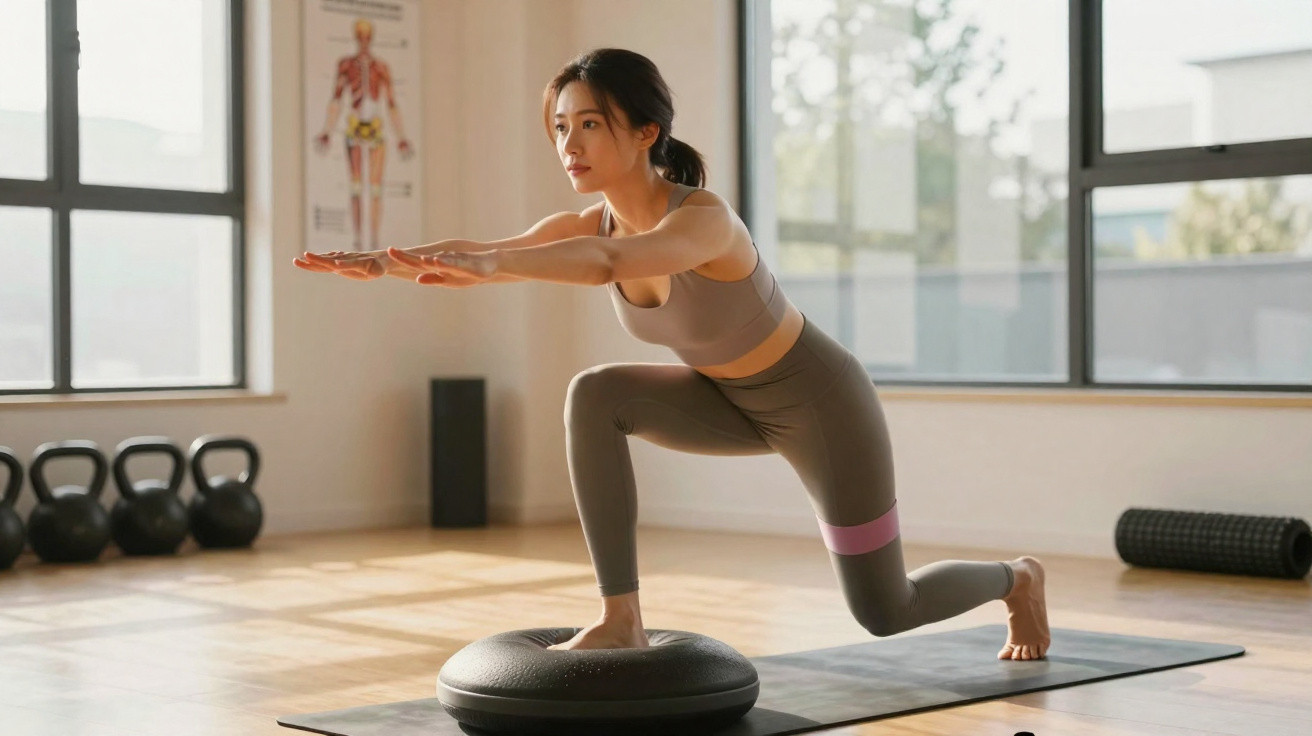
- Inhale: Breathe calmly into the sides of the ribcage as you bend the hips, knees and ankles.
- Deliberately send the glutes backwards, as though you were slowly sitting down on an imaginary chair.
- Keep the knees above the feet and do not allow them to fall inwards.
- If needed, raise the arms forwards to assist with balance.
- Exhale: Work from the centre of the body, press the feet firmly into the floor and return to standing.
- Let the arms relax back down by your sides and steady the body.
As a general guide, coaches recommend three sets of 12 to 15 repetitions, two to four times a week, depending on your fitness level.
Common errors that can harm the knees
People who have not exercised for years often slip automatically into squat patterns that place strain on the joints. Try to avoid the following:
- the knees collapsing inwards
- the heels lifting off the floor while bending
- the upper body tipping too far forwards
- movements becoming jerky and uncontrolled
- holding your breath instead of breathing steadily
If you experience sharp pain in the knee or back while exercising, the movement should be adapted, ideally with support from a physiotherapist or trainer if necessary.
Variations and support for different fitness levels
For beginners and people with discomfort
- Chair squat: Sit down on a sturdy chair and stand back up in a controlled way. Anyone who feels unsteady can use the backrest for support.
- Partial movement: Squat only halfway down. The range of motion can gradually increase over time.
- Wall support: Lightly place your hands against a wall to help maintain balance.
For more advanced exercisers
- Slower execution: Take three to four seconds for the lowering phase, then stand up powerfully; this increases the training stimulus.
- Pulsing repetitions: Make small up-and-down movements at the lowest point to challenge the muscles more intensely.
- Combined with arm exercises: Lift light dumbbells as you stand up to involve the upper body too.
How many sessions a week are enough for an anti-ageing effect?
For people who have been inactive for a long time, even a small amount can make a substantial difference. Investing a few minutes in squats three to four times a week provides a clear stimulus against muscle loss. Ideally, combine them with other short periods of activity, such as:
- brisk walking
- gentle endurance exercise such as cycling or swimming
- further Pilates exercises for the core and back
Consistency is what counts: it is better to practise for five to ten minutes each day over several months than to exhaust yourself completely once a week.
Why Pilates principles make the squat joint-friendly
The major benefit of the Pilates approach lies in deliberate control. It is not about speed, but movement quality. Learning to keep the pelvis, spine and shoulder girdle stable protects the back and distributes load evenly.
This can have noticeable benefits in daily life. Carrying shopping, gardening and climbing stairs all become easier when the deep core muscles contribute and the joints are guided correctly. Many older people report that this kind of training makes them feel “more secure in their own body”.
Other useful additions for healthy ageing
The squat provides a strong foundation, but it can be combined effectively with other activities. Pilates roll-ups for the spine, gentle planks for the core and bridge exercises for the glutes all complement the programme well. Yoga or gentle mobility training can help ensure that muscles remain not only strong, but supple too.
Anyone with pre-existing conditions such as osteoarthritis, heart problems or osteoporosis should ideally discuss their training briefly with a doctor. With professional guidance, the squat can almost always be adapted to remain safe, because the underlying principle stays the same: training a simple everyday movement so that it keeps us independent, strong and mobile for as long as possible.
Comments
No comments yet. Be the first to comment!
Leave a Comment