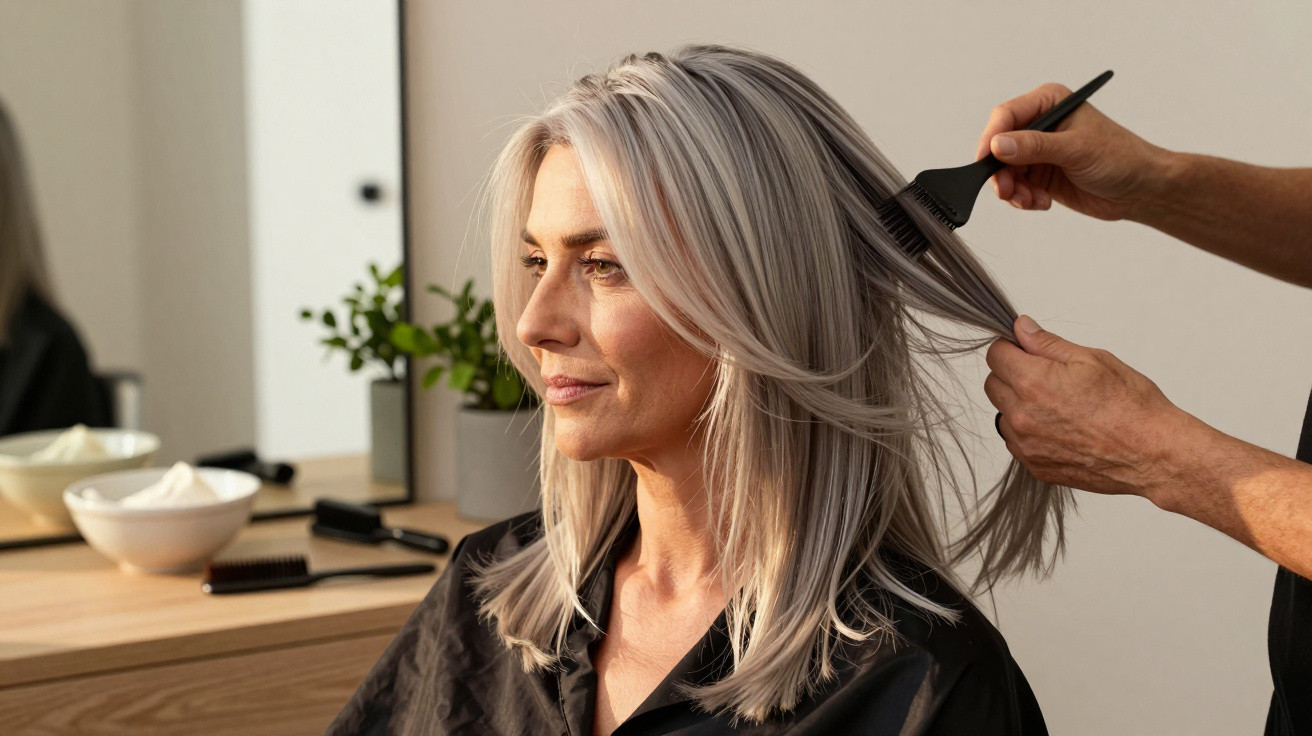
The first white hair often appears while you are stopped at traffic lights, reflected in a car window. You angle your head, draw the strand forwards and spot it: a fine silver thread that was not there a month ago. For a while, you play a game of hide-and-seek with your roots: box dye in the bathroom, salon visits wedged in between meetings, and selfies taken solely from “the good side”. Then, one day, you notice a woman on the Underground with an immaculate, glossy and intentional salt-and-pepper mane, and something changes. Perhaps the issue is not the grey itself, but how it is coming through. This is where a smart colour technique known as “High-Low” balayage can help. It is a colourist’s middle ground between relentless root touch-ups and becoming completely silver overnight: a subtle hair revolution.
Why salt-and-pepper hair suddenly looks…cool
Visit any salon now and you are likely to see a small yet noticeable group of clients: women in their 30s, 40s, 50s and beyond who are confidently wearing their natural salt-and-pepper hair. There are no scarves concealing roots and no panicked requests to “cover my gray!”. Instead, they are asking for gloss, dimension and movement. Colourists tend to share this almost confidentially: grey is no longer a problem; it is a canvas. What was once hurriedly concealed is now being sculpted, illuminated and framed. The change is about more than fashion: it is a different perspective on the persistent roots you see in the mirror.
Claire*, a Paris-based hairdresser specialising in grey transitions for ten years, witnesses this every week. One 47-year-old client came in with two centimetres of silver regrowth and uniformly dark-brown lengths. It was the classic “helmet” effect. She had had enough of monthly touch-ups and of worrying about humidity in her holiday photographs. They opted for a High-Low balayage, using brighter, cooler sections to mirror the natural white alongside deeper veils to blur the demarcation line. When she returned three months later, it was not for urgent coverage but simply for a gloss. “My colleagues keep asking me if I changed my haircut,” she laughed. “They don’t get that I just stopped fighting my hair.”
The impact of salt-and-pepper hair comes from contrast. White strands beside dark ones give immediate depth, almost as though the hair has its own highlights. Yet this contrast can also appear severe when grey is limited to the roots while the remainder is coloured in one flat shade. This is why conventional all-over colour can feel like a treadmill: the more coverage you apply, the more pronounced the regrowth becomes. High-Low balayage uses contrast rather than trying to remove it. It combines your natural grey with deliberately created light and shade, allowing your hair to tell a story rather than reveal a battle. The aim is not to look younger at any price, but to look like an improved version of yourself.
What “High-Low” balayage really does to your grey
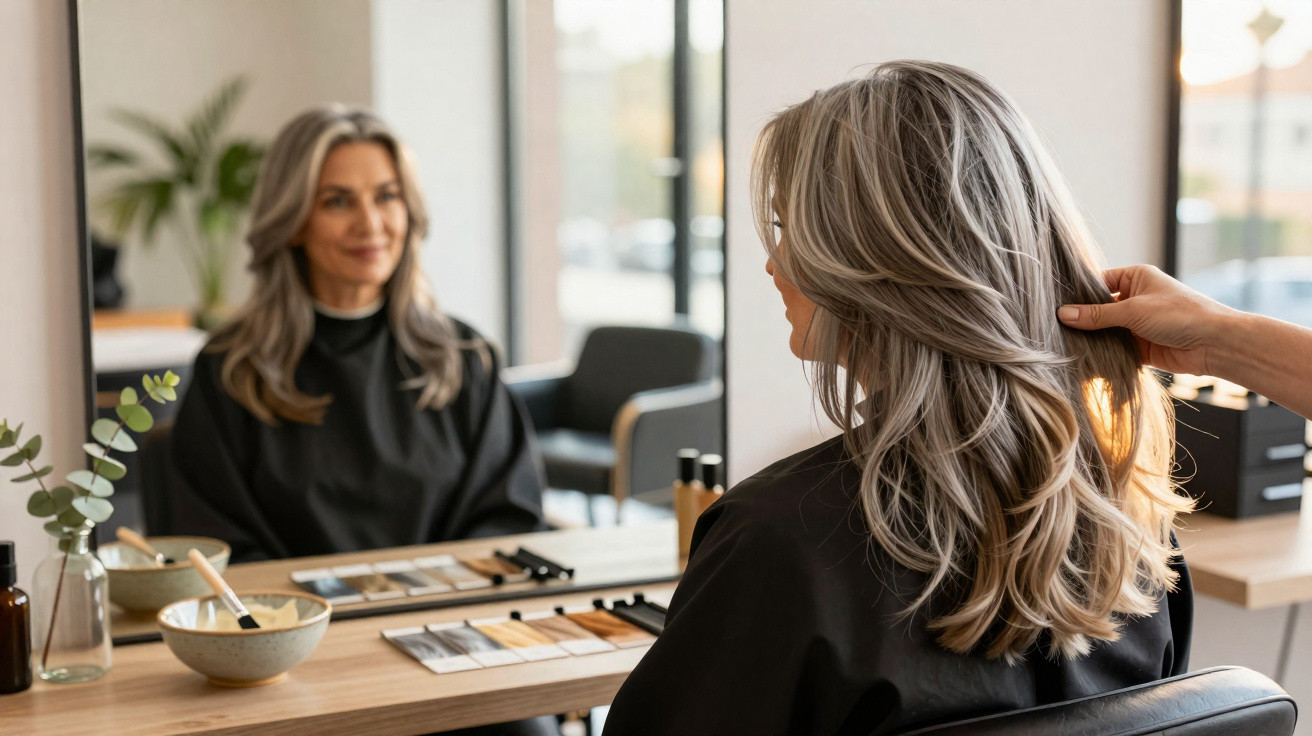
High-Low balayage does precisely what its name suggests: lighter and slightly darker shades are painted freehand throughout the hair to complement your existing salt-and-pepper pattern. The “high” sections echo white and silver strands, making them appear purposeful and almost radiant. The “low” sections bring gentle depth where your natural base seems overly flat or where grey is concentrated in one area. Rather than producing a single-colour helmet effect, it creates a gradient resembling sunlight filtering through the hair. To achieve this, the hairdresser assesses your root pattern: where grey is most concentrated, where it is scarcely visible and how it shapes your face. The brush then follows that individual map.
One of Claire’s favourite client experiences involved a 55-year-old lawyer facing a familiar dilemma: “If I stop dyeing, I’ll look old. If I continue, I look artificial.” Her temples were 70% gray, while the rest of her head was 30% gray, and she had coloured it dark brown for twenty years. They began with a particularly soft High-Low balayage: ultra-fine light strands around the face, with several cooler beige pieces distributed through the mid-lengths. Next came fine lowlights, slightly ashier than her base, to soften the stark demarcation. After the first appointment, her friends assumed that she had “gone blonder.” Six months on, her hair was largely natural, with only a few painted sections maintaining the blend. The grey had not vanished; it had finally gained company.
Technically, this approach gives you more time between appointments. As the roots grow out, they do not clash with one uniform shade because the surrounding hair already contains tonal variation. The eye sees an interplay of colours rather than a separating line. Salon appointments can move from every four weeks to every three or four months. Your hair is also exposed to less damage from repeated whole-head colouring. There is a further, quieter benefit: High-Low balayage allows you to discover how you feel about seeing more grey without the abrupt shock of stopping colour all at once. Gradually, you can let your natural salt and pepper take centre stage while balayage discreetly supports it in the background.
How to ask your hairdresser for the perfect salt-and-pepper “High-Low”
The most important step takes place before any colour is applied: the consultation. Arrive with clean, dry hair that shows its natural texture. Avoid slicked-back buns and heavy oils. Once seated, explain exactly what you want to leave behind: monthly root anxiety, lengths that are too dark and the “shoe polish” appearance along your parting. Then put it simply: “I want to blend my gray, not hide it. I heard about High-Low balayage. Can we create light and shade to work with my salt-and-pepper?” Bring photographs of hair where the grey is visible, rather than only standard blonde balayage references. A suitable colourist will immediately become engaged, indicating your temples and crown while explaining where lighter pieces should go and where your natural tone should remain untouched.
Many people arrive at an appointment quietly saying, “I’m going gray, fix it,” only to leave with hair that is darker than before. That is the trap. If a stylist pushes full coverage “to look younger,” trust your instincts. You are not a flaw to be erased. Another frequent error is requesting a dramatically blonder result in one sitting in the hope of disguising grey. This can easily leave hair dry, overprocessed and straw-like. Salt-and-pepper hair requires consideration, softness and room to breathe. The emotional aspect matters as well. We all know the moment when a mirror seems to judge rather than merely reflect. A skilled colourist will guide you through those feelings instead of steamrolling your uncertainty with one harsh dye application.
“High-Low balayage is like good makeup,” says Claire. “You don’t notice the technique, you just notice that the person looks rested, bright, and strangely at ease with themselves.” She adds: “Believe me, the sexiest thing is not zero gray. It’s hair that tells the truth softly.”
- Put together a “mood board” featuring 3–5 images of salt-and-pepper hair you love, rather than celebrity blondes.
- Before they begin, ask the stylist exactly where they intend to position the light and dark sections.
- Keep the first session conservative; additional light can always be added next time.
- Schedule a toner or gloss every 6–8 weeks to ensure grey remains bright rather than yellow.
- Keep this straightforward fact in mind: nobody genuinely maintains a 4-week root routine forever.
Living with salt-and-pepper: beyond the salon chair
After a High-Low balayage, everyday life shifts in a subtle way. Under unforgiving bathroom strip lighting, your hair appears gentler. In daylight, silver catches the sun instead of standing out against flat colour. You may wear it up less often, leave it loose over your shoulders during video calls and abandon the hurried effort to conceal your parting. Some mornings may still feel unfamiliar. On others, you may notice a fresh white streak and unexpectedly think, “That looks kind of cool.” This is the understated effect of a successful grey transition: it changes not only the colour of your hair, but also the narrative in your mind whenever you encounter a reflective surface.
| Key point | Detail | Value for the reader |
|---|---|---|
| High-Low balayage blends grey | A mixture of lighter and darker pieces is painted around natural salt-and-pepper hair | Less noticeable roots, a smoother transition and gentler contrast |
| Fewer root touch-ups | Salon appointments are spaced every 3–4 months rather than monthly | Saves time and money, while reducing stress about regrowth |
| Personalised placement | Colour follows your individual grey pattern and face shape | A more flattering, natural-looking result that still feels “like you” |














Comments
No comments yet. Be the first to comment!
Leave a Comment