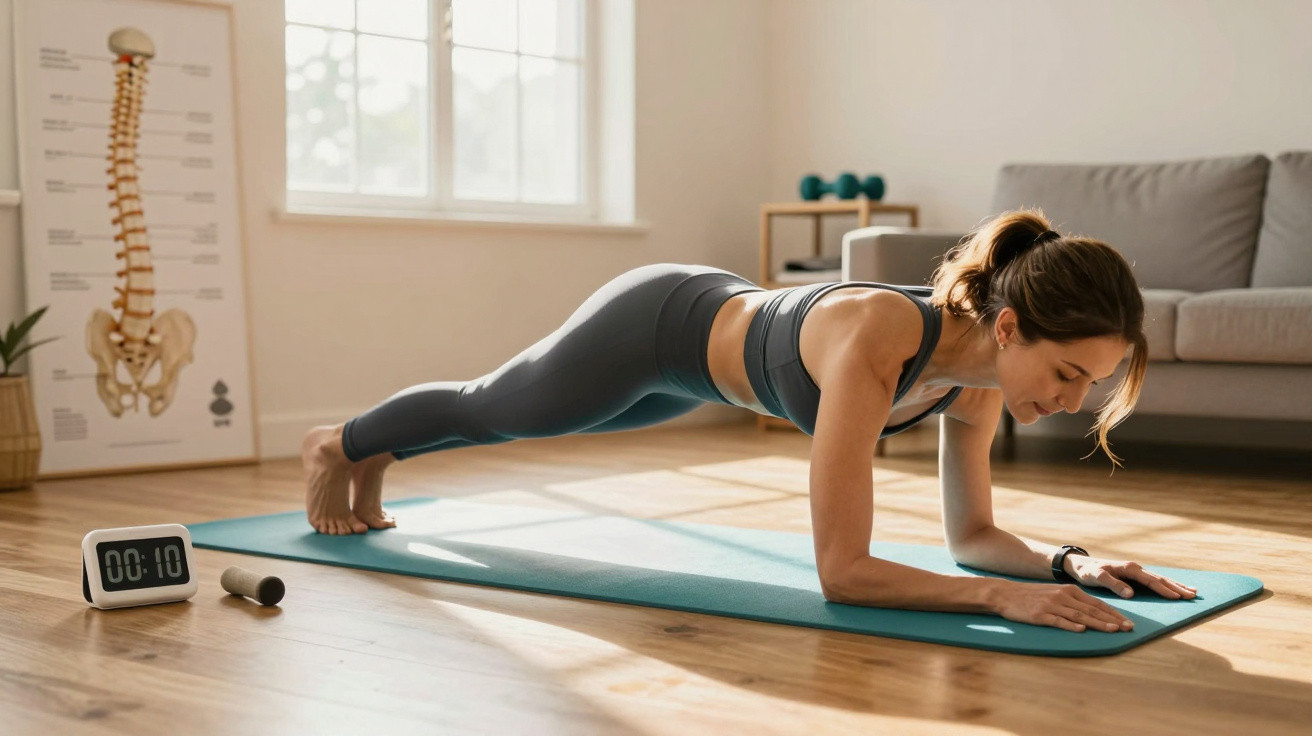
Many people time themselves in the plank – but particularly after 50, this can be exactly when the spine begins to object quietly.
The plank is widely seen as a miracle exercise for a toned stomach and a stable core. On social media, people compete to see who can hold the static position for the longest. Yet from around the age of 50, the balance between benefit and strain can change quickly – especially when the position is held for too long and form deteriorates.
Why the plank can become a trap after 50
As we age, the spine changes. It is not “broken”, but it becomes less tolerant of prolonged stress. Intervertebral discs lose water, while minor issues accumulated through decades of desk work, gardening or carrying heavy bags can become noticeable.
This is where an overly long plank may cause difficulties. The position places considerable pressure on the lumbar spine – which is not inherently dangerous while the deep core muscles are working correctly. However, when the hold becomes too long, abdominal tension decreases and the spine has to absorb the pressure on its own.
Beyond roughly 30 seconds, the effect reverses: the abdominal muscles do less work, while the intervertebral discs and ligaments take on increasingly more of the load.
A leading spinal researcher such as Stuart McGill considers lengthy holds anatomically questionable, particularly in later life and when repeated every day. Measurements suggest that, during a prolonged plank, pressure on the lower lumbar vertebrae can equal the weight of a well-stocked fridge.
The 30-second limit: what lies behind it
The key factor is how the deep core muscles work, especially the transverse abdominal muscle. These muscles act like an internal corset. They stabilise the spine by contracting intensely for a short period.
That is precisely the difficulty: this musculature is designed for powerful, relatively brief contractions. It can work at a high level for around 10 to 15 seconds. After that, the nervous system's protective mechanism intervenes, reducing intensity to avoid overload.
What happens next? The holding effort shifts increasingly to the shoulders, arms and, above all, passive structures such as ligaments and intervertebral discs. For many people, once they go beyond 30 seconds, the deep abdominal muscles can no longer stabilise the lumbar spine safely.
Common mistake: the pelvis drops
Anyone who holds the position for longer will recognise it: fatigue creeps in, shaking increases and the pelvis gradually drops by a few centimetres. Visually, it may not look too serious, but biomechanically it changes everything.
- Abdominal tension collapses.
- The lumbar spine moves into an excessive arch.
- Pressure on the lower spinal segments rises considerably.
- The exercise loses almost all of its training benefit for the deep core.
This is why, particularly after 50, a clear guideline is worthwhile: no more than 30 seconds at a time, and only for as long as technique remains completely stable. The aim is not to impress a stopwatch, but to protect the spine over the long term.
Better short and sharp: the 10-second microcycle approach
The good news is that nobody needs to give up the plank. Rather than battling the clock in one long hold, modern training approaches use short, highly controlled efforts over several rounds – known as microcycles.
Hold for less time, but with maximum quality – it does more for the stomach and is kinder to the spine.
How 10-second microcycles work
One possible protocol, particularly suitable for people over 50, is as follows:
- Move into a forearm plank: place the elbows beneath the shoulders, keep the forearms parallel and form a straight line from the back of the head to the heels.
- Tense everything as firmly as possible – draw the stomach flat inwards, squeeze the buttocks and actively engage the thighs. Imagine that someone is about to punch you in the stomach.
- Maintain this maximum tension for 10 seconds.
- Then place the knees on the floor and relax completely for 3 seconds.
- Repeat the cycle 5 to 6 times.
This gives you 50 to 60 seconds of intense core work without any single block exceeding the critical limit. During these short intervals, the nervous system permits much higher-quality muscular work, while the spine remains better protected.
| Approach | Typical duration | Strain on the spine | Training effect on the core |
|---|---|---|---|
| Long continuous plank | 60–120 seconds | increases sharply as fatigue builds | declines markedly towards the end |
| Microcycles | 5–6 × 10 seconds with breaks | remains moderate because form stays stable | consistently high because deep muscles stay active |
How often should people over 50 practise the plank?
For healthy, active people over 50, working specifically on core stability two to three times a week is usually enough. Planks performed in microcycles can be one part of this, but they should not be the only element.
Anyone who has spent a long time sitting, experiences recurring back pain or is just starting to exercise should begin more cautiously:
- Train 2 to 3 times per week rather than every day.
- Start with only 3 to 4 microcycles of 10 seconds.
- Take breaks of 3 to 5 seconds between cycles.
- Increase the workload only once the 10 seconds genuinely feel safe and stable.
If you already have back problems, it is sensible to consult a physiotherapist or sports medicine doctor before starting a new programme. Many complaints are linked not only to the abdominal muscles, but also to hip mobility and glute strength.
A quick five-minute routine for back and stomach
If everyday life leaves little time, you can still achieve a great deal by incorporating the plank into a short whole-body routine. This example is especially suitable for days spent in the office or working from home:
- 1 minute of mobility: gently circle the hips, roll the shoulders and perform light cat-cow movements on all fours.
- 2 minutes of plank microcycles: hold for 10 seconds, rest for 3 seconds, completing 5–6 repetitions depending on your fitness level.
- 2 × 30 seconds of side plank with the knee on the floor: a side forearm plank with the lower leg bent, activating the oblique abdominal muscles without overloading the lumbar spine.
- 1 minute of bird dog: from an all-fours position, alternately extend the opposite arm and leg, moving slowly and with control while keeping the spine stable.
This short session can fit into almost any day and trains not only the stomach, but the entire stabilising system that protects you from back pain in daily life.
How to recognise correct plank technique
When training after 50, you gain more from focusing on quality than on records. A few checkpoints can help you assess your own technique realistically:
- Look slightly downwards, keeping the neck in line with the spine.
- Actively push the shoulders away from the floor without lifting them towards the ears.
- Do not allow the ribcage to sag; the upper body should form a stable line.
- Draw the stomach inwards and upwards, as though the waistband of your trousers were becoming tighter.
- Keep the pelvis aligned with the shoulders and heels, without sinking into an excessive arch.
As soon as the pelvis visibly drops or the lower back starts to pull, the set is over – completely regardless of the stopwatch.
For people who used to do a lot of sport, this can be a mental adjustment: determination must not decide when to stop; technique should.
Risks of extreme planks and how they differ from everyday training
Record attempts involving several hours in a plank may look spectacular and reliably make headlines. They offer little to emulate for the average back after 50. Even record holders have experienced nerve irritation and lengthy rehabilitation periods – a high price for a photograph in the media.
Everyday training has a different goal: you should be able to get out of the car more easily, carry the shopping and walk upstairs without your back complaining every time. For this, it is entirely sufficient to challenge the core muscles regularly, deliberately and in manageable amounts.
Why the core is more than just the stomach
When planks are discussed, attention often centres solely on the stomach. In reality, the core is an entire network of muscles: deep back extensors, the pelvic floor, oblique abdominals, glutes and hip flexors. Together, they protect the spine during everyday movement.
Anyone who only performs planks and neglects everything else misses a great deal of potential. Useful additions include exercises such as:
- Bridging (lifting the pelvis while lying on your back) for the glutes and posterior chain
- Kneeling side plank variations for the oblique abdominal muscles
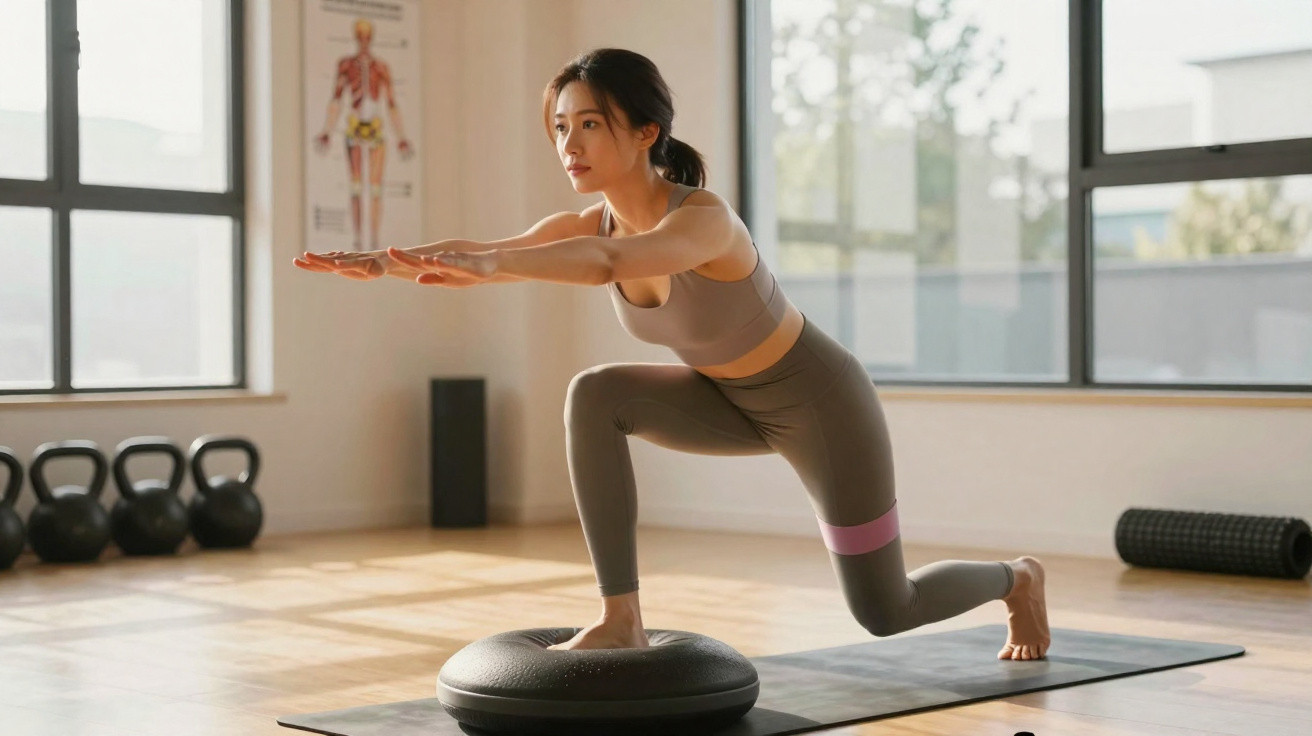
- Bodyweight squats for the legs and core
- Standing rotations with a mini band to make twisting movements safer
This combination of stability, strength and mobility pays off especially in the second half of life. Combining short, high-quality planks with these full-body exercises builds a robust protective shield for the spine – without marathon-length forearm planks.








Comments
No comments yet. Be the first to comment!
Leave a Comment