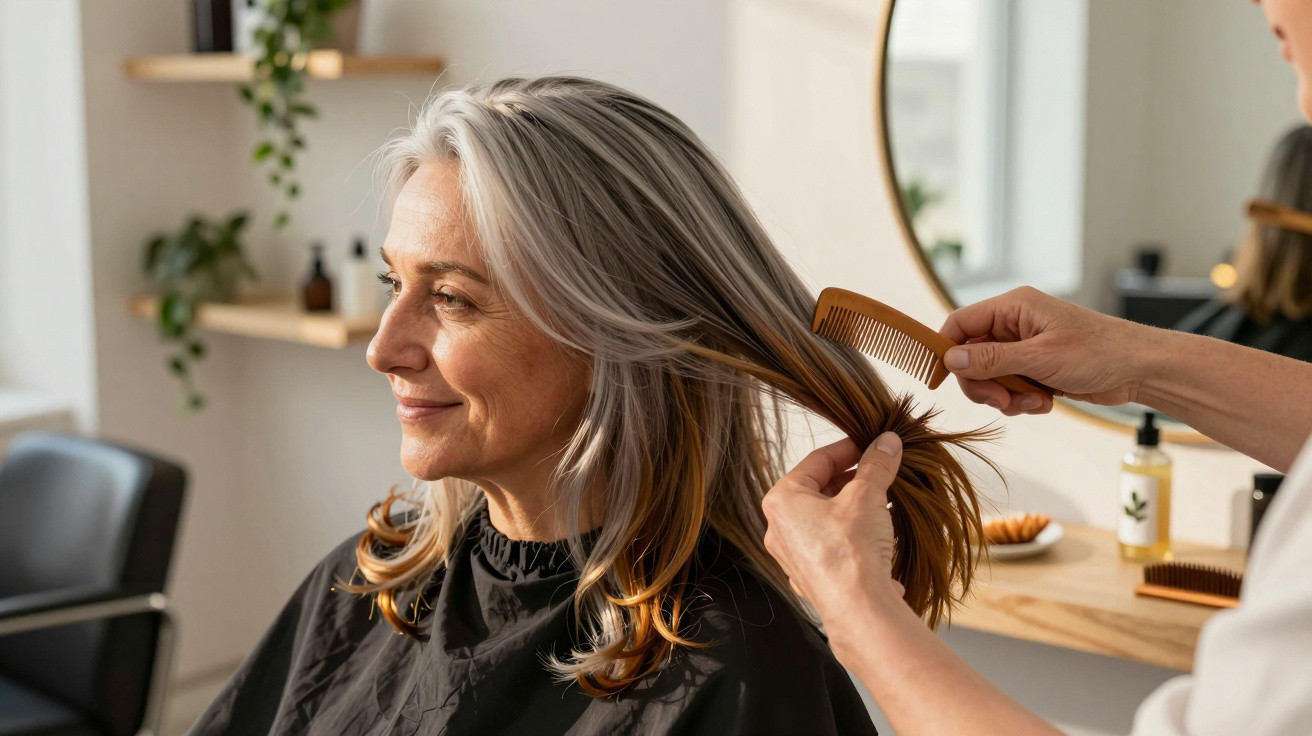
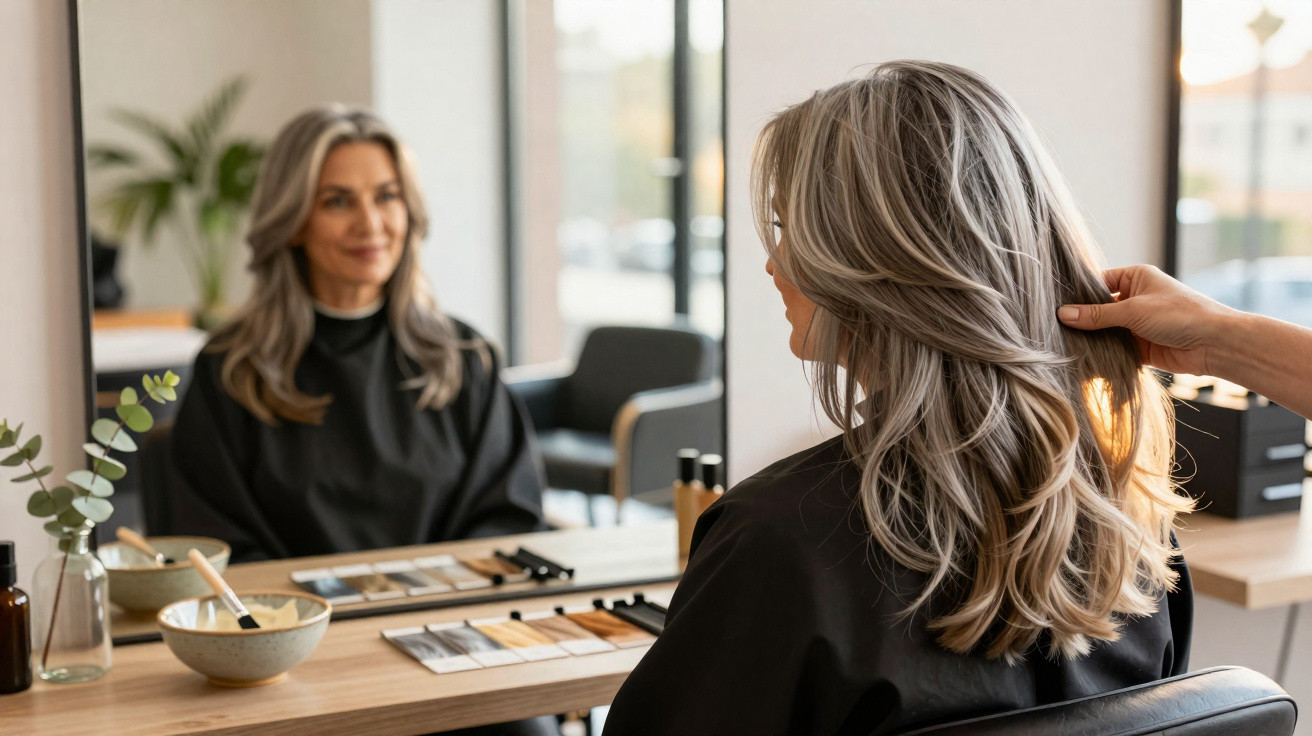
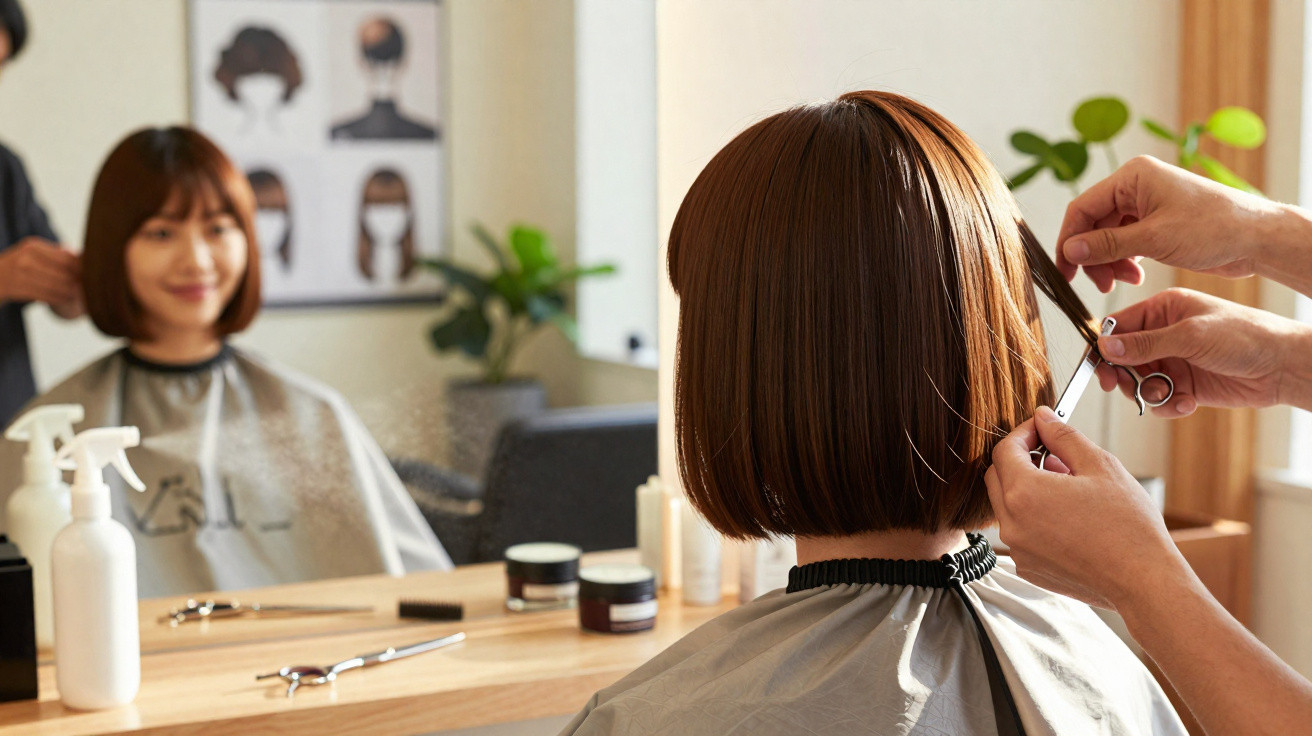
The hairdresser made a quiet clicking sound as she picked up a section by my temple. “You see this?” she asked, angling the mirror so I could see my expression. Fine silver strands caught the fluorescent light. Nothing striking, just enough to suggest, “Time’s moving.” The salon smelled of peroxide, while hairdryers droned in the background. On my left, a teenager was having their hair taken platinum. On my right, a woman in her 50s requested “the usual dark brown, no grey showing, please”.
My stylist smiled. “You know you don’t have to dye everything anymore, right? There’s a new way to wear it. Softer. Younger. Less… fake.”
It felt like an odd, almost defiant idea.
Could allowing a little grey to show really make you appear fresher?
Grey hair, but softer: how the new trend is changing the rules
Take a close look as you walk through any major city and you will start to notice it. A woman in her 40s with a sun-kissed bob and a delicate haze of blended silver at the roots. A man in his 50s whose salt-and-pepper temples look deliberate rather than uncared for. Flat, one-dimensional home colour is gradually giving way to a subtler approach.
Rather than treating grey hair as something to conceal, this trend incorporates it. The focus is on glosses, toners and “grey-blending”, not all-over coverage. The finish can often appear more youthful than a dense, opaque dye application. Unexpectedly, visible grey can now communicate confidence rather than “I gave up”.
Colourists tend to tell the same story. Clients in their 30s, 40s and 50s arrive saying: “I’m tired of chasing my roots every three weeks.” One Paris colourist I spoke to even calls it the “roots fatigue revolution”.
She described a 47-year-old client who had coloured her hair jet black since her late twenties. In the salon lighting, the contrast against her fair skin looked severe. Eventually, she burst into tears and said, “I don’t recognise myself. I look like I’m trying too hard.” They moved to a gentle grey-blending method, adding warm chocolate lowlights and lighter face-framing pieces. People stopped asking whether she was tired. Her husband believed she had done “something to her skin”. She had not. Only her hair had changed.
There is a straightforward visual explanation. A solid dark block of colour next to a face that is naturally ageing creates a stark outline, making every shadow and fine line more visible. Dimension in the hair, lighter sections and a small amount of visible grey create a gentler overall effect.
It is much like lighting. Strong overhead lights reveal every detail, whereas a warm lamp softens the edges and feels more forgiving. Grey-blending can have that effect on your features. The hair looks less like a mask and more like part of your actual life story. Silver strands stop looking like “failures to cover” and instead become part of the texture.
Goodbye full dyes: new ways to cover and embrace grey
The technique many colourists now favour is partial coverage: not everything or nothing. Instead of colouring every grey strand, they lighten selected areas. This may be around the face, at the crown or through the lengths where the eye naturally falls.
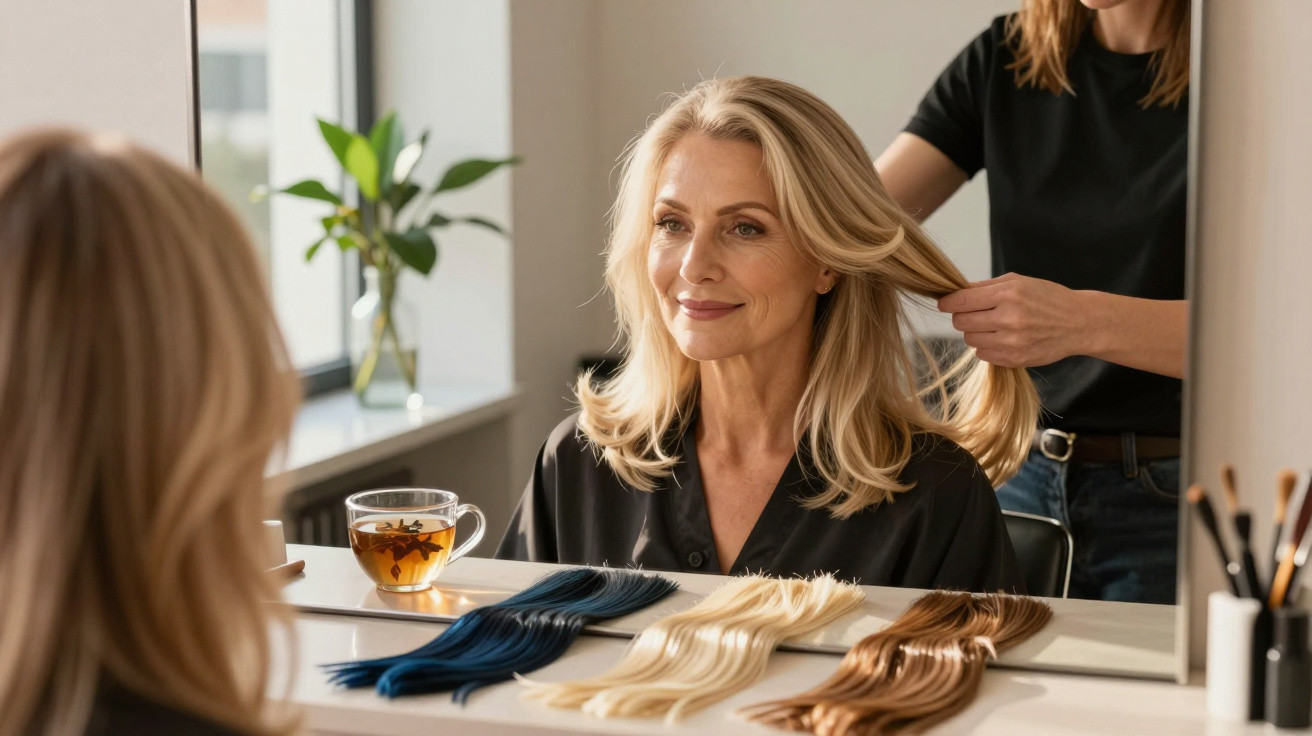
They may apply a demi-permanent gloss to reduce the stark difference between dark hair and white roots. Alternatively, they might add extremely fine highlights that merge with the greys, making it difficult to see where one ends and the other begins. The grey remains, but the eye no longer fixes on an abrupt line. Instead of “fresh dye, aging face”, the result suggests “youthful hair with nuance”.
A familiar journey often goes like this. At 35, you see your first grey. At 38, you choose traditional colour: one solid shade that matches your natural tone. At 42, the regrowth line becomes your personal enemy. You make urgent bookings before holidays, weddings or any occasion involving photographs. We have all experienced that moment of tilting our head towards the bathroom mirror and finding a crisp white stripe dividing the hair in two.
Then you miss an appointment one day. Perhaps because of life, work, children or money. You arrive at the salon with three centimetres of grey growth. Rather than criticising you, a good colourist will now say: “We can use this. Let’s blend, not erase.”
Technically, the movement is also linked to scalp health and long-term hair beauty. Repeated full-head permanent colour can dry the hair shaft, irritate the scalp and gradually reduce its natural shine. Each cycle of complete coverage leaves strong pigments on every strand, whether it is grey or not. Your hair ends up paying the price for a few stubborn roots.
Moving towards grey-blending, lowlights or glosses means the hair receives less of an onslaught. The natural pigment still present in non-grey hair can continue to reflect light, and the cuticle layer undergoes less stress. Long story short: you get hair that moves, shines and catches sunlight, rather than a weighty curtain of colour that looks “fresh” for only around ten days.
Moving to grey-blending without panicking
If you have coloured your hair for years, the prospect of reintroducing grey can be intimidating. The most secure approach is to transition slowly. At one appointment, state clearly: “I want to stop full coverage and move toward blending my grey.” Do not trail off when you say it. Deliver it as confidently as you would order precisely what you want from a menu.
Request a softer base shade that is one or two shades lighter than your existing dye, then add ultra-fine highlights or babylights where your grey is most obvious. This immediately softens the impact of regrowth. As your roots grow, they emerge as a blend of shades rather than a solid white section forcing its way through a dark barrier.
The earliest months can be the most emotionally challenging. You may catch your reflection in a shop window and wonder, “Is this really me?” Your mind has become accustomed to uniform colour, so allow it time to adapt. You are not letting yourself go; you are allowing yourself some room to breathe.
Try not to panic-dye at home as soon as you notice a patch of silver along your parting. Fast box-colour solutions often bring another issue: uneven bands of colour and dry, brittle ends. Realistically, nobody follows this perfectly every day, but leaving more time between washes, using purple or blue shampoo to tackle brassiness, and covering roots with temporary sprays for major events can prevent a relapse.
“Once my clients stop fighting every single grey and start working with them, their whole face relaxes,” says London colourist Marta R. “They don’t look older. They look like themselves, minus the stress.”
Test first in small zones
Begin by blending grey at the nape or in the under-layers before altering the whole top section. It is easy to correct if you dislike the result.Use semi-permanent colour instead of permanent
These formulas fade progressively, preventing a razor-sharp root line as the grey grows through.Play with tone, not just coverage
Warm caramel or cool ash near the face may suit your complexion better than your original natural shade ever did.Schedule “transition months”
Allow 6–12 months for the full shift from overall colour to blended grey. This makes each awkward stage part of the plan.Support the texture, not just the colour
Grey hair is commonly drier. Moisturising masks, lightweight oils and gentle styling help it stay soft and reflective, which always appears more youthful.
What looking “younger” means when you stop hiding every grey
Spend time with people who have made this change and an unexpected theme emerges. They rarely speak mainly about the colour. Instead, they discuss energy: feeling less anxious whenever they wash their hair, and finally recognising themselves from morning until evening rather than worrying about the next half-centimetre of growth.
The new grey hair trend is not a statement against beauty. It is a shift in what people believe deserves attention: smooth, healthy texture; light moving over the hair rather than sitting on its surface; a shade that works with the skin instead of competing with it; and a style that still looks good three weeks after a salon appointment, not just on day one. Quietly, it also brings a degree of peace with the calendar.
The irony is clear: many people look younger as soon as they stop trying to appear exactly the age they were at 25. The years have not vanished, but the strain has. That is the real glow now appearing all over our feeds and on the street.
| Key point | Detail | Value for the reader |
|---|---|---|
| Shift from full dye to grey-blending | Use highlights, lowlights and glosses instead of uniform colour | Softer regrowth and a more natural, youthful look |
| Protect hair and scalp | Reduce permanent dyes, favour demi or semi-permanent formulas | Healthier, shinier hair that ages better |
| Plan a transition period | Allow 6–12 months with gradual adjustments | Less stress, no drastic “before/after” shock |
FAQ:
- Question 1 Does letting some grey show automatically make me look older?
- Question 2 How often will I need salon visits with grey-blending compared to full dyes?
- Question 3 Can I switch from black box dye to this new trend without damaging my hair?
- Question 4 Will this work on curly or textured hair, or only on straight hair?
- Question 5 What can I do at home to keep my blended grey looking fresh between appointments?




Comments
No comments yet. Be the first to comment!
Leave a Comment