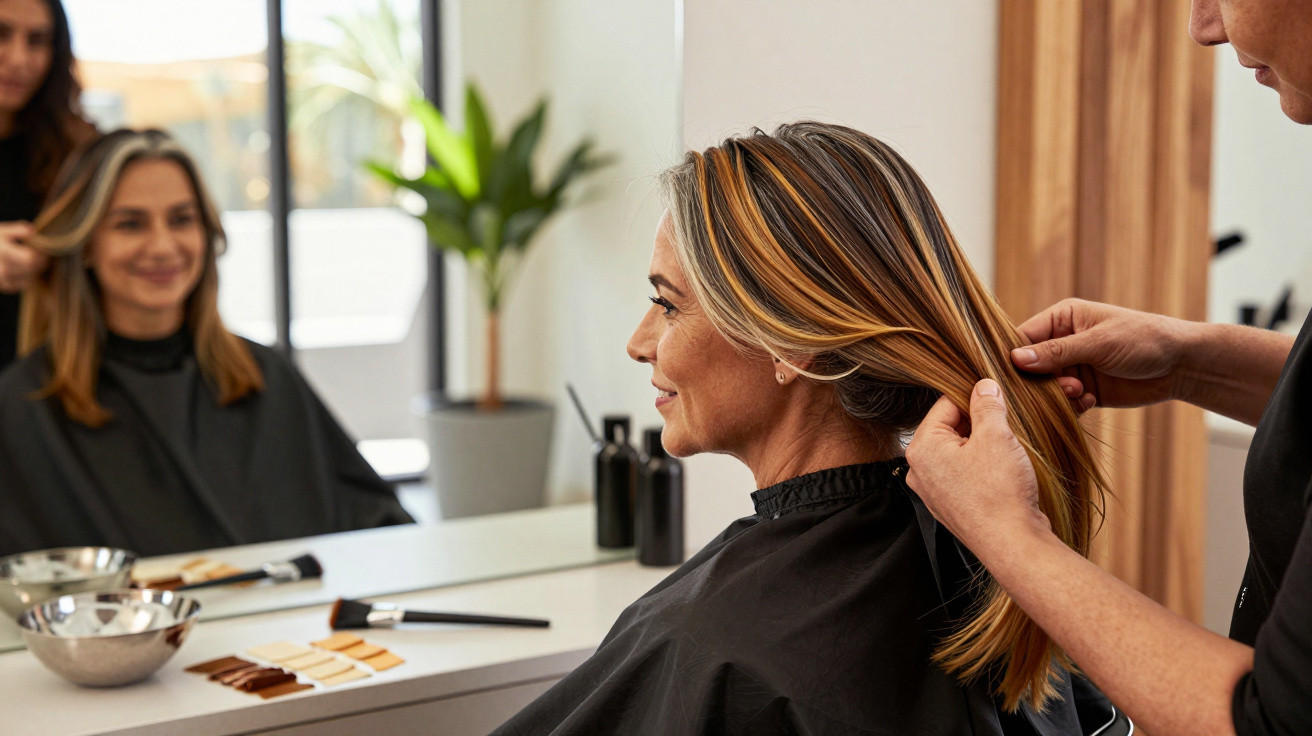
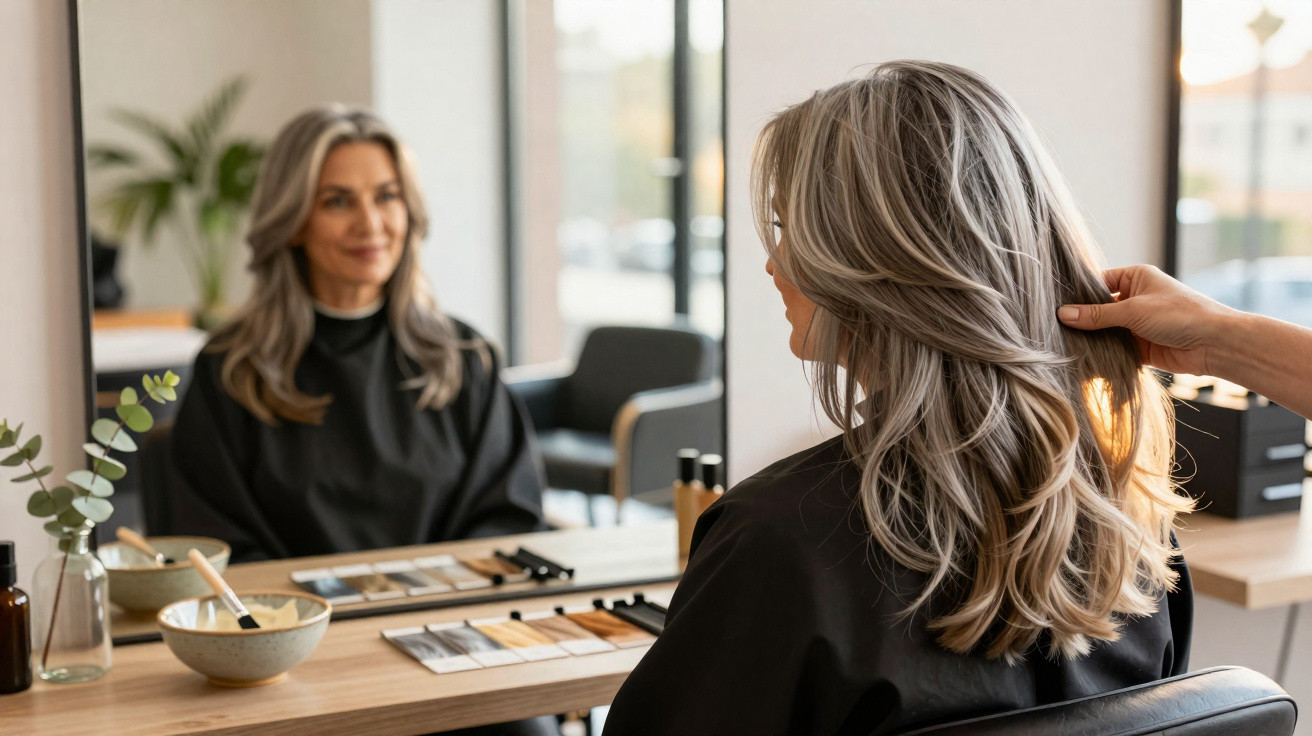
The woman in the salon chair lets out a sigh as her colourist raises a section of hair threaded with silver. “If we keep doing balayage every three months, you’re going to go crazy,” he laughs. In the mirror, the same familiar struggle appears: warm honey-coloured lengths, roots dusted with persistent grey, and the obvious line where her previous highlighting appointment is beginning to grow out. She loves the lightness balayage creates, yet she is exhausted by treating regrowth like an overdue payment. Her stylist suggests a different approach: “Let’s melt it all instead of hiding it.”
He explains “melting”, a colouring method that does not battle grey so much as soften it into the rest of the hair. Rather than harsh lines or striped contrast, it creates a gentle gradient that makes every strand feel connected.
The finished effect is entirely different from conventional highlights.
From sharp lines to gentle fades: why balayage is falling behind
Step into a fashionable salon now and the same phrase is often heard at the backwash: “More melting, less balayage.” Colourists are subtly changing their approach, moving away from the Instagram-ready blonde ribbons that dominated the past decade. In their place, they are merging shades so completely that it becomes difficult to see exactly where the grey begins or finishes. Hair no longer shouts “fresh colour”; it suggests “healthy, natural and lived-in”.
This is a quiet shift towards less contrast and more subtlety.
A Paris colourist told me about a client in her late forties who arrived almost in tears. She had chosen balayage for years. Initially, it was enjoyable, but eventually it felt restrictive. Her grey hair was appearing more quickly, her highlighted lengths were becoming paler, and the divide between the two seemed to grow twice as large every month. She was paying to look polished, only to feel dissatisfied again after six weeks.
That appointment marked a change to melting. They used three shades rather than one: a slightly darker root, a soft middle tone and lighter accents only through the ends. When the client returned two months later, she did not need anything “fixed” - she simply wanted to go a little cooler.
Balayage was created to bring dimension and a sun-kissed finish, not to disguise grey regrowth over the long term. The contrast that looks striking on a 25-year-old can produce pronounced boundaries on a scalp where silver is spreading. Melting reverses that principle. The colourist intentionally lowers root contrast, blending darker and lighter shades together so grey strands become part of a gradient. As they grow out, they merge with the existing pattern rather than slicing through it as a bright white band.
The outcome is less “just left the salon” and more “this is naturally how my hair grows”.
How colour melting works with grey hair
At its heart, melting means treating the hair as three areas rather than applying a single shade from roots to ends. The colourist begins by lightly shading the roots with a tone close to your natural colour, sometimes only half a level deeper. This then moves into a softer colour through the mid-lengths, made slightly warmer or cooler according to your skin tone. The ends hold the palest and most luminous shade, as though a holiday breeze has naturally lightened them.
The transitions between these areas are softened with a brush and, at times, the fingers. There are no foils arranged in a precise pattern and no severe dividing lines - only a gradual fade.
The subtlety is especially effective where grey hair emerges. Rather than attempting to cover every white strand, the colourist allows some of them to play a role in the gradient. Some greys receive a light tint, others are softened with a sheer gloss, while a few remain untouched. For a brunette, for instance, roots may be smoky brown, the mid-lengths hazelnut and the ends tawny or caramel. The natural grey threads then act like tiny highlights within the soft backdrop, similar to light reflecting on silk.
From a distance, the eye cannot settle on a distinct grey root line. The overall appearance is simply softly blended.
From a technical perspective, melting requires a different way of thinking from balayage. Rather than aiming for maximum contrast and face-framing “money pieces”, the colourist prioritises movement and flow. They hold the brush vertically, feather the colour and frequently use semi-permanent dyes or acidic glosses to build transparency. That transparency matters: grey does not disappear, but it becomes diffused. Hair gains dimension without the zebra-like effect that some highlights can create on ageing hair.
Let’s be honest: hardly anyone wants to spend every four weeks in a salon chair simply to cover a stubborn silver stripe. Melting lengthens the time between appointments because regrowth becomes almost… uninteresting.
Getting a colour melt: practical advice before booking
Before requesting melting, the first step is to show your reality rather than only a Pinterest image. That means revealing your true root shade, the percentage of grey you have and how your hair behaves when left alone. Take a daylight photograph a few days before your appointment, with visible roots and no filters. This is the “canvas” your colourist needs.
At the salon, be specific: explain that you want gentle regrowth, blurred transitions and colour that wears well between visits. Refer to a “colour melt” or “root melt”, and make clear that you do not want every grey hair aggressively covered.
A common mistake is requesting melting while privately expecting complete camouflage. This can lead to disappointment because melting does not eliminate grey; it changes how the eye sees it. If you expect an entirely uniform, opaque finish, you may notice a few silver strands that are “still showing”, when in fact those strands are exactly what make the result look natural and expensive.
We have all experienced that moment of leaning towards the mirror to search for the smallest white strand as though it represents a personal failure. Melting asks for a change in perspective: move from “zero grey allowed” to “grey, but in a beautiful context”. It is kinder to the hair, the budget and, honestly, the nerves.
One London colorist told me, “The goal is not to deny your gray, but to stage it so you barely notice it between two coffees.” That sentence stayed with me. It’s the opposite of those rigid, single-tone dyes that look flat after two shampoos.
- Ask for a soft root melt: A marginally deeper shade at the roots blends grey and reduces the “helmet” effect caused by full coverage.
- Choose semi-permanent colour or gloss through the lengths: This means less damage, more shine and a sheer veil that allows natural variation to show.
- Space highlights thoughtfully: A handful of brighter ends or face-framing sections add light without making every grey strand look more contrasting.
- Discuss maintenance honestly: Explain how often you genuinely want to visit, rather than saying what you believe your colourist wants to hear.
- Protect your melt at home: Use sulphate-free shampoo, rinse with cool water and occasionally use purple or blue shampoo if your colour tends to become brassy.
A different relationship with grey: from conflict to choreography
Melting changes more than the appearance of hair; it can also quietly alter how many people feel about ageing. Instead of waking each morning and inspecting your parting for “damage”, you begin to notice something different: movement, depth and shine, even with silver strands included. The mirror stops feeling like a battleground and starts to feel like a negotiation. You accept that more white hairs will appear, but they enter a landscape that already has space for them.
Some clients eventually go lighter or cooler, using melting as a transition towards embracing increasing amounts of their natural grey without an extreme “big chop” or a year of awkward grow-out.
| Key point | Detail | Value for the reader |
|---|---|---|
| Melting softens regrowth | A gentle gradient runs from deeper roots to lighter ends, created with translucent colour | Grey is less noticeable between appointments, reducing “emergency” salon visits |
| Works with, rather than against, grey | Some strands are tinted, some are glossed and others stay natural within a tonal harmony | Hair appears modern and dimensional instead of flat or over-processed |
| A personalised maintenance rhythm | The technique can be adapted to your budget, lifestyle and tolerance for regrowth | A realistic, sustainable colour routine that suits your life |












Comments
No comments yet. Be the first to comment!
Leave a Comment