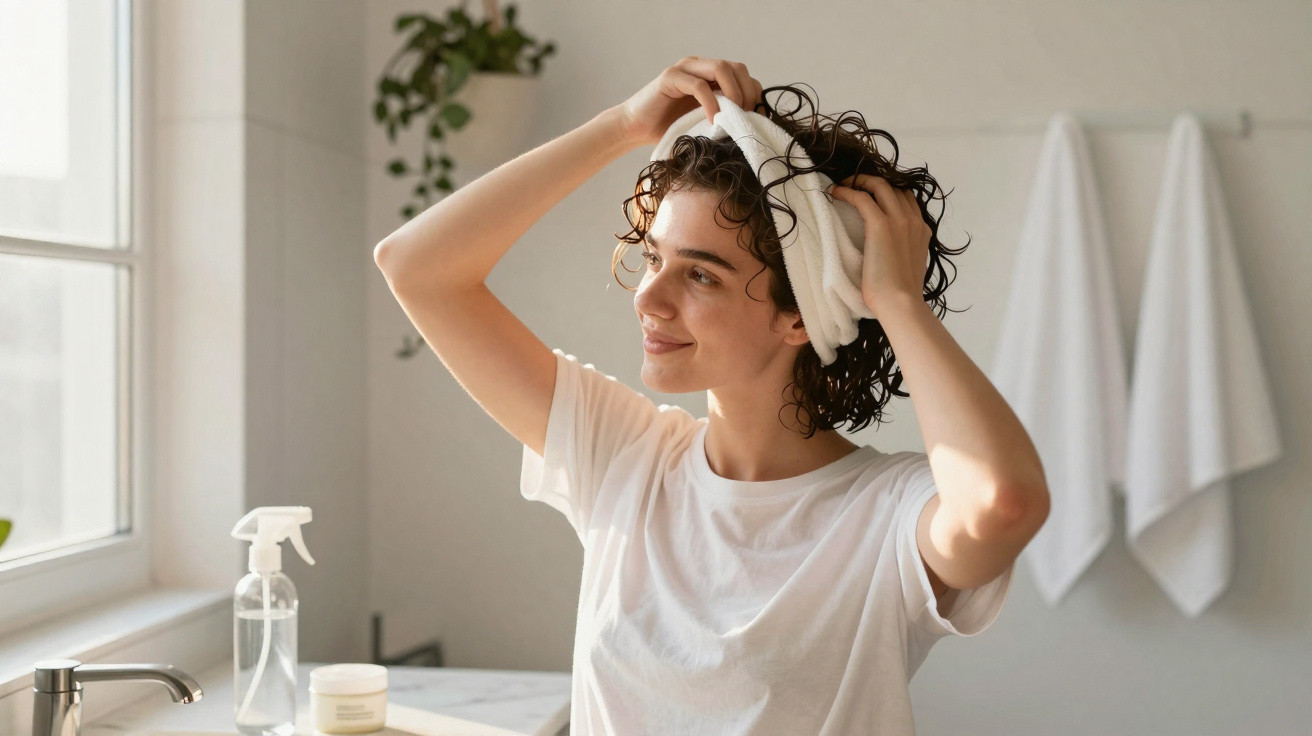
The “it looked cute when it was wet” effect. Her cropped bob had dried into a frizzy cloud, with stray waves competing for space and ends jutting out like little static-filled wires. She raked her fingers through it, only worsening the problem, then sighed: “I don’t get it. I just let it air-dry. Isn’t that supposed to be healthy?” The stylist smiled, pulled an old cotton t-shirt from a drawer and began to explain a curious technique called “plopping”. Ten minutes later, the very same hair appeared softer, fuller and almost as though it had been styled with a diffuser. There was no crunchy gel and no heated tool involved: only fabric and gravity. The answer was not in the products, but in what happened between wet and dry.
Why air-drying makes short hair frizzy
Short hair dries quickly, which can be both helpful and frustrating. Water has little time to remain within the strands, meaning the whole drying process takes place at speed. The cuticles lift, moisture disappears and the hair effectively sets in whichever shape it was given by the last draught or bit of towel friction. The result can be odd bends at the nape alongside straighter pieces around the front. From the outside, it simply reads as frizz.
With a short cut, there is nowhere for these details to disappear. You do not have long, weighty lengths to pull the hair down or refine its outline. Every small section behaves independently, responding to the humidity indoors, the position you slept in or the hand that keeps touching your fringe. So, when you leave the shower and decide to “let it be”, you are really allowing hundreds of fine strands to bargain with the air. They seldom reach a peaceful agreement.
Imagine hair as a fabric. Long hair resembles a heavy curtain: even if it is slightly fluffy, it tends to fall into place. Short hair is closer to a lightweight linen napkin, which creases, flicks and retains every fold. When it dries without any guidance, the hair expands unevenly. Some cuticles settle flat while others remain raised. Once the hair is dry, those lifted cuticles scatter light and snag against nearby strands. That visual disorder is what we call frizz. You are not “doing it wrong”; your hair is simply responding to water and physics.
How t-shirt plopping reshapes short-hair texture
The t-shirt plopping method brings gentle structure to that unruly drying stage. Rather than allowing water to run downwards and stretch curls or waves until they become limp, a t-shirt gathers the hair loosely at the top of the head. The roots are raised, the mid-lengths form a curve and the ends sit neatly instead of pointing in every direction. For short hair, where every centimetre matters, this can alter the entire result.
The technique itself is simple. Place a soft cotton t-shirt flat across a bed or chair, with the neckline facing you. Bend forwards and allow your short hair to drop down, then “lower” it onto the middle of the shirt so that its natural curves and bends gather upwards. Next, bring the fabric around your head and tie it loosely at the sides or back. Do not twist it or create a tight turban. The t-shirt should simply cradle the shape you have made as the cotton quietly absorbs excess water.
Inside that bundle, several useful things are happening. A t-shirt has a smoother surface than an ordinary towel, so it is less likely to disturb the cuticle. It removes enough water for styling products to hold, without taking away all the hair’s moisture. Meanwhile, your natural pattern - whether that is a wave, curl or subtle bend - remains supported as it sets. When you take the shirt off, the strands have dried with some order. There is less uneven swelling, fewer raised cuticles and a finish that appears deliberate rather than accidental. It may feel like a shortcut, but it is simply a more intelligent way to dry hair.
Step-by-step t-shirt plopping for short hair
Begin immediately after washing, while your hair is still very wet but no longer dripping everywhere. Press out surplus water carefully with your hands, then blot with the same t-shirt rather than rubbing. Apply your styling product while the hair remains damp: this might be a lightweight cream, flexible gel or curl lotion if your hair has waves. Smooth it in using flat palms instead of combing through with your fingers. That alone reduces the chance of frizz before you even begin plopping.
Spread the t-shirt flat, then tip your head forwards. Allow your hair to “fall” into the fabric’s centre, much as though you were placing it on a pillow. Use the lower part of the shirt to cup the back of your head, bring both sides upwards, and tie them above or behind your head. It does not need to look elegant. It only needs to sit softly and securely, without tugging at your hairline. For short hair, leave it in place for 10 to 20 minutes; a longer session may trap too much moisture.
Once you unwrap it, try not to start adjusting everything. Let the hair settle where it naturally falls. If a section needs changing, gently pinch and lift it with your fingertips rather than brushing it. Leave it to finish air-drying, or use a diffuser on low heat if time is short. Let’s be honest: nobody really does this every day. However, on the days when you do, the improvement in softness and definition can be striking.
Common plopping mistakes and realistic ways to avoid them
One of the main problems when plopping short hair is choosing unsuitable fabric. A fluffy towel or thick microfibre turban may appear comforting, but it can be too absorbent or too abrasive. It draws out water too fast and disrupts the cuticle. Choose an old, smooth cotton t-shirt or a lightweight cotton scarf instead. A thinner fabric creates a gentler, more controlled dry that protects your natural texture.
Wrapping too tightly is another familiar error. If the t-shirt is pulled around your head like a bandage, the hair beneath it becomes flat and bent at the roots. That is how strange dents and “helmet hair” happen. The wrap should feel like a hood resting over your head, not compression wear. With short hairstyles, even slight tension can alter the parting and flatten volume. If you notice pressure on your scalp, loosen it and start again. Your hair will settle better, and your head will appreciate it too.
Timing matters as well. Keeping your hair plopped throughout an entire Netflix marathon may sound productive, but it can have the opposite effect. The hair may absorb too much product or stay damp for too long, which can create flat patches or leave it feeling slightly overloaded with product.
“The sweet spot for short hair is usually that 10–20 minute window,” notes one London stylist I spoke to. “Long enough for the pattern to set, short enough to keep bounce and movement.”
To make the method easy to remember, use this brief checklist:
- Choose a thin, smooth cotton t-shirt instead of a bulky towel.
- Put product onto very damp hair, rather than hair that is already half dry.
- Keep the wrap loose so the roots retain lift and avoid dents.
- Plop for 10–20 minutes, then allow the hair to finish drying naturally.
- Touch your hair as little as possible while it completes the drying process.
How plopping can change the way you see short hair
At a deeper level, plopping is more than a useful trick; it offers another way to approach your natural texture. Short hair is often expected to behave, as though being low-maintenance means it should always look sleek. When it expands, frizzes or flicks out in unexpected places, the usual reaction is to fight it with heat or strong hold. Plopping changes that approach. Rather than forcing your hair into submission, you give it room to do what it naturally does, with more support and order.
In practical terms, it can turn a “panic re-wash” morning into a “wow, I can work with this” one. A quick plop after showering can suddenly make your fringe curve rather than stick out. Your crown can gain lift without backcombing. Your ends can curl gently inwards rather than shooting out like tiny antennae. During a busy weekday, that small success can do more for confidence than another expensive product waiting on the shelf.
On a more personal level, it can feel unexpectedly reassuring. On a day when everything else seems unnecessarily complicated, wrapping your hair in a t-shirt for 15 minutes becomes almost ritualistic. You are giving your hair a little structure while the rest of life feels untidy. We have all had that moment of looking in the mirror and thinking that even our hair has decided to let us down. Plopping will not sort out your to-do list, but it may offer one small, physical sense of control. Sometimes, that is what you take out the door with you - just as much as the new texture itself.
| Key point | Detail | Benefit for the reader |
|---|---|---|
| Why air-drying causes frizz | Short hair dries quickly, cuticles lift and strands set into random shapes | Helps you see that frizz is a process, not a personal failure |
| What t-shirt plopping changes | Soft cotton absorbs water while supporting the natural pattern | Shows how to achieve definition and softness without heat styling |
| How to adapt it to real life | A loose 10–20 minute wrap, suitable fabric and minimal touching afterwards | Makes the method manageable on busy mornings, not only on TikTok |


Comments
No comments yet. Be the first to comment!
Leave a Comment