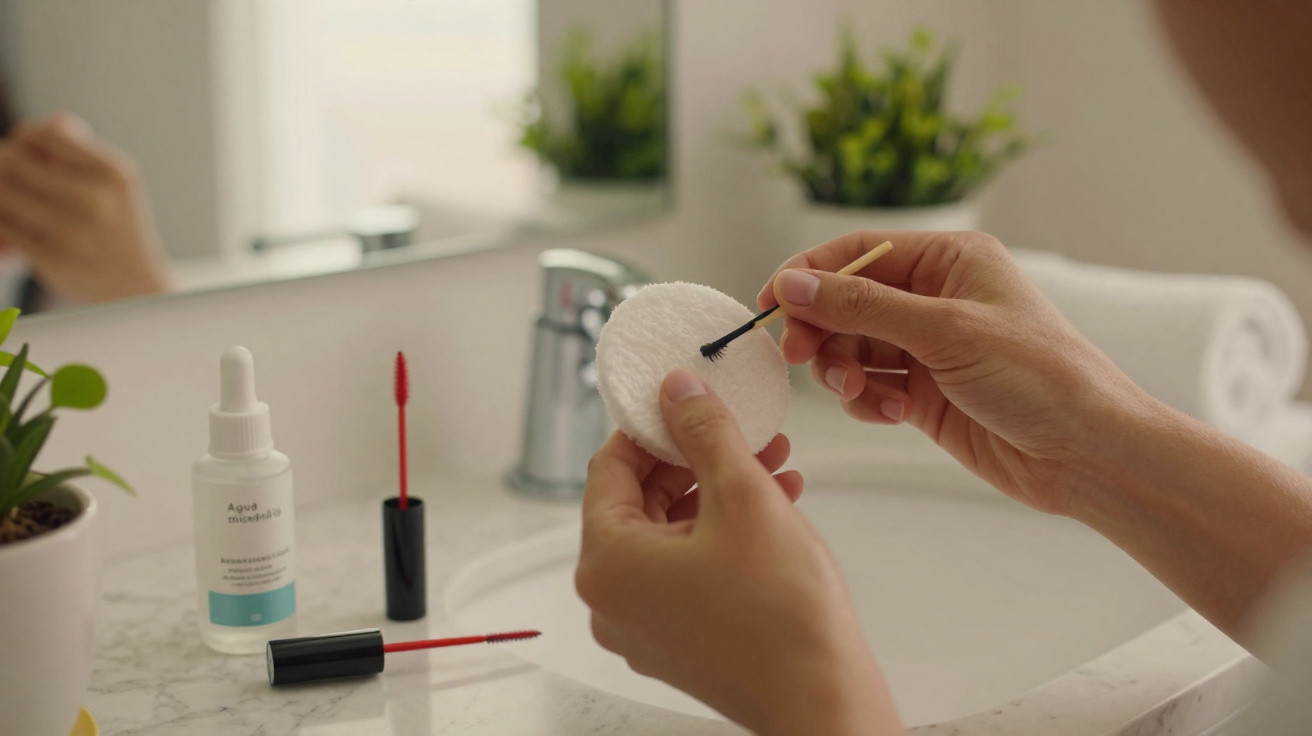
The only sound in the bathroom is the tap.
After a long day, you move towards the mirror with a cotton pad in your hand, going through the motions automatically. You make several determined passes over your eyelids, rub a little to shift the final traces of mascara, then rinse. Finished. You barely pay attention to your lashes these days - you simply assume they will be there, as they always have.
The following morning, there is one solitary lash on your cheek. Then you spot two more in the sink. You blink and wonder whether stress, age or a new mascara could be responsible. Scrolling through your phone brings up serums, extensions and lash lifts. Hardly anyone mentions the most fundamental part of the routine: the way you cleanse them. Yet this is precisely where problems can quietly begin - every single night.
The daily cleansing habit that gradually damages your lashes
Most people do not really “cleanse” their lashes - they assault them. In countless bathrooms, the pattern is identical: waterproof mascara after a long day, followed by a cotton pad drenched in whichever remover is nearby. It is moved repeatedly over the eyes, pressed and dragged in an effort to dissolve stubborn makeup as quickly as possible.
Eyelid skin is fine and lashes are small, yet the movement is often broad and impatient. Rubbing back and forth can seem effective, quick and practical. However, every pass pulls at tiny hair follicles that were never intended to withstand this degree of daily friction. The harm is not visible after one evening. It emerges months later, when your lash line unexpectedly appears… less full.
Any lash technician or dermatologist is likely to describe the same scenario: people arrive blaming mascara, ageing or even hormones. Looking at the wider picture usually reveals one recurring factor - makeup removal that is overly forceful, hurried and mechanical. In most cases, the cleanser is not the culprit. The movement is. Using a cotton pad as though it were a scrubbing brush is the issue. Repeating that small action for 700 consecutive nights can gradually wear lashes down.
One Tuesday afternoon at a busy London clinic, a dermatologist showed me a magnified photograph of a patient’s eyelid. There were no filters and no makeup, only the unforgiving truth under bright lighting. Her lash line was patchy, with gaps resembling missing teeth. “She thought her serum caused this,” the doctor said. “It’s her cleansing.” The woman had followed a double-cleansing routine faithfully and took pride in her diligence. Every evening, she scrubbed around her eyes until the cotton pad came away completely white.
At first glance, this seemed like good hygiene: clean skin, no remaining mascara and a protected pillowcase. Beneath the surface, however, every rubbing motion was flexing and loosening delicate follicles. A 2022 consumer study from a major beauty brand found that women who rubbed their eyes firmly while cleansing were almost twice as likely to report lash thinning after 12 months, including when they used “gentle” products. The formula was not the problem; the pressure was.
We often discuss breakage in scalp hair, whether caused by heat, brushing or tight ponytails. Lashes experience comparable strain, only far more quietly. Each lash sits in a delicate follicle within fragile eyelid skin. Vigorous rubbing places tension along the entire hair shaft. Some lashes snap halfway along, while others are slightly pulled at the root. The body replaces them, although not necessarily at an even rate, leaving the lash line looking thin or irregular.
With time, ongoing friction may also inflame the lid margins themselves. People can then develop redness and sensitivity, or find that their lashes begin growing in different directions. The body is continually attempting to repair repeated micro-trauma. It is a gradual process that is almost impossible to notice from one day to the next - until one morning, when your mascara no longer seems to “hold” as it once did.
How to cleanse your lashes without gradually destroying them
The answer is not an expensive serum. It begins with teaching your hands a new approach. Rather than scrubbing, think about soaking. The most lash-friendly way to remove eye makeup is almost uneventful: saturate a cotton pad with a bi-phase or oil-based remover, lay it gently over your closed eye and hold it there for 15–20 seconds. Do not rub or rush.
In that brief pause, the oils break down mascara and liner around the lash roots. Then draw the pad downwards, following the direction in which the lashes grow, as though smoothing a ribbon. Most makeup should lift away with one or two unhurried passes. If necessary, fold the pad to expose a clean edge and repeat the same downward movement. It can feel implausibly gentle if you are accustomed to scrubbing, but that is exactly the intention.
Gel and foam cleansers can also be suitable, provided that your movements remain light and directional. Picture yourself cleaning something fragile that a friend has lent you and that you are determined not to damage. Microfibre rounds and reusable cotton pads may help because they hold onto product without requiring as much pressure. The aim is not to “polish” the eye area. It is to dissolve and slide away yesterday’s makeup with as little friction as possible. Keep your hands calm, your touch light and your pace slow.
People do not usually harm their lashes because they dislike them. They do it because they are exhausted. At 11:30 pm, when you only want to take your face off, the urge to hurry is powerful. A common error is applying face wash directly over the eyes, massaging it in, then rubbing the area with a towel. Another is attempting to shift waterproof mascara with ordinary micellar water, which almost always results in extra scrubbing.
The consequences tend to become clear weeks later: short, stubby lashes where there was once length, or lashes that shed readily and may cause slight discomfort at the root. This is when panic buying begins - growth serums, supplements and castor oil. But unless the cleansing movement changes, the pattern remains. One of the most overlooked forms of lash care is simply sparing them this nightly aggression. Consider what a year of gentle, intentional removal might achieve.
A lash specialist once told me something that stayed with me:
“Your lashes don’t fall out because of one bad night. They fall out because of the hundred nights you didn’t think twice about.”
That thought redirects attention away from miracle solutions and towards ordinary routines: the small, unseen choices made at the sink.
To make those decisions simpler, keep the following points in mind:
- Pick a remover that properly dissolves the mascara you normally wear, particularly if it is waterproof.
- Press and hold the pad instead of rubbing it back and forth.
- Wipe in the direction of lash growth rather than across the lashes.
- Pat the area dry using a soft towel; do not rub.
- Where possible, give your lashes one or two “naked” days each week.
Let’s be honest: nobody manages every “ideal” step every night. Life becomes chaotic, phones keep glowing and bed is calling. The aim is not perfection but consistency. If gentleness is your usual approach, the occasional rushed cleanse will not undo all your efforts. Your lash line can forgive the odd lazy moment, provided harsh rubbing is not the norm.
Rethinking your relationship with your lashes
Lashes are curious little features. They are decorative, certainly, but they also protect the eyes by catching dust and particles before they get in. They sit directly between vanity and biology. That is why losing them can feel so unsettling: it is not merely a beauty concern, but something that changes your face.
Emotionally, sparse lashes can subtly affect how awake or expressive you feel. Practically speaking, follicles that have been persistently inflamed or damaged may not recover as readily, regardless of how fashionable the serum is. This is not a reason to panic or feel guilty about previous habits. It simply means that what you do tonight can genuinely matter six months from now - not in some dramatic, life-changing sense, but in a small, tangible and visible way that you will notice whenever you look closely in the mirror.
Whether you are on a bus, in a bathroom or at a friend’s home after a long day, gentle cleansing can become more than a skincare tip. It is a small gesture of respect for a part of your face that is rarely appreciated. You do not need to become fixated on it - just slightly more conscious. The same hands that may have unknowingly weakened your lashes for years can just as readily help them look fuller, softer and stronger a few seasons from now. The routine is the same; the touch is different.
| Key point | Detail | Why it matters to the reader |
|---|---|---|
| Rubbing weakens follicles | Back-and-forth cleansing movements pull on lashes and can irritate the lash line over time | Explains why lashes may thin despite using “good” products |
| Soak, do not scrub | Allow remover to sit, then wipe downwards in the direction of growth | A straightforward change of technique that helps protect length and density |
| Consistent gentleness wins | Small nightly habits have more impact than occasional treatments | Offers a realistic, low-effort approach to stronger lashes |
















Comments
No comments yet. Be the first to comment!
Leave a Comment