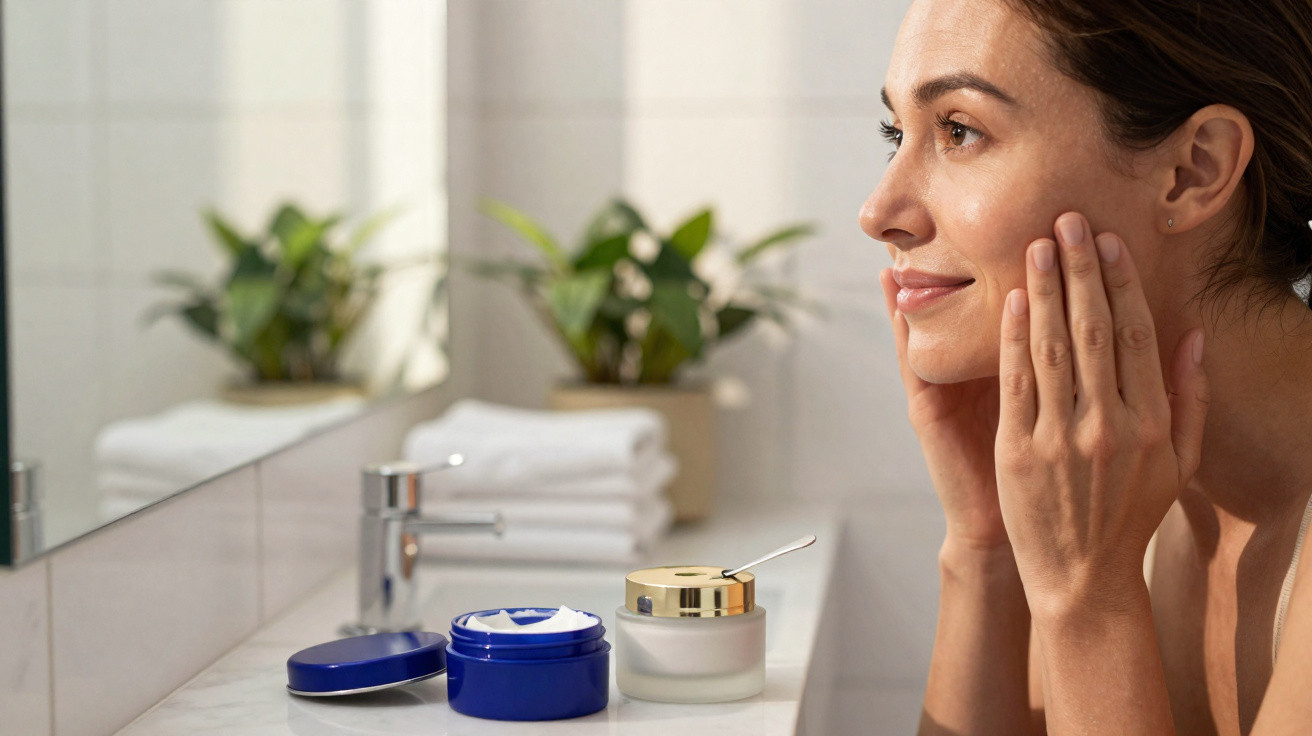
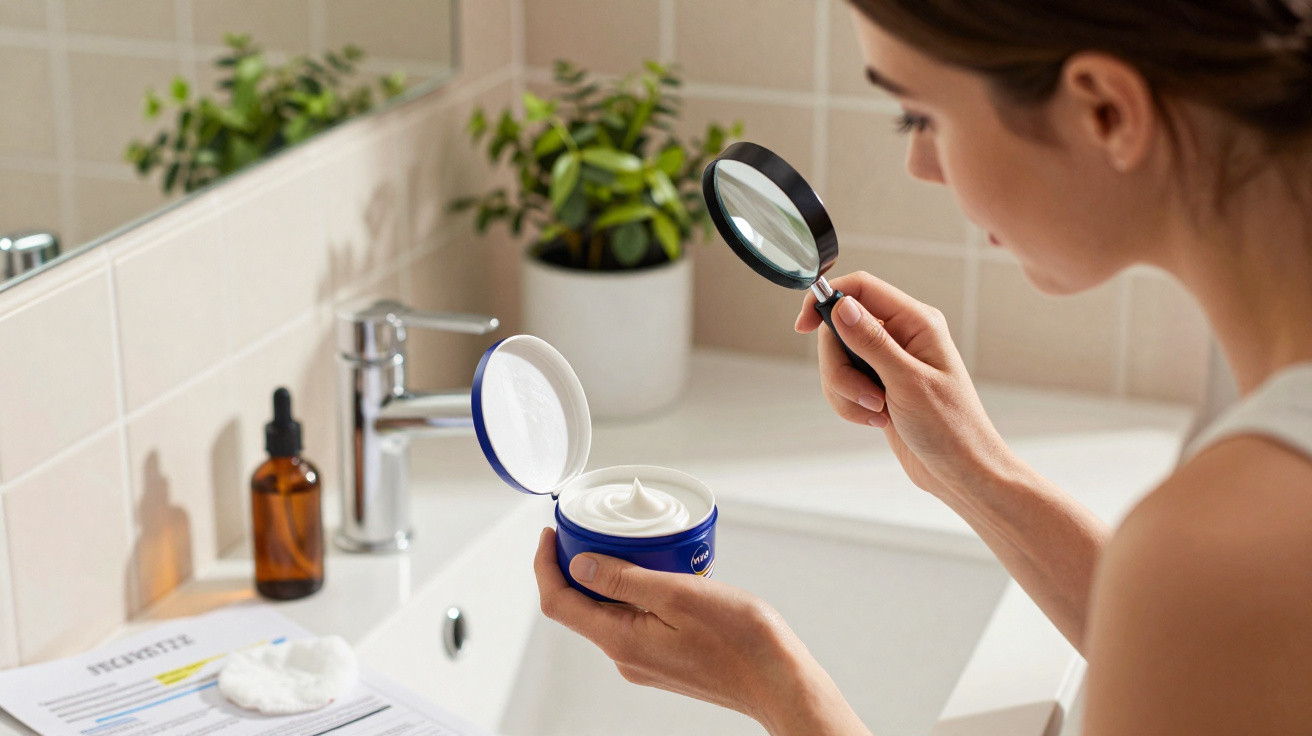
A British beauty journalist stopped relying on assumptions and carried out a month-long split-face trial. On one cheek, she used Nivea’s famous blue-tin cream; on the other, La Mer’s cult moisturiser. With a dermatologist monitoring the process, she set out to find whether a £1 high-street basic could genuinely match a luxury formula marketed as a high-tech anti-ageing product.
Why this Nivea vs La Mer comparison matters for your skincare shelf
Most skincare routines are built around two shared aims: keeping skin clean and properly hydrated. Cleansing is usually the simpler part. Moisturising is more complicated. Today, a moisturiser is expected to do plenty: leave skin soft, work with a particular skin type and, frequently, address fine lines, dehydration, redness, blemishes or several concerns at once.
The market hardly makes the decision clearer. Shop shelves contain pots priced from pocket change to the equivalent of half a week’s wages. Sooner or later, the same question arises: does paying more actually deliver better results for your skin?
That straightforward question prompted Daily Mail staff member Claire Cisotti to attempt what many people merely discuss: a real-world contest between a cheap cult cream and a luxury anti-ageing favourite.
The test compared Nivea’s classic blue cream (about €1–2 per 100 ml) with La Mer’s moisturiser (close to €500 per 100 ml), applied on opposite sides of the face for four weeks under dermatological supervision.
The experiment: two creams, one face and four weeks
Rules for the Nivea and La Mer skincare duel
Before beginning the trial, Cisotti saw a dermatologist for a thorough assessment of her skin. Her complexion displayed several signs that will be familiar to many people as they get older:
- Skin dehydration
- Noticeable fine lines and early wrinkles
- Mild rosacea and redness
For a full month, she followed a tightly controlled regime:
| Left side of face | Right side of face |
|---|---|
| Nivea blue-tin cream | La Mer moisturising cream |
| Mass-market, low cost | Premium, luxury cost |
| Rich, hydrating texture | Hydration with anti-ageing claims |
Every other variable remained unchanged: she used the same cleanser and maintained the same lifestyle and environment. The moisturisers were the only difference, making it easier to link any changes to the products themselves.
Week one: an unexpectedly level beginning
At the end of seven days, there was no obvious contrast between the two cheeks. Each side appeared smoother and felt more comfortable. Hydration seemed broadly equal, without tightness or flaky areas on either side.
There was, however, one slight variation: the La Mer side looked marginally less red. That could be relevant to people susceptible to flushing or rosacea. In terms of basic skin texture, though, the two sides felt much the same. For a pot costing roughly €1, Nivea was already proving more than capable of competing.
In the first week, the “budget” and “luxury” sides of her face looked almost identical to the naked eye, with both feeling softer and more supple.
Week two: an issue on the pricier side
The second week brought a more notable development. Tiny blemishes emerged beside the right side of her nose - the side treated with La Mer. Although they disappeared within a few days, the incident reinforced a point dermatologists often make: paying a high price does not ensure that a product will cause no irritation.
Apart from that brief flare-up, Cisotti still found it difficult to identify any dramatic difference between her cheeks. Their texture, everyday comfort and overall radiance remained similar. By this point, the main finding was that the cheaper cream was simply not falling behind.
Week three: colleagues notice a change
During the third week, Cisotti noticed an unexpected difference when she looked in the mirror. The fine lines around the eye on the Nivea-treated side appeared slightly softened, while that cheek looked a touch fuller and more “bouncy”.
Concerned that she might be seeing what she wanted to see, she asked colleagues to assess her complexion without revealing which cream had been used on each side. Every one of them selected the same side as the better-looking half: the left, which had received Nivea.
Every colleague she asked chose the Nivea side as the fresher, smoother half of her face. None of them picked the La Mer side.
The difference was modest rather than spectacular, yet it was enough to question the common assumption that a luxury anti-ageing cream will inevitably produce more noticeable wrinkle results.
Week four: “Did you get Botox?”
By the final week, both moisturisers had visibly improved her skin compared with its condition at the outset. Hydration had increased and her face looked generally more refreshed. Friends and relatives noticed the change too. One family member even asked whether she had secretly had Botox injections, suggesting just how much better her complexion appeared overall.
Personal observations can only reveal so much, however. To replace impressions with professional analysis, she went back to the dermatologist for a follow-up assessment.
The dermatologist’s verdict: price versus performance
Nivea performs better for hydration and fine lines
After the four-week trial, the dermatologist assessed both halves of Cisotti’s face, focusing especially on hydration, redness and fine-line depth. The findings were not what many buyers would anticipate from a €490 cream.
According to the dermatologist’s measurements, the Nivea side retained better hydration, showed fewer red patches and presented a visible reduction in fine lines around the eyes.
The specialist judged that the Nivea-treated side looked approximately five years younger than it had at the experiment’s beginning. La Mer had also improved the skin compared with the first appointment, but the less expensive cream performed better across the principal measures being monitored.
For the dermatologist, the trial reinforced an important point: a costly formula may offer a luxurious feel, sophisticated fragrance and a prestigious backstory, but none of this automatically produces better clinical outcomes.
Why a £1 moisturiser can compete with a luxury pot
In formulation terms, the result is not quite as surprising as it first appears. Traditional creams such as Nivea often use established ingredients including glycerin, paraffin and occlusive agents, which seal moisture into the skin. By forming a protective surface barrier, they limit water loss and help the complexion appear plumper.
La Mer promotes a sophisticated blend of marine extracts and an extended fermentation process. This technology may indeed benefit certain users. However, skin biology frequently responds more strongly to reliable, uncomplicated hydration than to rare or exotic active ingredients alone. Applying a rich, stable cream daily can support barrier repair, reduce redness and make fine lines seem less pronounced, simply because the skin holds more water.
What the trial means for your skincare budget
Looking at price tags more critically
This example does not prove that luxury creams never deliver results, nor that low-cost products always come out on top. Skin is highly individual. Some people do not tolerate rich, occlusive formulations well, while others require fragrance-free products - something the classic blue Nivea cream does not offer.
Even so, the experiment provides a valuable reminder about judging skincare products. A larger price tag commonly covers:
- Expensive advertising campaigns and celebrity partnerships
- Prestigious packaging and premium retail placement
- Development of exclusive complexes or textures
These elements do not automatically result in stronger long-term skin health. Often, dependable moisturising, SPF and gentle cleansing are more significant than an extensive list of unusual botanical extracts.
The experiment suggests that building a solid routine with simple, effective products can sometimes beat splurging on a single hero jar.
Choosing a moisturiser that truly suits you
For anyone considering what to do with these findings, several practical lessons emerge. Before purchasing the next viral cream, it may be useful to:
- Establish your leading concern: dehydration, pigmentation, spots, redness or pronounced wrinkles
- Look for evidence-based ingredients, including glycerin, ceramides, niacinamide and hyaluronic acid
- Consider the texture and whether it suits your skin type: oily, dry, combination or sensitive
- Try a small quantity first, particularly if your skin is reactive
For anti-ageing purposes, dermatologists consistently stress that everyday SPF and regular hydration can be more effective than occasional use of a costly cream. Sunscreen, a mild cleanser and a moisturiser your skin tolerates well make a solid foundation. Targeted serums, retinoids or prescription treatments may then be introduced if necessary.
Beyond the trial: beauty expectations and skincare
The Nivea vs La Mer story reflects a broader conflict within beauty culture. Many people feel pressured to “invest” in their skin through high-end products, as though choosing a cheaper pot represents inadequate self-care. Marketing often plays on this feeling, associating luxurious textures with youth, achievement and commitment.
This trial challenges that story. It indicates that skincare decisions should be guided by practicality rather than guilt. Consistency, tolerance and ingredient quality may count for more than a brand’s status. A product that works for your skin, suits your budget and will genuinely be used every day is more likely to soften lines than a beautiful pot left unused on a shelf.
There is a psychological element as well. When a cream feels enjoyable and fits easily into your routine, you are more inclined to use it consistently. Hydration improves gradually. If a £1 moisturiser helps you maintain that habit, it could be more beneficial for your face than a product applied with anxiety because of its cost.
For those concerned about ageing but sceptical of beauty marketing, the message is straightforward: consider what your skin actually requires, read ingredient lists more objectively and remember that striking results can come from unexpectedly modest products.







Comments
No comments yet. Be the first to comment!
Leave a Comment