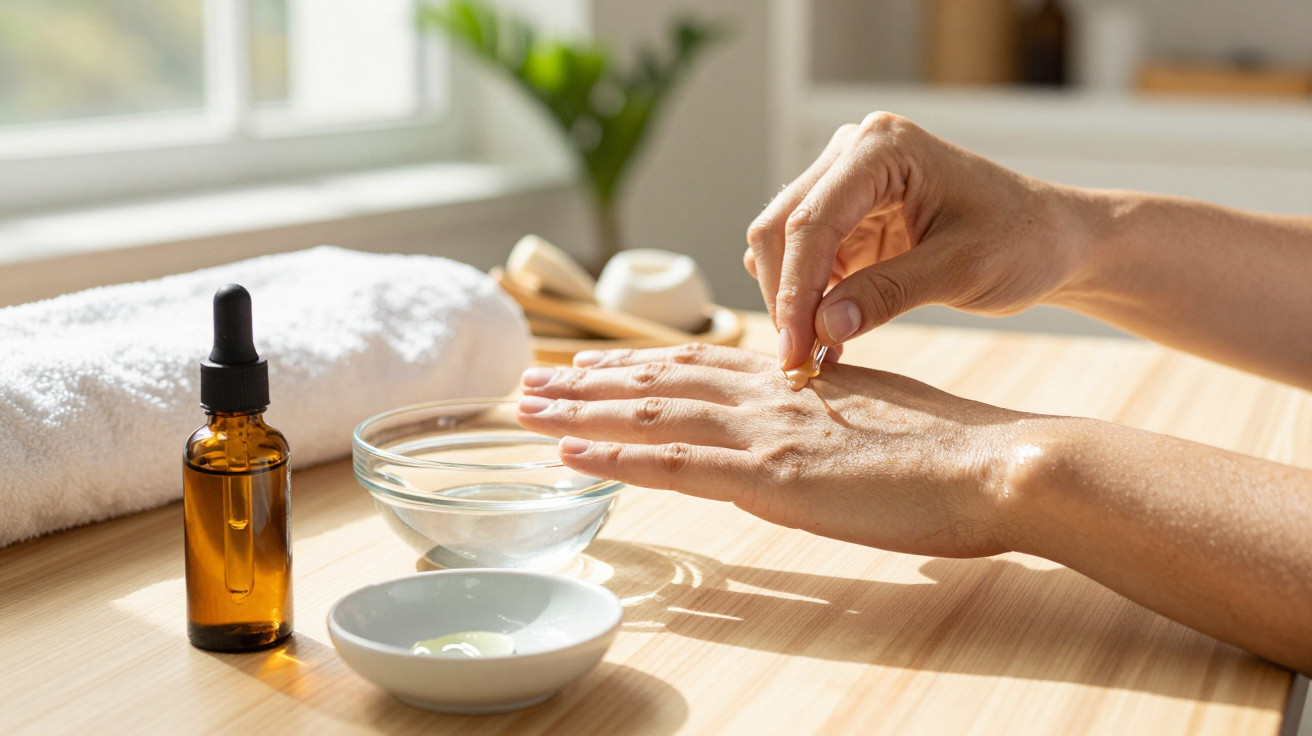
The esthetician does not begin by examining your face.
She takes your hands instead, slowly rotating them beneath the ring light. With a fingertip accustomed to thousands of cuticles and countless stories, she follows the dryness across your knuckles. Your nails look fine, but the skin? It feels tight and coarse, somehow older than the rest of you.
She gives the knowing smile of someone who has encountered this a hundred times already that day. “Do you cook a lot? Use sanitizer? Work on a laptop all day?” You agree to all three, expecting an expensive product recommendation. Instead, she reaches behind the showy creams for a plain, unlabelled bottle. One ingredient. No perfume, no sparkle and no exaggerated claims.
She rubs a few drops between her palms before pressing them into your hands, as though locking something inside. “Come back in a week,” she says. “You won’t recognize them.”
She is not overstating it.
Why estheticians rely on one single-ingredient hero
Ask three estheticians for their hand-care “secret” and they may show you three different bottles, yet the same foundation is likely to be inside: pure, medical-grade glycerin. No fragrance. No colour. No elaborate eighteen-step ritual. Only a clear, faintly sticky liquid that is far from glamorous.
Among shelves packed with shea butter, luxurious oils and seasonal fragrances, glycerin can seem rather dull. Still, it is often the bottle sitting half empty, repeatedly used throughout the day. It quietly finds its way into salon routines: stirred into masks, dabbed over cuticles and mixed with water before a massage.
The longer you watch, the clearer it is: this is the true workhorse.
A London esthetician keeps a miniature bottle of glycerin in her apron pocket. “I go through this faster than my moisturiser,” she laughs. After washing her hands between clients, she pats them dry, presses in a drop of glycerin while they remain a little damp, and carries on. There is no grand ritual involved.
She told me that in the pandemic years, when frequent sanitiser use left everyone’s hands in terrible condition, people who maintained this small habit had noticeably different skin. They experienced less splitting, fewer sore patches and almost no bleeding knuckles during winter. The sole difference? Glycerin twice daily rather than ten new creams.
Dermatologists discreetly support this too. In one frequently cited review, glycerin repeatedly performed highly as a humectant, drawing water into the skin’s outer layers and retaining it there for hours. It may not make for the most exciting headline, but it is compelling when your hands ache every time you wash up.
Once the branding and marketing are removed, hand hydration comes down largely to one straightforward task: bringing water into the skin and preventing it from escaping too quickly. Glycerin is remarkably effective at this. As a humectant, it attracts water and works like a tiny sponge within the skin’s outer layer. Applied to slightly damp hands, it keeps moisture there rather than allowing it to evaporate.
Other ingredients have their place – oils and butters form a protective barrier, while silicones provide that silky glide – but glycerin does the main work when skin is seriously dehydrated. It is small enough to enter the upper layers, stable enough not to degrade easily and mild enough for most skin types.
That is why so many professionals quietly depend on it: it just works, even when nothing else does.
The esthetician method: using glycerin to genuinely transform your hands
The most important “trick” estheticians use with glycerin is all about timing. They do not simply apply it whenever it occurs to them. They use it immediately after contact with water: after washing their hands, showering or doing the washing-up. When skin is still slightly damp, glycerin becomes effective rather than merely sticky.
In reality, the technique is almost laughably simple. Put one or two drops of pure glycerin into your palm, then add a quick splash or mist of water. Rub your hands together for 20–30 seconds, making sure to work it between the fingers and over the knuckles. If your skin is exceptionally dry, finish by sealing it in at night with a light layer of any basic hand cream or a plain ointment.
Follow this twice a day for a week, and your hands begin to feel less like sandpaper and more like skin again.
The real challenge is consistency. Most people can keep up a beautiful routine for roughly three days before everyday life gets in the way. A cold commute, a hot coffee and twenty emails before 9 a.m., and suddenly your hands feel like cardboard again. Let us be honest: nobody really manages this every day without at least a little organisation.
Estheticians get around this by attaching the habit to something they already do. Their glycerin sits beside the soap rather than hidden away in a drawer. A small bottle goes in the same pocket as their keys. One client told me that she sticks a tiny note reading “drops” to her kitchen tap. That alone is enough to remind her after washing up.
Using too much, then faulting the ingredient, is another frequent mistake. Applied neat and excessively, glycerin can feel tacky, especially if there is no water involved. Professionals use far less than you might imagine, dilute it with a little moisture and layer something soothing over it at night. A tiny amount can make a major difference.
One Paris-based hand-care specialist expressed it in a memorable way:
“People think their hands are ‘just dry’. Most of the time, they’re actually thirsty. Glycerin is like giving them a drink, not just a coat.”
That comparison has reshaped how many of her clients look after their skin. Rather than regarding hand cream as an optional luxury, they begin to treat hydration as part of basic health. The priority moves away from hands that are merely soft and attractive towards hands that feel comfortable and work properly, without stinging whenever you pick up a lemon or go out in the cold.
- Apply glycerin immediately after water, while the skin remains damp.
- Aim for “two drops, not ten” to prevent a sticky sensation.
- At night, seal it in with a straightforward hand cream or balm.
- Store a small bottle beside the sink to make the routine automatic.
- If your skin stings or reacts, stop using it and move to a gentler formula.
What changes when your hands are properly hydrated
We often overlook how much our hands reveal before we have said a word. Consider a handshake at an interview, a first date across a café table or the way you hand a glass of water to a child. Rough, red hands can leave you feeling older, more tired and less “put together” than you truly are.
At a subtle level, hydrated hands can alter your posture. You no longer conceal them beneath the table or inside your sleeves. You offer them more readily and gesture with greater ease while speaking. Practically speaking, minor splits and rough areas no longer snag on paper or fabric, sting in cold air or wake you in the night when they crack open.
On a difficult day, that matters.
We have all experienced a winter morning spent fumbling for keys with fingers that feel like dry wood. After a week or two of using glycerin as estheticians do, that problem quietly fades away. Your skin bends without resistance, and your knuckles no longer appear ten years older than your face in the bathroom mirror.
There is also something unexpectedly grounding in caring for one small, specific area of your body. It offers a pause from pursuing perfect skin, perfect hair and perfection in everything else. It is simply a few seconds, a few drops and a small commitment to comfort rather than looks.
Once you have experienced that relief, you begin noticing other people’s hands as well. You spot the supermarket cashier with split cuticles from constant scanning, the nurse with sanitiser-damaged palms and the parent at the playground whose hands are sore from washing bottles and wiping spills.
You want to pass on the secret.
| Key point | Detail | Benefit for the reader |
|---|---|---|
| The role of glycerin | A humectant that draws water into the skin and holds it there | Understand why a single ingredient can transform dry hands |
| When to apply it | Apply to slightly damp skin, directly after contact with water | Maximise effectiveness without a complicated routine |
| A simple routine | A few drops of glycerin, followed by cream at night if needed | Achieve visible results without costly products or lengthy steps |












Comments
No comments yet. Be the first to comment!
Leave a Comment