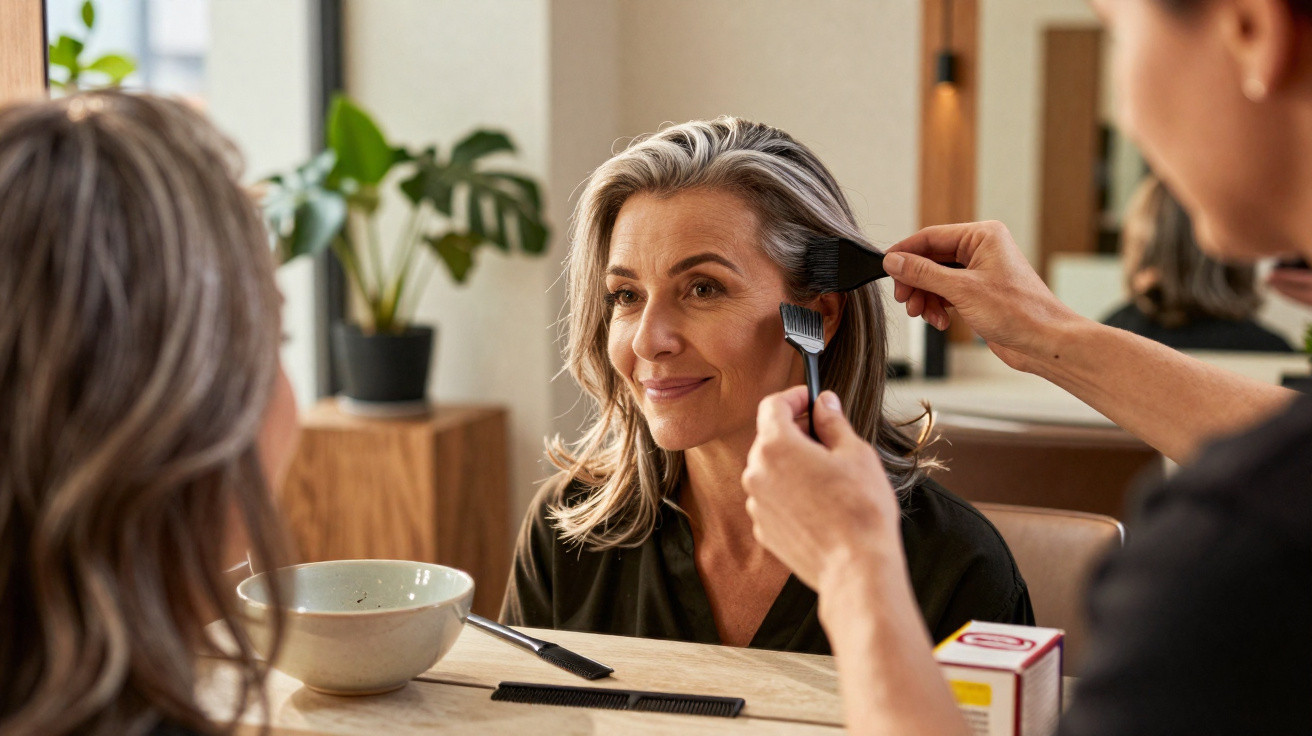
Forty-five minutes beneath bright lights, a towel draped over her shoulders and that familiar chemical scent that stings the eyes slightly. She scrolls through her phone until she stops at a photograph from ten years ago. The smile is unchanged, as are her eyes … yet her hair has become a flat, uniform brown, with no brightness or movement.
Her colourist approaches, picks up a strand and says, “We could try something else. Less dye. More… you.” The woman pauses, her fingers automatically reaching for the silver roots she has been battling every four weeks. A stillness settles in, the sort that arrives just before a minor revolution. The foils remain on the tray. The bottles stay sealed.
On the shelf beneath the mirror, between the brushes and clips, sits a slim wand beside a small pot of coloured powder. Those modest tools are about to change everything.
A subtle move away from all-over hair dye
The former routine was straightforward: spot a grey hair, arrange a colour appointment and remove every sign of it. A new habit is now taking shape in salons and at home. Rather than dyeing everything, people are retaining their natural base colour and addressing only the areas that genuinely trouble them. Covering grey has become more targeted and less all-encompassing.
Rather than saturating the hair with permanent colour, clients are requesting glosses, tinted masks and “root tricks” that soften the divide between grey and pigment. Their language reflects the change: instead of saying “I want to be dark brown again”, they are more likely to say “I just want to look rested”. Full-colour appointments are gradually giving way to speedy touch-ups and gentle refresh treatments. Perfection is no longer the aim. The aim is for it to look believable.
Colourists from New York to Berlin report the same development: box dyes are left gathering dust while small, discreet tools sell rapidly. The market often reveals the direction of a trend well before it reaches TikTok.
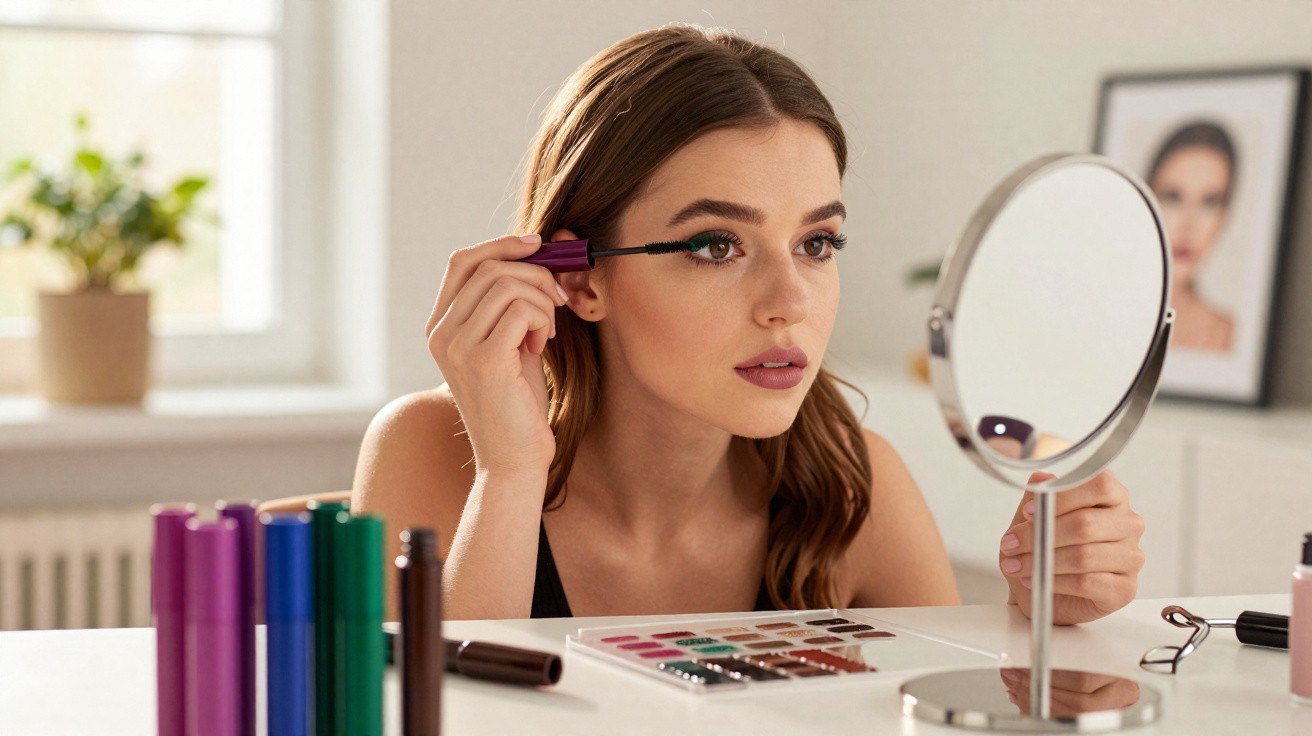
Speak to any in-demand stylist and they are likely to identify the current favourite: temporary grey-blurring. This includes root powders, tinted sprays, mascara-style wands and demi-permanent glazes that fade softly instead of leaving severe regrowth lines. Once treated as secondary products beside major colour brands, these items now take pride of place at the till, arranged near the register like sweets.
At one London salon, its owner records how often clients return for complete colour services compared with “refresher” treatments. Before 2020, more than 70% booked full dye appointments every six to eight weeks. By last year, refresh services - including glosses, toners and root camouflage - had caught up, accounting for almost half of all colour bookings. Nor is this purely an age-related shift. Women in their early thirties are arriving to request “micro-coverage” for their first isolated silver strands.
The same pattern appears online. Searches for “root touch up powder” and “grey blending” continue to rise, while “full coverage dye” is slowly declining. People do not always want to conceal the fact that they are ageing. They simply do not want their hair to announce it before they are ready.
There is practical reasoning behind the movement as well as cosmetic appeal. Conventional permanent dyes can trap people in a maintenance cycle: monthly root appointments, colour correction as the shade fades and repair work once the hair begins to break. Many are quietly choosing to step off that treadmill. Temporary grey-blurring allows them to reduce the frequency, spend less and preserve more of their authentic colour.
Rather than committing to a complete change of palette, they reduce contrast at the temples, along the hairline and through the parting. It may involve a few strokes with a wand, a spritz of spray before a meeting or a gloss every few months. The result looks fresher without shouting “just stepped out of the salon”. It is the visual equivalent of a good night’s sleep rather than a full face of makeup.
There is a psychological element, too. Letting some grey exist alongside natural colour, merely softened and blended, can feel kinder than eliminating it altogether. It changes ageing hair from a fight into a compromise.
How the new grey-blending method works at home and in the salon
This approach is not based on one particular product. It is a mindset: treat selected areas, soften them and blend them in. Begin with the places the eye notices first: the parting, the front hairline and the small grey wings emerging at the temples. Your overall colour remains intact, while the most distracting spots are toned down.
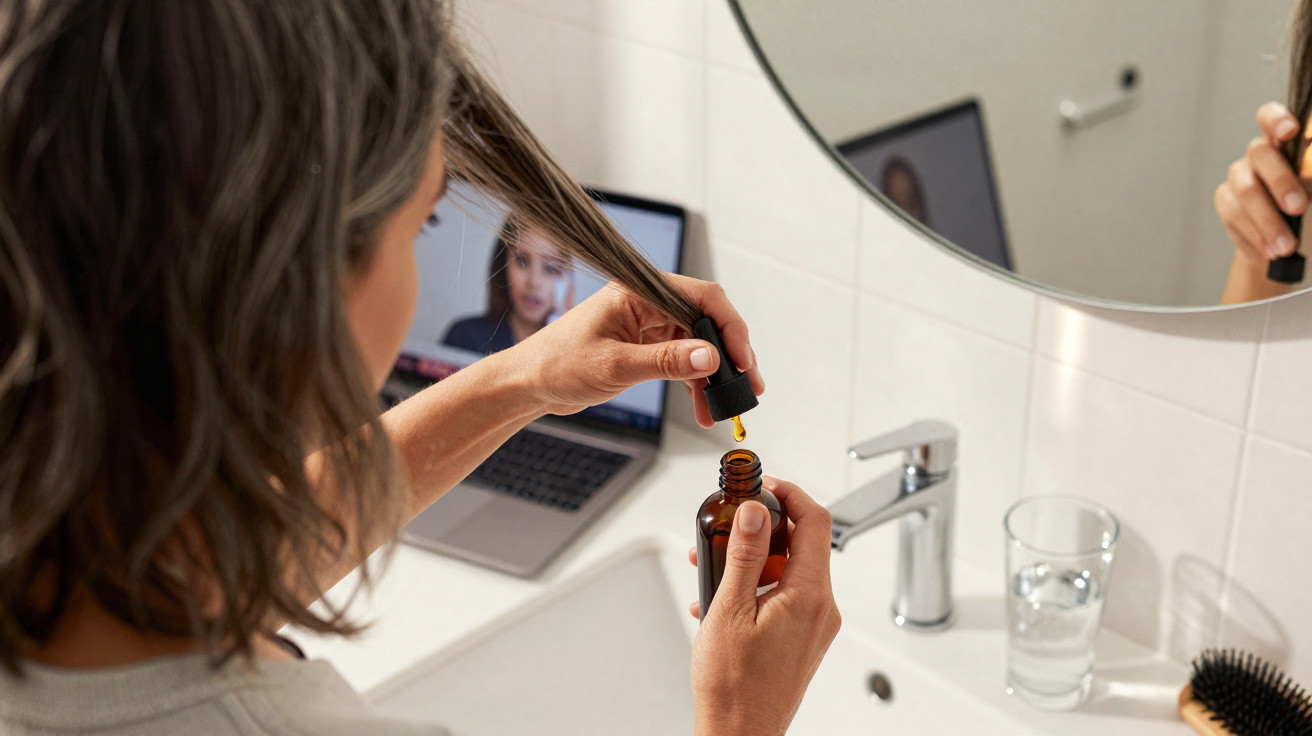
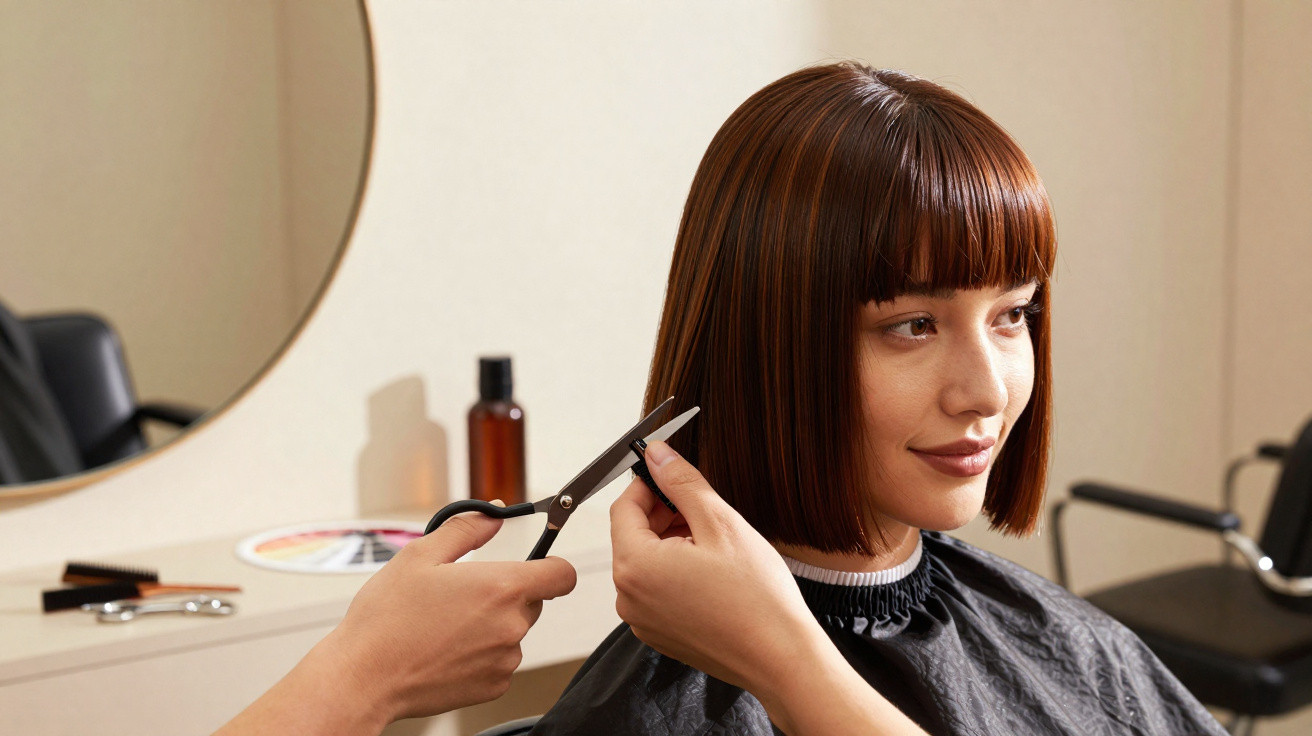
For home use, root touch-up powders and pens offer the fastest solution. Apply powder to dry hair with a brush, much like using eyeshadow along the parting. Wands and pens behave more like mascara, coating individual hairs with colour in seconds. In salons, colourists use demi-permanent glazes or tonal baths to bring shine and gently tint grey, allowing some brightness to remain visible rather than covering every strand with opaque colour.
The technique is adaptable. Have an important meeting tomorrow? Use spray and carry on. Fed up with dull lengths? Book a gloss for added warmth instead of an entirely different shade.
Certain principles make the method genuinely practical rather than merely fashionable. First, selecting a shade slightly softer than your original colour makes blending more forgiving. A dense, inky black against newly white roots looks severe; a cool soft-brown glaze that lets a little grey show through appears deliberate. Many colourists recommend lifting the base by one or two levels, then allowing the greys to function as natural highlights.
Placement follows. For scattered grey hairs, an all-over gloss combined with quick root powder at the parting may be sufficient. Where there is more prominent silver at the front, a professional “grey blending” service uses foils and lowlights to weave warmer strands among the white hairs rather than concealing all of them. The essential element is irregularity. Nature creates it without effort; effective blending recreates it.
Maintenance becomes less demanding as well. Instead of adhering to a strict six-week booking cycle, people can extend appointments to eight, ten or even twelve weeks, topping up at home in the meantime. Let’s be honest: nobody really does it every day.
Naturally, this freedom introduces some potential mistakes. One of the most common is choosing the wrong shade. A root powder that is two shades darker than the natural hair can sit on its surface like chalk, catching every strip of office lighting. Using a shade that is too warm on cool-toned skin can also be unflattering, turning soft grey hairs into a brassy halo.
Applying too much product is another regular error. Sprays and powders are intended for small sections. Used across half the head, they can leave hair looking rigid and dusty, while pillows and shirt collars may become marked. People may then dismiss the technique as something that “doesn’t work”, although excessive application is the real problem. A considerate colourist will generally say, “Let’s keep this for the spots that bother you most, and let the rest breathe.”
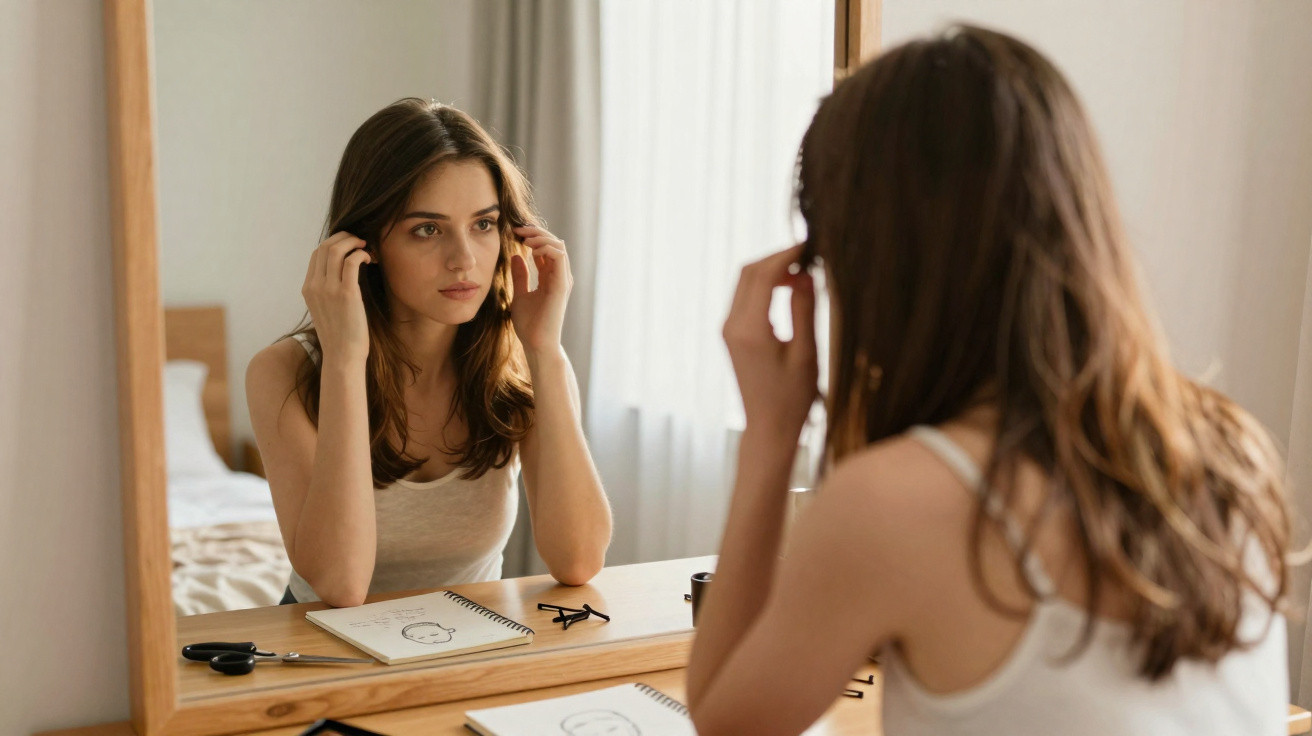
There is an emotional dimension as well. On a hurried morning, noticing more grey than the day before can feel like the mirror is shouting at you. On a better day, the identical streak may look full of character. We have all experienced that moment of staring at one detail in the mirror as though everything depends on it. The new method invites people to handle that emotional fluctuation more gently, rather than pressing the panic button whenever a silver hair appears.
“The goal isn’t to erase your age,” says Paris-based colourist Anaïs Dupont. “It’s to make sure your hair and your face tell the same story. When everything is too dark and flat, the story looks fake. When we blend the grey softly, people just say you look well.”
For readers trying to make sense of the options, several simple principles are useful:
- Select root products in daylight rather than under unforgiving bathroom lights.
- Trial a new shade on a small section behind the ear before using it more widely.
- Begin with a light application, adding more only where the grey is truly visible.
- Consult a professional once about your most suitable tone, then replicate it at home.
These modest practices can turn grey-blending from an untidy experiment into a dependable, understated ritual.
| Key point | Details | Why it matters to readers |
|---|---|---|
| Choose the format that suits your lifestyle | Powders are most effective for accurate coverage along the parting, sprays for quickly covering larger sections, and wands for the temples and hairline. Salon glosses and toners work well every 8–12 weeks to restore shine and tone. | Selecting an appropriate tool keeps the routine quick and manageable, rather than creating a complicated step you will stop following after two weeks. |
| Match the tone, not merely “brown” or “blonde” | Consider whether your hair has cool undertones (ash, beige) or warm ones (gold, copper). Root products described as “neutral” or “ash” suit most people who want to avoid brassiness, while warm tones complement naturally golden skin. | Accurate tonal matching helps touch-ups merge into the hair rather than looking like makeup in an unsuitable shade. |
| Blend progressively rather than pursuing complete coverage | Concentrate on the first 2–3 cm along the parting and around the face. Allow some grey to glint through at the crown or underneath. Request “grey blending” or “soft coverage” in the salon rather than “100% coverage”. | This minimises harsh regrowth lines, makes growing out colour simpler and gives you greater control over how quickly - or gradually - you accept visible grey. |
Sharing the mirror: what this change reveals about us
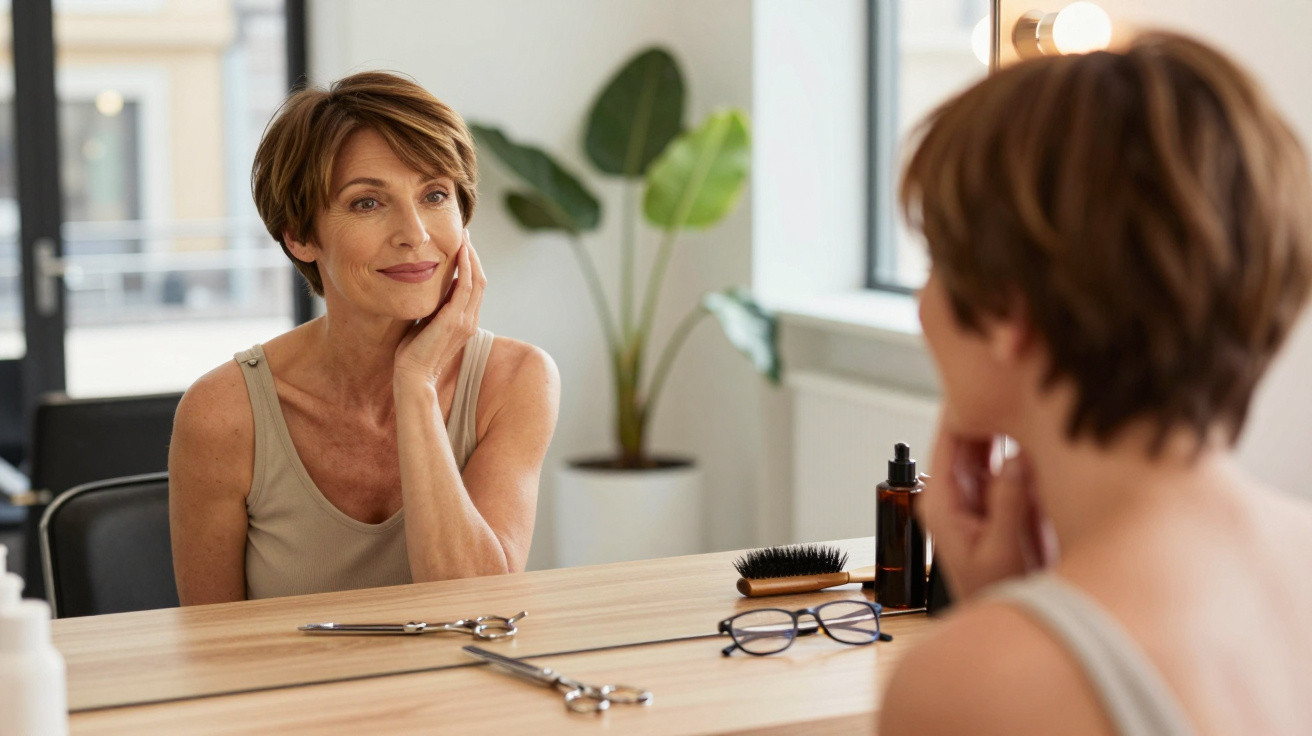
The shift from all-over dye towards grey-blurring is more than a beauty shortcut. It is a quiet but determined refusal to view ageing in absolute terms. People want to resemble themselves, only as a version who has slept well, stayed hydrated and perhaps returned from a holiday last month. They are replacing perfection with plausibility, and there is something unexpectedly freeing about that exchange.
It also changes the private pause in the bathroom or salon. Instead of asking, “How do I hide this?”, people ask, “What do I want to soften today?” On one morning, the answer may be a streak at the temple. On another, it may be nothing at all. Hair becomes a dialogue rather than a disguise. For many, this is a quiet yet significant change.
There is a social aspect, too. Colleagues may observe that you look more refreshed without understanding why. Friends may remark on your shine rather than your colour. Partners often say nothing, which can be a compliment in itself. That ambiguity creates room: you can discuss ageing when you choose, instead of having your root line declare it first. That control, even in something as light as hair colour, has real emotional weight.
The woman in the salon chair therefore sets down her phone. She watches the stylist dip a fine brush into a soft demi-permanent glaze and apply it only to the front sections, leaving almost all the rest of her hair untouched. Later that night, beneath the lighting in her own kitchen, she sees the same silvery strands, now quieter and less stark, seeming more like part of her. She passes a hand through her hair and experiences something she has not felt there for some time.
Not youth. Not denial. Simply a kind of truce.








Comments
No comments yet. Be the first to comment!
Leave a Comment