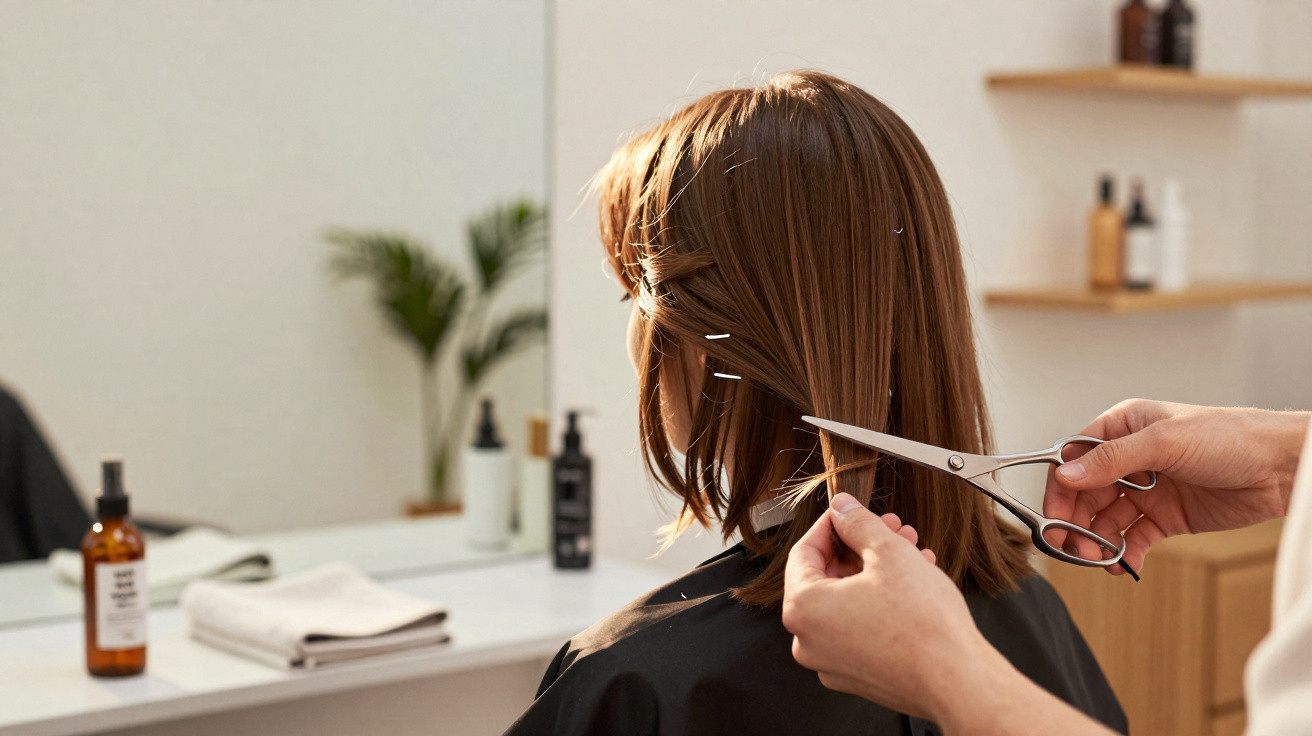
“It says ‘repairs split ends in one use’… so why do you still want to cut them?” she asked, eyes fixed on the mirror. Her hair shone at the roots, yet the final ten centimetres resembled unravelled thread: a soft cloud of static, snapped hairs and flyaways lit by the overhead light.
The stylist gave the familiar smile of someone who has answered that question countless times. She pressed out a pea-sized amount of serum, ran it over the ends and let the girl take in the immediate gloss. Then she silently selected a dry strand and eased it apart. The split was still visible; it was simply smoother and more slippery.
“See? Shiny dead ends,” she said quietly. The scissors made a crisp click against the counter, more convincing than any advertising claim.
Why “repairing” products can’t glue dead hair back together
Hair appears so alive that it is easy to overlook a basic fact: the visible length is already dead. Each strand is a tough keratin fibre, protected by a cuticle that cannot heal after it has been damaged. Once that cuticle tears or splits, no blood supply or living cells can restore it. What remains is a fault that grows each time a brush catches or heated straighteners pass over it.
That means a bottle promising to “repair split ends” is using marketing language rather than biology. Serums can perform a useful cosmetic job, much like clear nail varnish over a chipped manicure: they smooth the surface, temporarily hold rough edges together and create an impression of healthier hair. Beneath that shine, however, the chip remains.
Any chemist’s shelf is full of the split-end dream. “Bond builder”. “Seals 98% of split ends”. “Reverse years of damage”. The wording feels almost clinical, as though a ponytail could be operated on. Brands understand the anxiety that can arise from one disappointing glance in the bathroom mirror, and their pastel packaging and glossy tubes speak straight to it.
A UK consumer group tested “repairing” shampoos and found that users thought their hair looked improved, felt smoother and was easier to style. The marketing appealed because that surface-level result was genuine. Microscopic images, though, showed something else: splits remained, and the cuticle was still fissured like a dried riverbed. The product behaved more like filler than surgery.
One colourist recalled a regular client who avoided trims for nearly a year because she relied on a costly oil to “heal” her ends. With ring lighting and filters, her hair appeared fine on Instagram. In the salon’s lighting, its bottom third was a knotted mass of white dots, splits and breakage. When the stylist eventually persuaded her to have it cut, considerably more than a light dusting had to come off. The “repair” had merely postponed a difficult choice.
The science is harshly straightforward. A split end is more than a visual imperfection: it is a failure in the fibre’s structure. After keratin breaks or the cuticle lifts away, the damage can work its way upwards, like a ladder in a pair of tights. It may not be immediately obvious, but every wash, point of friction and heat-styling session can help the split travel.
Silicone- and oil-based serums coat the compromised section with a slick layer. That reduces friction, so strands feel softer and may break a little less in the short term. It is both helpful and sensible. Yet no ingredient in the formula is rebuilding proteins. There is no miniature construction team inside your conditioner.
This is why hairdressers keep repeating the frustrating reality: once it’s split, the only permanent fix is the scissors. Products can safeguard the undamaged lengths and improve the appearance of worn ends, but they cannot make a fractured strand whole again. Having it cut is not a failure; it prevents damage from moving further up the hair.
The only real cure: a clean, strategic cut (and what to do between trims)
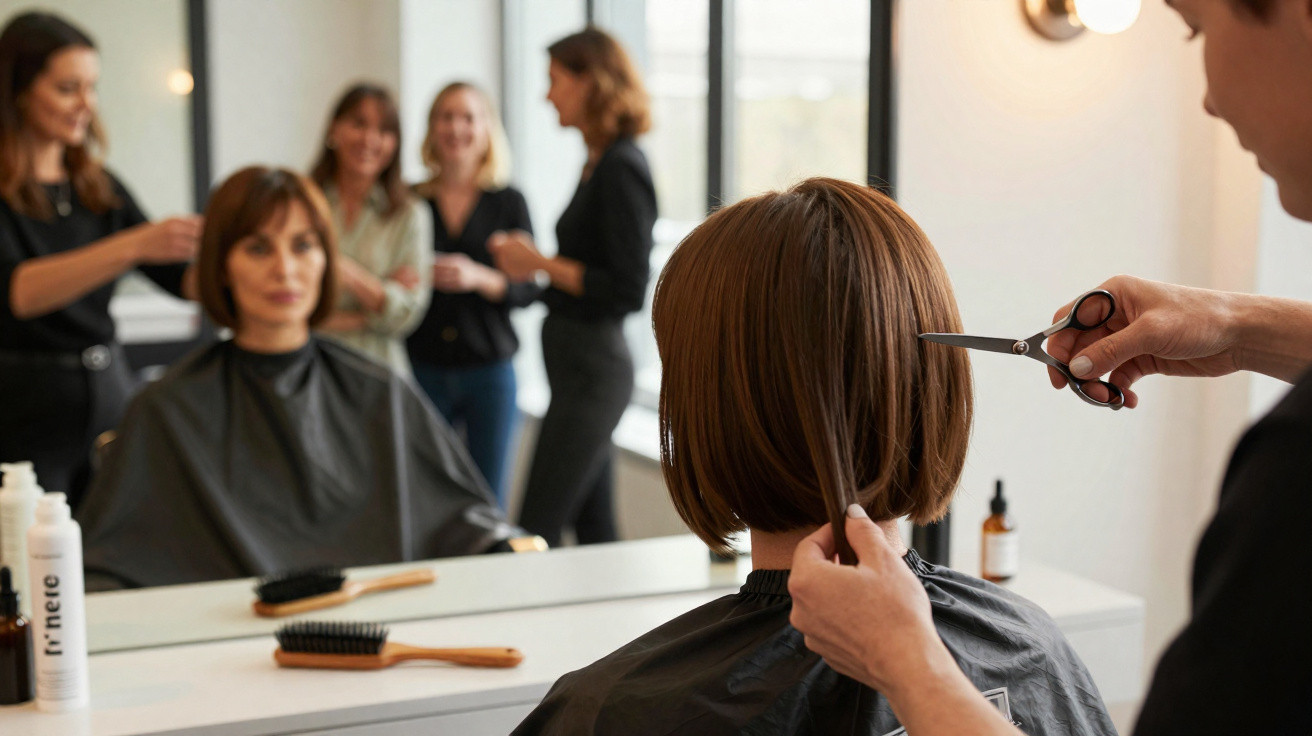
The most effective treatment for split ends is not sold in a bottle. It is a purposeful, almost surgical cut through the healthy section immediately above the damage. A skilled stylist will angle the strand, assess the way it catches the light and cut where the shaft still appears strong. That modest loss preserves the hair above it.
For many people, small regular trims every 8 to 12 weeks work much like pruning a plant. This is not simply about removing length; it is about deciding which part of the hair receives your conditioner, care and time. Even a consistent 0.5 cm trim can prevent minor splits becoming major fraying that later demands an unwanted large cut.
When salon appointments are not practical, a cautious at-home “search and destroy” approach can be useful. In strong natural daylight, twist small portions of hair and snip only the visibly protruding ends that look white or rough. Use sharp hair shears, never kitchen scissors. It will not be flawless, but it is much more realistic than expecting serum to become a doctor.
In practical terms, trimming is only one part of the answer. Your routine between appointments determines how many new splits develop in the first place. High-heat styling, abrasive towels, tight hair ties and chemical treatments all act as low-level daily damage to the cuticle, gradually lifting and cracking it.
A straightforward routine can therefore make a difference: choose lukewarm water rather than very hot showers, apply conditioner through the mid-lengths and ends at every wash, and use a leave-in product on damp hair to limit friction. Let hair partly air-dry before using a hairdryer. Apply heat protection whenever you style, even when you “only straighten the front bits”.
And realistically, no one follows every “perfect” recommendation every day. Life gets in the way. You sleep through the alarm, drag a brush through a knot or turn the straighteners up to maximum because you are running late. The aim is not to become a flawless hair-care machine. It is to remove visible damage when it appears, while reducing the number of fresh splits you cause.
“Hair care marketing is brilliant at stretching words,” says a Paris‑based trichologist. “When a product claims to ‘repair’, it often means ‘improve the surface feel and appearance’. That isn’t lying. It just isn’t the miracle people imagine. The real repair is always preventive, or done with scissors.”
The emotional pull is understandable. Cutting your hair can feel like throwing away progress, which is why so many people attempt to preserve every centimetre with masks and serums. During a difficult week, these bottles can also feel like self-care: a small ritual suggesting that something is being fixed. They do have value, too: they protect healthier lengths and soften the look of damage while you work out what to do next.
A simple way of thinking about it helps many people accept the scissors:
- Products = protection and camouflage, short term.
- Trims = real repair, long term.
- Habits = prevention, every single day.
Viewed this way, a “split end serum” is no longer a deception. It becomes what it actually is: a styling product with benefits rather than a substitute for your next trim.
Rethinking “good hair”: why cutting can feel better than clinging
Spend a quiet evening browsing beauty hashtags and the same pattern appears again and again: people proudly measure their hair against a wall, count the months and promise never to cut it. Length turns into a scorecard, with every centimetre carrying far more emotion than it should.
That is why even a minor trim can meet such intense resistance. The hair on the floor is not just hair. It can represent promises made to a younger self, past remarks that “short hair doesn’t suit you”, or memories of the school friend who always had thicker, longer hair. We attach a great deal to dead keratin.
Yet a change often happens once people finally part with thin, scraggly ends. Blow-drying can suddenly take half as long. The brush glides instead of catching. A ponytail may be shorter, but it looks more substantial. Many readers quietly say the same thing after a cut: their hair feels like their own again rather than a project that has gone slightly wrong.
A colourist described a client who arrived with hip-length hair and a firm rule: “don’t cut anything, just repair it”. The final 20 centimetres were translucent, like cobwebs. They agreed to remove five. That evening, the client sent a photograph from home with her hair moving naturally. She wrote: “It’s weird. I thought I’d be sad. I just feel… lighter.”
That is the understated truth that bottles cannot advertise: sometimes the boldest choice is not to preserve what is damaged, but to release it so the remaining hair can genuinely thrive.
Most of us have stood before the mirror, noticed exhausted-looking ends and reached for serum rather than booking a cut. It is understandable. One option feels kind, while the other feels like a risk. But hair gains length more slowly when it continually breaks, and products cannot overcome physics.
Next time a label murmurs that it can “repair years of damage”, consider it with a little more distance. Think about what you actually want: several more weeks of an illusion, or hair that behaves, shines and moves well because it is strong from root to tip. There is no moral judgement and no inherently “good” or “bad” decision. It is simply a matter of which truth feels right on your head at that moment.
| Key point | Detail | Why it matters to the reader |
|---|---|---|
| Split ends are irreversible | Once the fibre has split, no living cells can “repair” it | Understand why miracle promises do not work over the long term |
| Scissors are the only genuinely curative “treatment” | Cutting above the damaged section prevents the split from travelling upwards | See a haircut as protection rather than failure |
| Products = protection, not resurrection | Oils and serums smooth, lubricate and disguise damage | Use treatments to prevent damage and improve appearance, without unrealistic expectations |
















Comments
No comments yet. Be the first to comment!
Leave a Comment