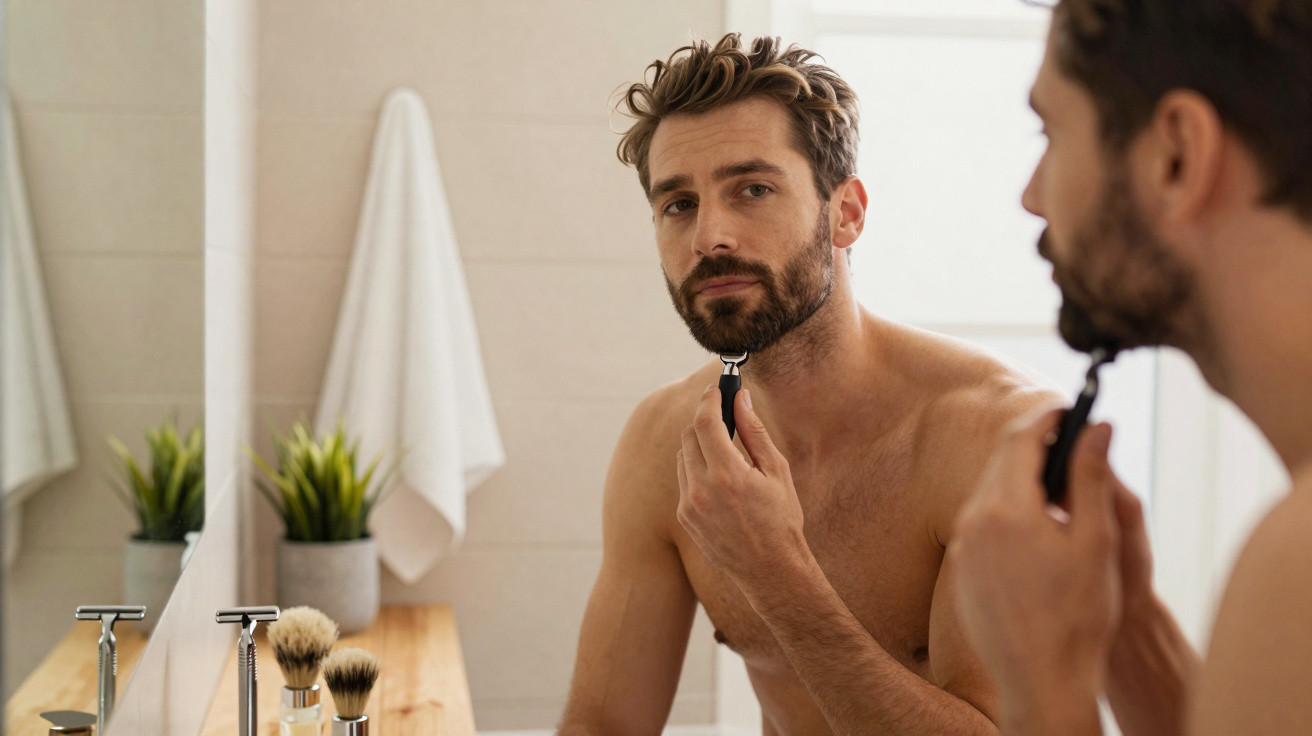
The man in the mirror looks much as he did a year ago. The same eyes, the same worn hoodie, the same shoulders that keep promising, “I’ll go to the gym tomorrow”. Yet one understated detail has changed: his beard line. It is neither an unruly mass nor a sparse experiment. His jaw has a clear edge, his cheeks are neat and his neck is faded. His face suddenly seems to have a proper frame.
He brushes a hand over it, then stops.
Nothing major has happened. He has not gained muscle or landed a new job. Still, he holds his head a few degrees higher. The beard is not demanding attention. It is simply… there. Somehow, he feels more like himself.
Why can such a minor change matter so much?
The quiet power of a well-shaped beard
Visit any barber shop on a Saturday and the pattern is familiar. A man arrives looking a little flat, absorbed in his phone. Twenty minutes later, he leaves running a hand along his jaw as though he has just been given armour. The beard has not made him somebody else; it has merely defined the person who was there already.
That is the unusual strength of a good beard shape. It does not announce itself. It quietly adds structure.
Consider the classic “short boxed” beard worn by actors, athletes and the quietly self-assured man in your office. It sits close to the face, follows the natural jaw and does not battle against your genetics. Last month, I met a photographer who insisted his career shifted once he stopped pursuing a Viking beard and chose this clean, shaped look instead.
The camera was the same, as were his skills. Only the outline of his face had changed. Afterwards, clients began calling him “sharp” and “reassuring” in their feedback. It is strange how hair can affect the way pixels respond.
A straightforward visual effect is at work. A well-shaped beard gives the jawline more weight, filling the areas nature left sparse and removing the parts it made too full. We tend to read strong, clean lines around the lower face as signs of maturity and stability. In effect, the beard works like contouring make-up, although nobody describes it as make-up.
This is why that beard shape feels masculine without becoming excessive. It is not attempting to make you look like a cartoon lumberjack. Instead, it enhances the bone structure already there and allows the rest of your face to settle.
How to shape a beard that feels grounded, not performative
Begin with the neck. This is where many beards shift from “confident” to “cousin who lives in his car”. Turn sideways in front of the mirror and locate the point where your neck joins the underside of your jaw. Picture a curved line running from behind one ear, beneath that point, and up to behind the other ear. That is your basic neckline.
Trim or shave everything beneath it. This one adjustment immediately makes the whole face look more lifted.
Then assess your cheeks. A natural, gently curved cheek line that follows the way your beard grows will nearly always look better than one cut with ruler-like precision. Those extremely sharp cheek lines seen on Instagram may look striking in a photograph, but they can feel rather intense in the supermarket.
The aim is to shape your beard so that people notice your eyes first, your expression second and your beard third. Keep the length restrained, work with the jawline and retain enough softness to appear approachable. You’re not auditioning to play a supervillain. You are simply refining the frame.
The biggest mistake is trying to copy another person’s beard shape on your own face. Most of us have had that moment: you show a barber a celebrity photo and overlook the fact that you do not share their jawline, nose or hair type.
“Your beard should look like it belongs to your bones, not your Instagram feed,” a barber in Lisbon told me once, while gently lowering my expectations for a Chris Hemsworth lookalike situation.
- Follow your natural growth: Use the areas that grow in most fully, and keep patchy sections shorter.
- Keep the cheeks tidy: Remove stray hairs above your chosen line, but do not carve away half your face.
- Respect your neck: A neckline set too high resembles a chin strap, while one left too low appears untidy.
- Trim little, trim often: Taking your time prevents that “oops, now I have to shave it all” moment.
- Use photos, not fantasies: Take front and side photographs to understand how your beard appears to other people.
Why this beard shape feels like character, not costume
There is a reason this moderate, structured beard shape connects with people, particularly now. Life seems noisier, while feeds are packed with extremes: huge lumberjack beards, glass-skin baby faces and elaborate grooming routines that resemble part-time work. Against all of that, a simple, well-shaped beard can feel calming.
It says, “I take care of myself, but I have a life to live.”
In truth, hardly anyone maintains it perfectly every day. Most men settle into an easy routine: a trim once a week, then a proper line-up before a date, interview or important meeting. The real benefit is that the beard continues doing its job in the background. It frames your mouth while you talk, grounds your face in group photographs and makes a tired Monday face look a little more deliberate.
You begin to notice the change in other people’s reactions: fewer “Are you okay?” comments and more “You look different-good different.”
This is where masculinity enters the picture, far from loud arguments and hot takes. A balanced beard shape does not shout dominance or toughness. It suggests steadiness instead. It shows that you are comfortable enough to occupy your own face, draw a line-literally-and say that this is who you are.
For some, that feeling begins when the trimmer first touches the neck. For others, it arrives weeks later when a stranger asks, “Do you have a regular barber? Your beard always looks on point.” The shape itself is uncomplicated: follow the jaw, honour the natural growth and keep it neat without making it rigid.
The more meaningful change lies in how you face your reflection-and the world-with your chin held slightly steadier.
| Key point | Detail | Value for the reader |
|---|---|---|
| Defined neckline | A curve from ear to ear where the neck meets the jaw; trim below it | Immediately defines the face and prevents the “neckbeard” effect |
| Natural cheek line | A soft curve that follows growth rather than an ultra-straight line | Appears masculine without seeming aggressive or over-styled |
| Work with your bone structure | Adapt the length and fullness to your own jaw and chin, rather than a celebrity photograph | Produces a beard that feels authentic and quietly confident |
FAQ:
- Question 1: What beard length feels masculine without going full lumberjack? Usually somewhere between 5 and 15 mm works for most faces. It is long enough to add weight to the jaw, yet short enough to remain clean and controlled.
- Question 2: My beard is patchy. Can I still get this effect? Yes. Keep the patchy sections shorter and concentrate on a clearly defined neckline and cheek line. A slightly shorter, more even beard often looks stronger than a longer, uneven one.
- Question 3: How often should I trim to keep the shape? Every 5–7 days with a trimmer at home will usually do the job. A professional line-up once a month can help restore the shape.
- Question 4: Do I need expensive products for a good-looking beard? No. For most men, a basic trimmer, a razor for the neck and cheeks, plus a simple oil or moisturiser, are sufficient.
- Question 5: How do I know if my beard shape suits me? Take a selfie from the front and side in natural light. If your jaw looks clearer, your mouth and eyes stand out, and nothing feels “costume-like”, you are on the right track.
















Comments
No comments yet. Be the first to comment!
Leave a Comment