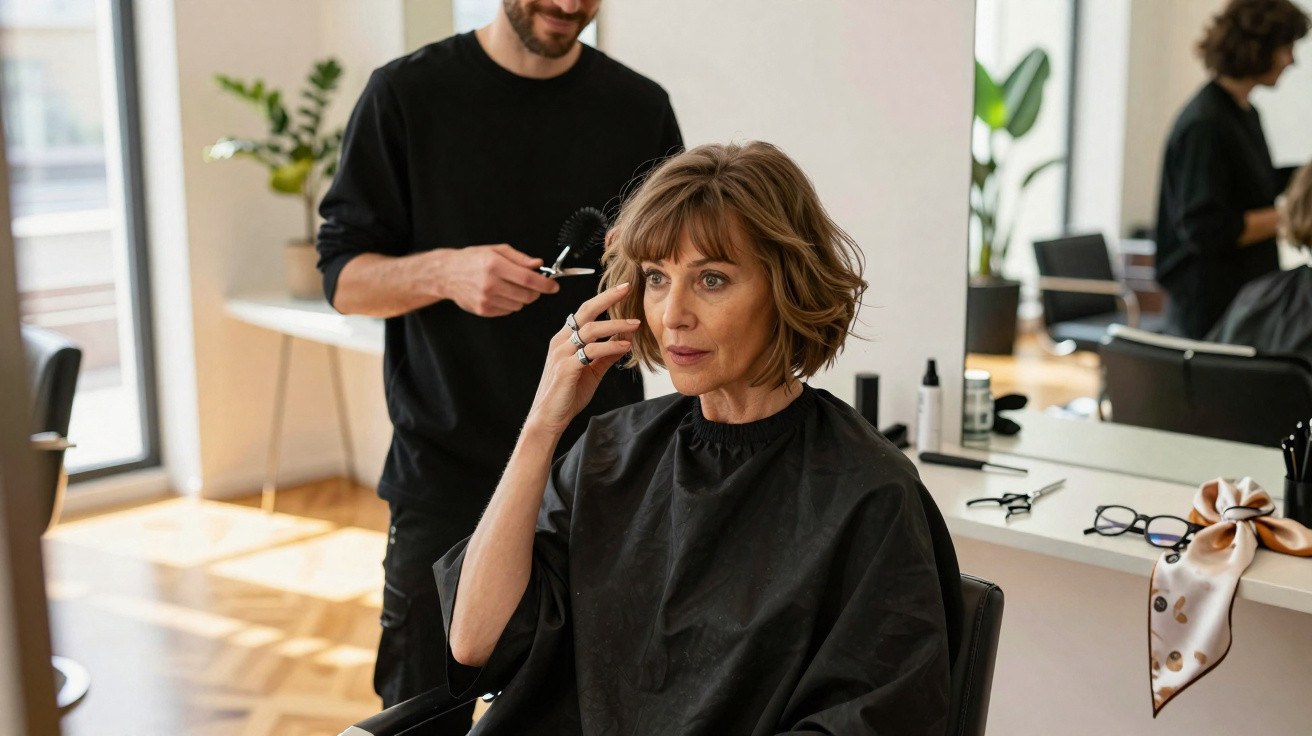
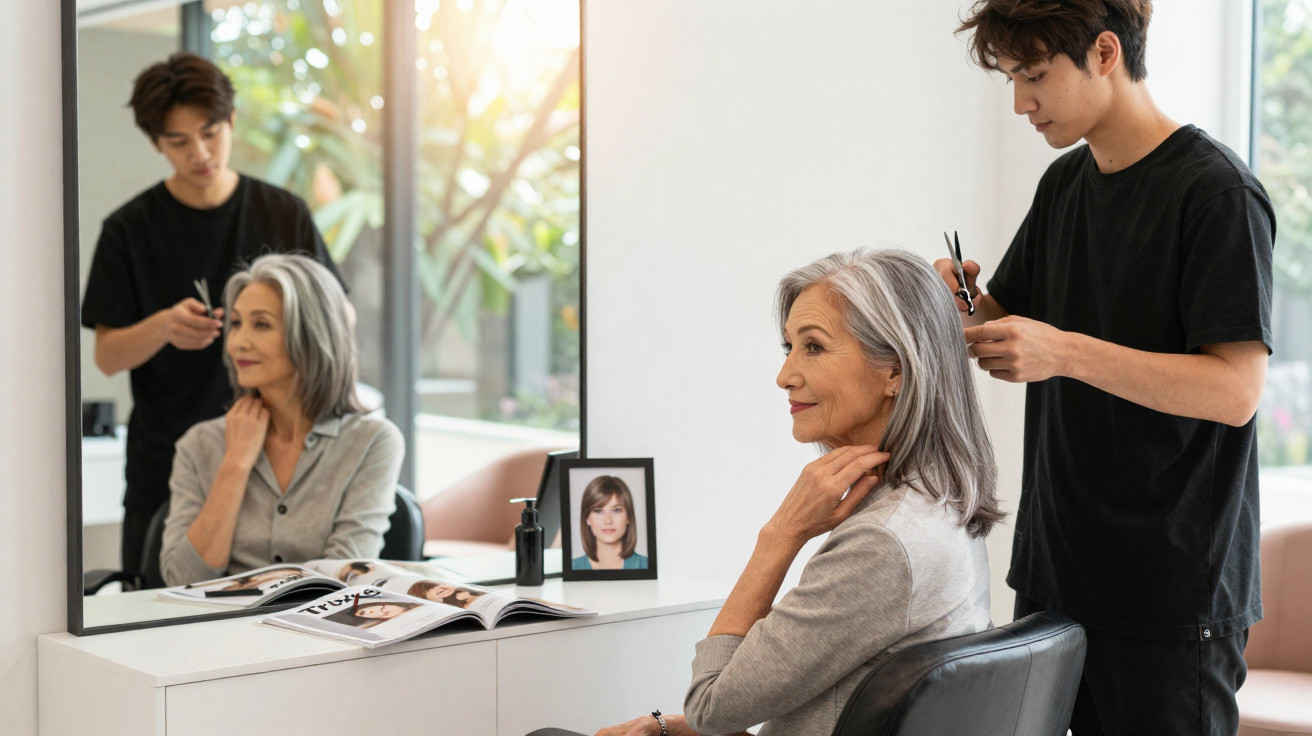
The hairdresser snapped her scissors closed and cocked her head. “You know, we could go for a real cut today.” Opposite her, Marianne, 64, went still, wearing the polite half-smile of someone determined not to lose any length. The salon buzzed around them: hairdryers, the scent of coffee, women in foils looking at their phones. A photograph on the mirror showed a client with a short, feather-light pixie cut, seemingly judging her. Vibrant. Current. Younger, without looking as though she was “trying to be young.”
Marianne murmured the familiar response: “At my age, I don’t want to look like I’m pretending.” Her hairdresser gave an almost imperceptible sigh.
Yet beneath this small exchange lies a question troubling many women over 60.
Who decided that adventurous hair after 60 should be viewed with suspicion?
Why some experts say rejecting a “youthful” cut can be fear in disguise
Speak to stylists who work with women over 60 every day and many describe the same pattern. The hesitation is seldom really about hair. It concerns what a new hairstyle appears to announce. Shorter, lighter and more defined styles communicate movement, visibility and presence. For women who have spent years being told to “tone it down” as they age, that can feel profoundly unsettling.
The supposedly safe option then becomes a long, wispy ponytail, an unchanged bob, or a carefully constructed “helmet”. It is not necessarily a matter of personal taste. Sometimes it serves as protection.
What is remarkable is how many professionals admit privately that they feel caught in this unspoken conflict. They recommend a fresher style; the client smiles and agrees, only to grip the old image on her phone as though it were a life jacket.
A Paris stylist told me about a 72-year-old client who had kept the same chin-length bob since the birth of her first child. “We’ve all been there, that moment when a photo from the past feels safer than the mirror.” After months of gentle encouragement, she eventually accepted a layered crop that hugged her cheekbones. It was not a drastic pixie, but more of a soft “French boyish” cut.
Two weeks afterwards, she returned not for a trim, but simply for a conversation. Strangers had complimented her at the supermarket. Her granddaughter said she looked “like a cool actress.” She had begun wearing lipstick again.
Nothing else had changed in her life that month. She had the same flat, the same joints cracking each morning and the same pension. Only the way her hair framed her face was different. Nevertheless, her posture while sitting in the waiting chair had changed completely.
Stylists and psychologists identify the same process. Hair can become a visible record of identity: long hair from “before the kids”, the fringe from a first job, the neat familiar bob from the marriage years. Cutting into that record can feel like deleting whole chapters, and this is where fear enters.
Experts promoting bolder, younger-looking cuts after 60 are not necessarily preoccupied with youth. Rather, they are challenging the fear of becoming too noticeable, too “alive” for the role society expects older women to play.
The simple reality is that ageism has taught many of us that the safest appearance is one that attracts no remarks. A modern, youthful cut attracts remarks.
The youthful cut experts recommend for women over 60 - and why it frightens many
When hair professionals discuss the “youthful cut” for women over 60, they are not all describing one identical style. However, one version repeatedly emerges: the short, airy crop. It is lighter at the nape, has movement around the temples and texture on top. It exposes the neck, opens up the face and visually raises the cheekbones.
This is not the extremely severe pixie associated with the 1990s. Instead, it is a gently tousled, shaped look that can be styled with the fingers. It suits grey, white, salt-and-pepper or coloured hair, and can work with both fine and thick textures. The intended effect is always the same: to bring the eyes and smile back into focus.
Stylists stress that the issue is less about the centimetres removed than the structure created. It is about opening the face and removing the heavy, drooping line that visually pulls everything down.
A London colourist showed me photographs of three clients in their late 60s. They were different women, but their stories were alike. Each had arrived with long hair drawn into a low bun “because it’s easier.” In the mirror, those buns seemed to add ten years. Their hair lay flat against the scalp, while the back lengths had become thin wisps.
After the cut, their hair sat at shoulder length or above, with layers that lifted around the jaw. With one especially bold client, they chose a full crop: soft sideburns, a rounded nape and a light fringe. She left wearing jeans and trainers, laughing that she looked like she had finally caught up with her playlist.
The colourist monitored reactions on Instagram. These styles received more saves and shares than most makeovers involving women in their thirties. The message in the comments was unmistakable: people want to see older women looking alert, not “beige and nice.”
For experts, the reasoning is almost mathematical. As we age, facial muscles loosen, skin loses density and angles become softer. A long, weighty curtain of hair draws the eye downwards. A shorter, structured style sends it visually upwards instead.
They argue that rejecting this option is often less about taste than a quiet dread of attention. A modern cut says “I’m still part of the picture.” Some women do not feel entitled to say that. Others fear being accused of “trying too hard.”
But once the noise is removed, hair is simply a tool. It can pull the past along behind you as a burden, or provide support for the life you live now. The controversial advice offered by many professionals is straightforward: the fear of looking “too young” may actually be a fear of being seen at all.
How to try the cut without feeling ridiculous
Stylists who achieve the strongest results with women over 60 seldom begin by saying, “Let’s go short.” Instead, they begin with a mirror and a question: which feature of your face do you still love? Your eyes, cheekbones, smile or jaw? The haircut is then created to highlight that feature.
If you love your eyes, they may use a light fringe or add height on top. If your jaw remains defined, they can expose the neck and keep the sides clean. A gradual transition is often suggested: begin with a mid-length cut containing more layers, then go shorter at the next appointment if you feel comfortable.
Many recommend one practical approach: take along three recent photographs of yourself that you like, plus three pictures of women your own age whose hair you admire. This offers a guide to both your real life and your fantasy life. The right style usually sits somewhere between the two.
These experts say the greatest mistake is treating the word “young” as an insult. “I don’t want to look young” often conceals another thought: “I’m afraid people will laugh if I look too alive.” That is not vanity; it is self-protection.
They also caution against what they call “hair martyrdom”: retaining a length that no longer suits your texture because resisting change feels virtuous, or holding on to a rigid, set hairstyle requiring rollers and half a can of hairspray every week.
Honestly, nobody keeps that up every day. The right cut after 60 should cope with unhurried mornings, rainy walks and days when there is only time for a quick wash and a rough finger-dry.
One New York stylist who works almost exclusively with women over 55 told me: “The most radical thing an older woman can do isn’t to cut her hair short. It’s to choose a cut that matches her energy instead of her fears.” That line stuck with me. Energy, not age, as the guiding rule.
- Ask for movement, not “youngness” - Use terms such as light, airy, textured and lifted. A stylist can translate those ideas into the length that suits you.
- Keep the back clean - A long, straggly nape is especially ageing. A tidy neckline immediately appears fresher both in photographs and in person.
- Honour your texture - Whether your hair is curly, wavy, fine or thick, the cut should work with its natural pattern rather than fight it.
- Plan a 3-month test - Agree with your stylist: “We try this shape, we live in it for a season, then we adjust.” There is no need for a lifelong commitment.
- Set your own “too much” line - If a full pixie feels frightening, choose a cropped bob. If a fringe seems daunting, start with longer, side-swept pieces.
What your hair really reveals about how you see your age
Stand in front of the mirror now, or later, and view your hair as if it belonged to someone else. Put aside your history, your mother’s voice and your partner’s preferences. Look only at the shape, the movement and the way it frames your face today. Does it reflect the woman you are at this moment? Or does it tell a story from twenty years ago that no longer fits?
Some experts will continue to insist that avoiding a youthful, modern cut is simply fear of your own vitality. Their view may be blunt, but it touches on something genuine: the gap between how old we feel inside and the quiet ways we begin making ourselves smaller on the outside.
Perhaps the answer is not “Go short or stay long.” Perhaps it is this: stop choosing hair that causes you to disappear. Whether you select a chic crop, a layered bob or a sharp silver shag, the underlying question remains the same.
Are you willing to be seen as the age you are, with all the light that comes with it?
| Key point | Detail | Value for the reader |
|---|---|---|
| Revealing the face lifts the whole look | Shorter napes, layers around the jaw and eyes redirect attention upward | Offers a simple visual trick to look fresher without chasing youth |
| Fear, not taste, often blocks change | Attachment to old styles can hide anxiety about visibility and judgement | Helps readers recognise emotional patterns behind their hairstyle choices |
| Energy is a better guide than age | Choosing cuts that match personality and lifestyle, not stereotypes over 60 | Gives permission to experiment with modern, vibrant looks at any age |









Comments
No comments yet. Be the first to comment!
Leave a Comment