
A blunt, mid-length cut with a lightly “swept-out” finish is appearing everywhere, from social feeds to celebrity red carpets. Hair professionals have dubbed it the broom bob, but women over 40 are divided: is it stylish, ageing, or simply too demanding to maintain?
What is the broom bob?
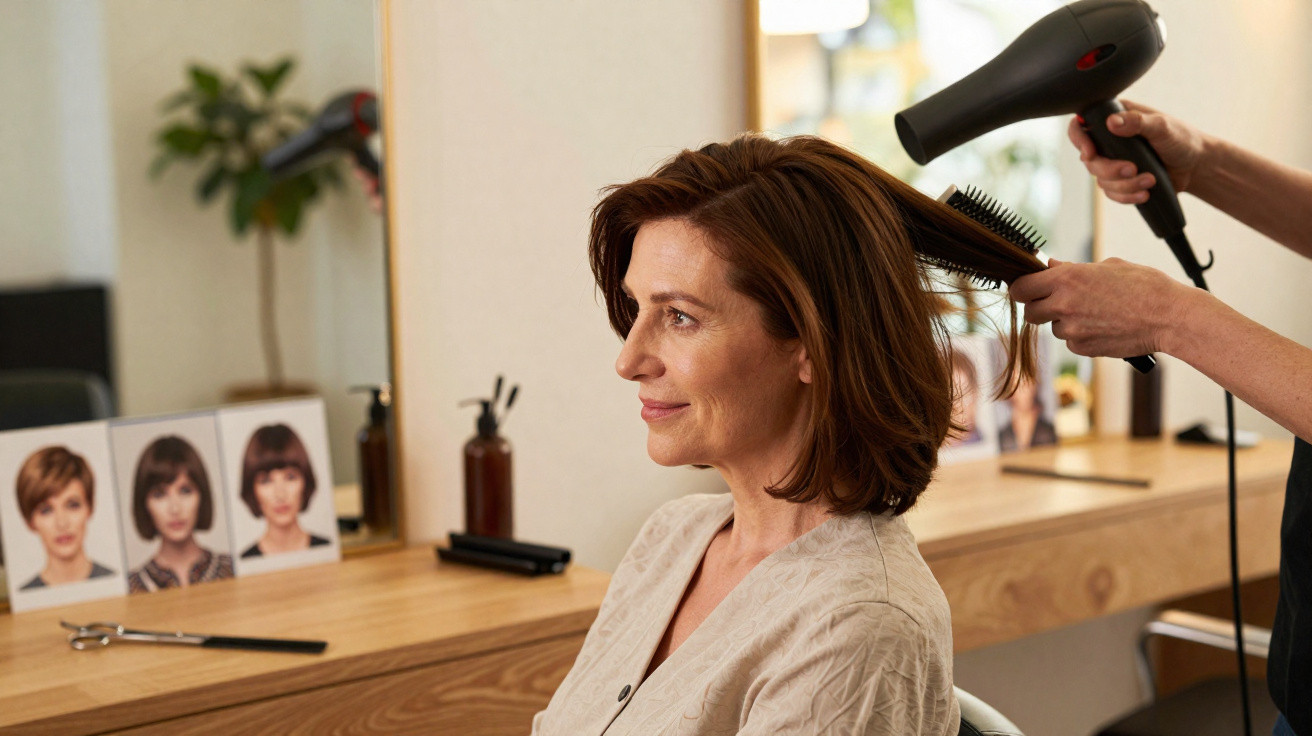
The broom bob falls anywhere between the jawline and collarbone. Its ends are cut into a straight line, then given the faintest amount of texture. The overall result is smooth rather than severe: think “neatly swept” rather than pin-straight.
The broom bob is defined by a blunt hemline, a clean outline, and movement that flicks just away from the face.
Its name refers to the way its ends spread very slightly, resembling the flat bristles of a broom. Some interpretations turn inwards, while others flick softly outwards. The final effect depends on whether the hair is blow-dried or straightened.
Key features of the broom bob trend
- Length: from chin to collarbone
- Ends: blunt, with gentle texturising to create movement
- Shape: straight or subtly rounded, generally with few layers
- Styling: a smooth finish, commonly achieved using a round brush or straighteners
- Fringe: an optional curtain fringe or side parting; a thick, full fringe is uncommon
The intention is to create definition without rigidity. It outlines the jaw, tidies the neckline and reveals the collarbones, all of which many stylists regard as flattering for women over 40.
Why spring 2026 is embracing mid-length hair
Following years dominated by XXL lengths and shaggy layered styles, many salon clients are looking for a cleaner shape. Mid-length bobs offer a fresh start without the commitment of a very short cut. They also fit comfortably beneath coats and scarves, a useful advantage during a changeable season.
Across social media, the broom bob sits naturally within the “quiet luxury” look: refined, uncomplicated and apparently effortless, even if it takes time to achieve. Fashion weeks in New York and London have likewise favoured more tailored shapes, and hairstyles are reflecting that direction.
For women navigating work, perimenopause, parenting and dating in their 40s and 50s, a low-fuss yet sharp haircut promises control.
Since January, hairdressers have seen more appointments for mid-length cuts, particularly among clients keen to remove damage caused by years of colouring.
Why stylists disagree about the broom bob
Hair professionals are not universally convinced by the style. Their disagreement is less about whether it looks good and more about its practicality and who it suits.
The argument in favour
Those who support the broom bob say it brings immediate shape to hair that has become finer through age or hormonal changes. A blunt perimeter can make hair look fuller, while the manageable length may help to limit tangles and breakage.
For colourists, it also creates a crisp backdrop for contemporary techniques such as soft balayage and grey blending. Its level baseline can make highlights appear more even, while collarbone-length hair reveals delicate tonal variation as it moves.
Concerns from sceptical stylists
Critics argue that the style can be unforgiving for certain face shapes and hair textures. A weighty blunt line may expand on wavy or coarse hair, producing a boxy outline that clients often find unflattering.
Without the right texture and styling effort, the broom bob risks looking like “helmet hair with a broom handle edge,” as one London stylist puts it.
There is also a risk that a cut sitting too high on the jaw, or finished too bluntly, can look severe on very angular faces. To soften the result, some stylists favour hidden layers or a gently rounded edge.
Why women over 40 have strong views
Women in their 40s and 50s remember the “Rachel”, the poker-straight bob of the 2000s and the school-run “mum cut”. It is unsurprising, then, that another mid-length hairstyle trend provokes such firm reactions.
Why some women love it
Fans see the broom bob as a welcome answer to the pressure to maintain long, mermaid-like hair after 40. Many feel it gives them a more defined professional look, particularly on video calls.
There is a psychological dimension as well. Choosing a collarbone-length cut can feel like taking back a sense of self after years of compromise hairstyles shaped by children, workplace dress codes or practical ponytails.
Why others say “not for me”
Others feel that mid-length hair can occupy an uncomfortable “no man’s land” between youthful and traditional. Some say that if they are cutting their hair shorter, they would rather choose a bold pixie cut or cropped bob than a style they consider “neither here nor there.”
Trend fatigue and expectations around age are another concern. Many women over 40 object to the suggestion that getting older means they should choose a neater, more controlled hairstyle, interpreting the broom bob as subtly prescriptive.
Who the broom bob actually suits
Stylists who regularly work with mid-life clients broadly agree on several practical considerations. The cut will not flatter everyone, but it can work extremely well when adapted to the individual rather than copied directly from a celebrity image.
| Factor | Best broom bob approach |
|---|---|
| Face shape | Round faces benefit from a length slightly below the chin; long faces suit collarbone length with a curtain fringe. |
| Hair texture | Straight to softly wavy hair works best with a cleaner edge; curls require more layers and shaping. |
| Hair density | Fine hair gains width from a blunt cut; thick hair needs internal layers to avoid a triangular silhouette. |
| Lifestyle | Those willing to use a brush or tool a few times a week get the most out of the shape. |
Maintenance, styling and everyday effort
For all its “polished but easy” appeal, the broom bob generally requires some effort. Trims every six to eight weeks are needed to preserve its clean edge. Even one or two centimetres of growth can alter the cut’s entire balance.
At home, most versions benefit from a blow-dry using a medium round brush, or a quick pass with straighteners to steer the ends slightly. Heat protection is essential, especially for coloured or peri-menopausal hair, which may be drier.
The broom bob is low on complexity but medium on upkeep. It’s not a wash‑and‑go cut for most people.
For thick hair, some salons suggest a lightly undercut internal layer to remove bulk and speed up everyday styling. With finer hair, a root-lifting spray or light mousse can stop the cut from lying flat against the scalp.
Ageing, confidence and the politics of a haircut
The discussion around the broom bob extends beyond face shape and hair texture. For many women over 40, hair length has long been tied to perceptions of youth, femininity and professional identity.
Social expectations still imply that “grown-up” women should wear hair that is tidy, not excessively long and not too wild. The broom bob fits comfortably within that idea, explaining why some women value its clean lines while others resist it as another understated instruction on looking “appropriate.”
Mental health professionals observe that changes in hair, particularly during mid-life, can accompany shifts in identity. Someone leaving a long-term job or relationship, or going through menopause, may select a cut that communicates clarity and control. Someone else may deliberately retain long hair to show that she has no need to conform.
Trying the broom bob without regret
Anyone considering the trend can minimise the risk through a few practical measures. For a first try, request a length just above the collarbone: it grows out more quickly and can still be tied back. Take pictures of hairstyles you like, but also examples of looks you definitely wish to avoid.
At the consultation, ask the stylist to show where the line would fall when your hair is straight, wavy and air-dried. A brief “simulation” using clips or temporary pins can show whether the shape complements your jaw and neck. For some people, a soft fringe or a small adjustment to the parting makes the style sufficiently more wearable.
If the maintenance feels daunting, a slightly layered lob with a softened edge is a useful transitional choice. It takes the broom bob’s structure but copes better with air-drying and grows out without such an obvious loss of shape.
Ultimately, the broom bob is not so much a rule as a conversation starter. It invites questions about how women in mid-life want to appear: sharp or soft, traditional or free, conscious of trends or wholly uninterested. The deciding factor is not the scissors, but how much of that conversation you want your hair to express each day.
















Comments
No comments yet. Be the first to comment!
Leave a Comment