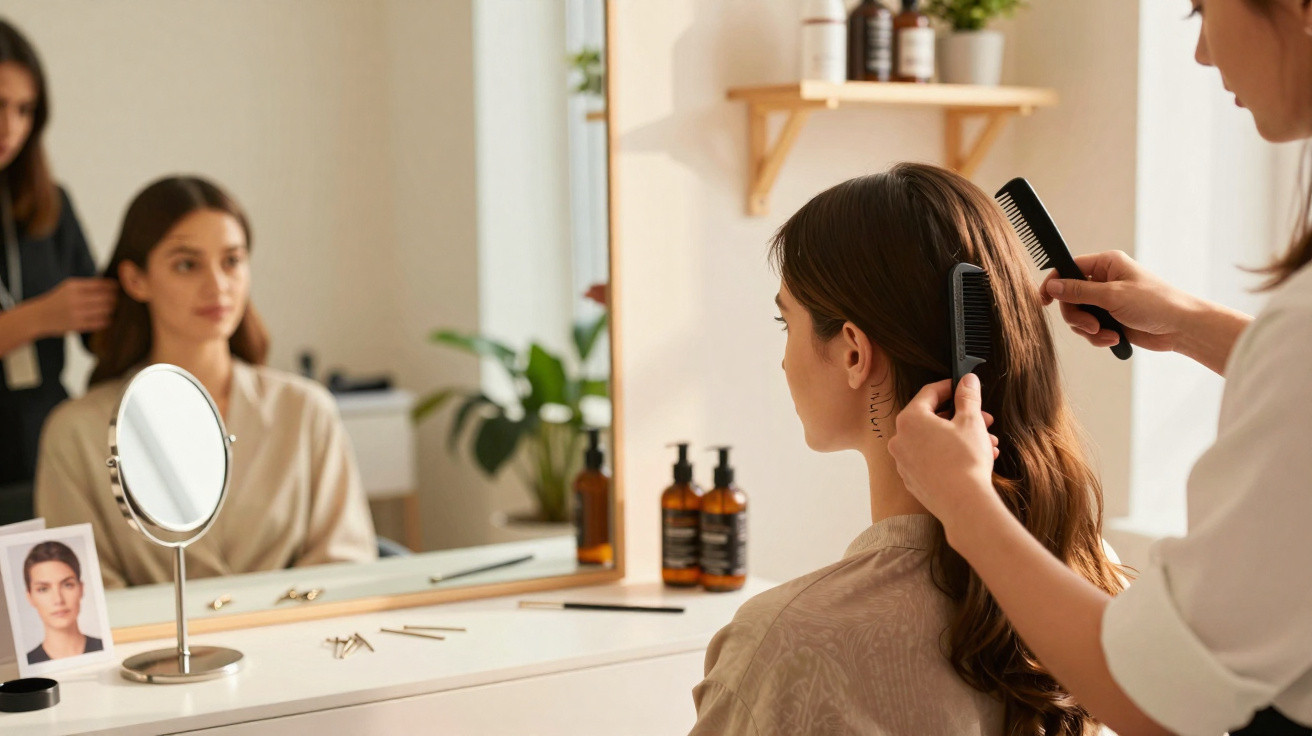
The hair salon smells of hairspray and freshly brewed coffee while rain drums against the window outside. A woman, perhaps in her mid-thirties, sits in the styling chair wearing a familiar expression: part curious, part doubtful. “Just a trim,” she says at first – the standard line when you really want more but do not quite dare. The hairdresser, dressed in a dark shirt with calm hands, studies her face in the mirror, tips his head slightly and smiles. “May I move your parting? Just a little.” With a fine comb and one swift movement, she suddenly looks different. Softer. More alert. Unexpectedly self-assured.
She looks at the mirror as though someone has switched on a filter. “Wow,” she murmurs, “my face somehow looks… different.” The hairdresser nods as if it is entirely ordinary. For him, it is. For her, it is not. Nor is it for most of us. After all, who expects an understated side parting to affect the face more than an expensive concealer can?
How a small side parting frames your entire face
We have all had that moment when a selfie simply does not look right, even though the make-up, lighting and pose should all work. Something appears harsh, wide or tired. Then you shift your parting on impulse and, suddenly, your face falls into place. It may sound like a social-media fairytale, yet it happens in salons every day. A side parting visually changes proportions: it can make cheekbones appear more defined, break up a high forehead, elongate a round face or soften an especially angular jawline. A few millimetres of hair placed differently can make your reflection tell a different story. Not dramatically. Just… more harmonious.
The hairdresser I spoke to is called Marco, and he has worked for 18 years in a small, permanently fully booked salon in a major German city. He tells me about one client who had worn a strict centre parting for years “because it was fashionable”. She had a round face, large eyes and rather soft features. “She always looked a little sad, even though she is really funny,” he says. One day, while blow-drying her hair, her parting happened to slip to the right. Marco paused, left it there and blow-dried over it once. “All of a sudden, her eyes were the focus, rather than her forehead,” he recalls. That evening, the client posted a selfie – and received twice as many likes as usual. Not because of a filter, but because of a side parting.
There is no magic behind it, only straightforward visual effect. A side parting directs the eye. It “pulls” volume to one side and creates a diagonal line across the face. That diagonal functions as a frame, bringing certain areas forward while letting others recede. A particularly wide face can look narrower because the eye no longer travels symmetrically from left to right, but is guided on a slight angle. A prominent chin can seem softer when more hair volume falls close to the cheeks. Let us be honest: no one calculates facial proportions while doing their hair in the morning. Yet that is precisely what a good hairdresser does mentally – within seconds.
How to find the “right” side parting for your face
Marco begins with the same quiet exercise for every client: he looks before he cuts. He assesses forehead height, the chin line and the distance between the eyes. He then takes a tail comb and first positions it directly at the centre of the forehead. From there, he gradually moves it to the left or right, usually by only one or two finger widths. “Many people think a side parting means going radically far over to the right,” he says. In fact, a slightly off-centre parting is often enough to alter the face. To try it at home, dampen your hair slightly, stand in front of a mirror and move the parting in tiny increments. Pause briefly after every adjustment and look only at your face, rather than your hair.
One common mistake is placing a side parting exactly where the hair “naturally” separates. It sounds sensible, but it is not always the most flattering position for the face. Many of us have cowlicks or flatter sections that automatically push the parting in one direction. That may be more practical, but it does not necessarily look better. Marco says that many people part their hair in the same place for years because they believe they “have no other choice”. Yet a parting can often be retrained if you give it a few days. It can be irritating at first. A few strands will stick out in the wrong direction, and you may feel slightly “unfinished”. Still, the transition is worth it when cheekbones you had almost forgotten begin to emerge.
Marco puts it rather directly in conversation:
“A parting is like a pair of glasses: it can open up your face or cover it. Most people simply wear the ‘wrong glasses’ because they have never tried anything else.”
He advises choosing a side parting that suits your own daily routine, rather than relying only on trends or influencer photos. Anyone who regularly wears headphones, caps or helmets will eventually curse an extremely deep side parting. Here are a few things to consider:
- Try a side parting just above the highest point of your eyebrow.
- Take photos in daylight – front-facing cameras often distort proportions.
- Check in the morning and evening how the parting “lives” when your hair is no longer freshly styled.
- Stick with it for one to two weeks before deciding that it is “not you at all”.
Why a side parting also affects how you feel about yourself
It may sound superficial, but anyone who has experienced how a small change in parting can emotionally shift their reflection knows that more is happening than simply moving hair from left to right. Many people say that a side parting makes them feel softer, more feminine or more grown-up. Others find that they suddenly look more professional and less “baby-faced”. This perceived difference is not imagined. Our brains react sensitively to symmetry and asymmetry. A centre parting appears neater and stricter. A side parting adds movement – a kind of small imperfection that makes the face look more alive.
We all know those days when we feel unfamiliar to ourselves in the mirror. New make-up, new glasses, freshly coloured hair – and still, it does not quite match. A side parting can become a quiet adjustment point. It is especially useful for people who do not want to reinvent themselves completely, but would rather make a subtle change. No dramatic cut and no striking colour. Only a different parting. Yet the world looks different when your reflection no longer seems harsher towards you than anyone else does. Many of Marco’s clients tell him that a well-placed side parting suddenly gives them more confidence to wear their hair down or sweep their fringe away from their face.
It would be easy to dismiss all this as “hairdresser poetry”. But one sober point remains: let us be honest, nobody changes their entire life merely by moving their parting. What changes is the small daily encounter with your own face. It is an encounter we have when tired in the bathroom in the morning, in a quick glance at a shop window or on a video call with a poor camera. If a simple side parting makes your face look more balanced, you will feel less irritated with yourself in those moments. It is not a miracle tool. It is a small, quiet correction that settles into your self-image in the background – almost without notice.
| Key point | Detail | Benefit for the reader |
|---|---|---|
| A side parting changes proportions | It guides the eye diagonally, accentuates the cheeks and disguises width or harshness | The reader understands why their face can suddenly appear “different” |
| A slight shift is often enough | Move it one to two finger widths away from the centre rather than creating an extremely deep parting | Easy to test at home, without a radical change of look |
| A parting is an emotional adjustment point | Asymmetry appears more lively, reduces severity and brings out character | The reader sees how a small detail can subtly improve their self-image |














Comments
No comments yet. Be the first to comment!
Leave a Comment