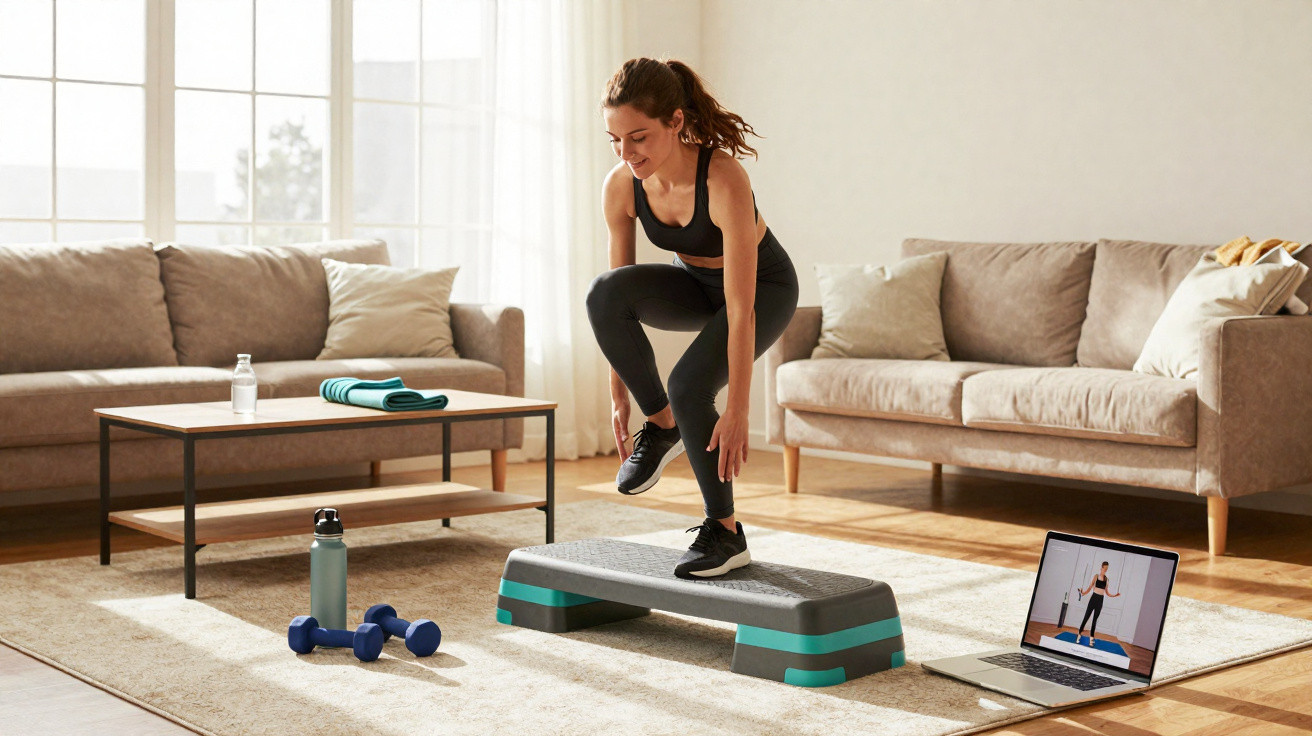
A low-cost Lidl gadget can turn the living room into a workout space.
Anyone aiming to exercise regularly can quickly end up facing subscription traps, online classes and crowded gyms. It need not be that way. A simple, compact exercise board from the discount retailer’s range demonstrates how much can be achieved with little money and minimal space – and why many users favour it over traditional Pilates or gym workouts.
What the Lidl fitness board offers
At the centre of it is a Crivit step platform, sold by Lidl for €22.99. Initially, it looks like an ordinary step board from a 1990s aerobics class. A closer look, however, reveals that it can do considerably more.
The Crivit step board combines cardio, strength and balance training in one piece of exercise equipment – for under €25.
Weighing just 2.8 kilograms, the board can be carried easily from one room to another. Its low-profile design means it can be stored upright against a wall or slid horizontally beneath a bed. This is particularly valuable in smaller flats: it does not have to remain in the way all the time.
Its key feature is the resistance bands built into the board, which can be used to work the upper body. That turns a conventional step into a compact all-in-one station for whole-body training.
Adjustable height: from beginner-friendly to sweat-inducing
The platform has two height settings, both adjustable within seconds:
- 10 centimetres: suited to beginners, low-impact sessions and moderate cardio
- 15 centimetres: designed for more experienced users, tougher workouts and greater calorie expenditure
A difference of only five centimetres has more impact than might be expected. The higher setting makes the thighs and glutes work harder. It also raises the heart rate, increasing energy expenditure during each session.
Common exercises on the board include basic step-ups and step-downs, side steps, step knee raises and jumping combinations. Adding squats and lunges creates a compact power workout that challenges the cardiovascular system and leg muscles at the same time.
More than simply stepping up and down
The platform is not limited to cardio workouts. Its sturdy, slightly raised surface also allows numerous strength exercises to be adapted:
- Press-ups with either hands or feet on the board
- Tricep dips using the edge
- Side planks with the forearm on the platform
- Planks with alternating hand positions to introduce more instability
- Standing on one leg on the board for balance training
Including these movements works not only the larger muscle groups, but also the deeper core muscles that support stability and healthy posture.
Why users rate the Lidl step board so highly
The equipment performs extremely well in user reviews, with an average rating of 4.9 out of 5. Stability, durability and value for money receive particularly frequent praise.
The combination of a non-slip deck and secure feet keeps workouts controlled, even on smooth floors.
The platform has a textured, slip-resistant finish. This gives feet sufficient grip, whether exercising barefoot or wearing trainers. Rubber feet beneath the base also greatly reduce the risk of the board sliding on tiles or parquet flooring.
Many buyers say they use the board several times a week, either for brief but intense 15-minute sessions in front of the television or alongside running and cycling. Quite a few state that it has enabled them to cut back on gym training.
Not a replacement for a trainer, but an excellent starting point
Naturally, a step platform cannot replace a professionally guided programme with a trainer, individual correction of mistakes and long-term planning. Even so, this kind of equipment offers many people a realistic first step towards becoming more active.
The low barrier to entry is especially helpful for anyone with little time after work or who feels uncomfortable at the gym: take out the board, put on some music, train hard for 20 minutes – and you are done.
Why this board is seen as an affordable alternative to Pilates
Pilates classes are among the most popular forms of whole-body exercise. Their focus is core stability, posture, controlled movement and breathing. Yet class fees can soon add up, and not everyone can find a suitable session nearby.
While the step board is not a complete replacement, it covers a surprisingly large number of similar aims:
| Aspect | Pilates | Step board training |
|---|---|---|
| Strengthening the core | Targeted core exercises on a mat | Planks, side planks and balance exercises on the board |
| Improving posture | Controlled exercise sequences | Stabilisation through upright stepping movements |
| Low-impact training | Usually slow, guided movements | Moderate height, with the pace freely selectable |
| Calorie expenditure | Generally moderate | Significantly higher due to the cardio element |
With a well-planned routine, the board can address typical “Pilates goals”, such as core strength and posture, while also placing a greater demand on the cardiovascular system. The integrated resistance bands are particularly useful here, creating a whole-body programme that can make many gym classes unnecessary.
Practical home workout ideas
To begin realistically, three sessions each week are enough. One possible beginner programme consists of:
- 5 minutes of gentle warm-up activity, such as marching on the spot and shoulder circles
- 8 minutes of basic step movements at a comfortable pace
- 3 minutes of squats with one foot on the board, then switching sides
- 4 minutes of upper-body work with the resistance bands, including rows, bicep exercises and shoulder raises
- 3 minutes of planks with hands on the board
- 2 minutes of easy cool-down activity and stretching
As fitness improves, jumping movements can be added, the height can be increased to 15 centimetres, or intervals can be used – for example, 30 seconds at full intensity followed by 30 seconds of rest.
Who the Lidl step board suits – and what to consider
It is particularly beneficial for:
- Working people with limited time who want short, effective workouts
- Exercise beginners who do not want to spend money on expensive subscriptions
- More experienced users seeking versatile additional equipment for home use
- People without enough room for large exercise machines
Anyone with knee or hip problems should build up their pace gradually and start on the lower setting. Correct technique is vital: the entire foot should be placed on the platform, and jumps should only be attempted when the joints and muscles are sufficiently stable.
Compared with traditional home exercise machines such as cross trainers or treadmills, the risk of injury is generally lower, provided users do not overdo it and listen to their body.
Why the purchase often pays for itself sooner than expected
When a Pilates or gym membership costing €25 to €40 per month is considered, the step board has effectively paid for itself after one or two months of intensive use. There is also a time saving: no travel, no fixed class times and no waiting for equipment to become available.
Of course, a €23 piece of equipment cannot replace a fully equipped gym with qualified staff. For many people, however, it is enough to become fitter, stronger and more active without putting pressure on their finances. Anyone who uses the board consistently and gradually takes on more challenging exercises gains a training tool that comes surprisingly close to paid classes.


Comments
No comments yet. Be the first to comment!
Leave a Comment