
The waiting area was unusually hushed for a Tuesday afternoon. Silver-haired people sat in a row, absorbed in phones, magazines or their own thoughts. At the far end, a woman in her early sixties repeatedly smoothed her hair, as though she could tuck the grey back beneath her scalp. When the young medical intern called her through, she hurried in, apologising for her “ugly roots”.
Ten minutes later, she emerged visibly unsettled. It was not a serious diagnosis that had shaken her, but an unexpected warning from the intern: a daily habit she had followed for years might be worsening her grey hair - and affecting her health.
The hardest part was that she considered it “normal after 60”.
Grey hair at 60: what can really affect your scalp
Ask people aged over 60 which part of ageing bothers them most and grey hair is often mentioned quickly. This is not always vanity; it can feel like a visible clock, signalling that the body is changing faster than the mind.
Many people try to tackle it discreetly: using box dye in the bathroom, keeping root-covering sprays in a cupboard, or pulling their hair into tight buns to hide white at the temples. From the outside, it seems harmless - simply another maintenance task that comes with getting older.
Yet this familiar routine can place quiet, daily strain on hair follicles, like a constant drip wearing away at roots that are already fragile.
At the dermatology department of a medium-sized hospital, an intern called Laura began to spot a recurring pattern. Men and women over 60 arrived with similar concerns: “My gray hair is getting thinner”, “My scalp burns after I color it”, “I feel like I’m losing more hair each month”.
When Laura asked about their routines, the same detail appeared again and again: years of using harsh permanent dyes alongside damaging hair practices, including regular colouring, tight rollers, heat styling and going to bed with products still on the scalp.
One retired teacher explained that she had coloured her hair every three weeks “religiously” for 25 years. When Laura examined her scalp, it was inflamed and marked with tiny red patches, while the hair around the front had become noticeably thin. The grey itself was not the issue; the damage came from how she tried to conceal it.
Grey hair is not a medical condition. As we age, melanocytes - the pigment-producing cells in hair follicles - simply make less melanin. Hair then grows out silver or white, but its structure may still remain strong. Problems begin when the scalp is repeatedly exposed to chemicals and pulling.
Powerful ammonia-based dyes, regular bleaching and tight hairstyles create a combination of small but repeated assaults. A follicle already working harder after 60 must also contend with irritation, inflammation and reduced blood flow. In time, this may result in finer, weaker grey hair, increased breakage and, in some cases, permanent hair loss.
The intern’s warning may sound clinical when written down, but it is straightforward: the habit to avoid at all costs is repeatedly subjecting ageing grey hair to harsh chemicals, particularly when the scalp is never allowed time to recover.
The bad habit: repeatedly attacking grey hair after 60
For Laura, the intern, it became almost automatic: whenever she saw a red, glossy scalp and brittle grey lengths, she would gently ask, “How often do you color your hair?” The responses made her wince: root coverage every fortnight, three colour treatments before a holiday, or leaving dye on “a bit longer” to improve coverage.
The pattern is simple: treating grey hair as an enemy to be eliminated. Permanent dye is applied layer upon layer, with dark pigments and sometimes inexpensive supermarket products placed on a scalp that is thinner, drier and more reactive than it was at 30.
The issue is not solely the product. It is also the belief that anything is worth doing to avoid spotting a single white strand in the mirror.
One afternoon, a 63-year-old former hairdresser arrived with an inflamed, itchy scalp and scattered bald areas at her temples. Nervously, she laughed and said: “I know what you’re going to tell me, I’ve done this job for 40 years.”
She had been colouring her roots every 15 days with a strong black permanent dye. If the grey seemed “stubborn”, she sometimes left it on for an extra 10 minutes. She also slept in a tight headband to preserve her hairstyle. Eventually, the combination of continuous tension and chemicals had caused chronic inflammation and suspected contact dermatitis.
When Laura advised her to stop using permanent dyes for a while, her initial concern was not her health. Instead, she asked: “But what will people think when they see all my white?” That one question is echoed in millions of bathrooms every month.
From a biological perspective, a scalp after 60 does not function in the same way as a 30-year-old scalp. Its skin barrier is more delicate, sebaceous glands make less oil and microcirculation may be reduced. Adding ammonia, high-volume peroxide and repeated pigment treatments is like cleaning an old painting with industrial-strength chemicals.
Grey hair fibres are generally more porous and coarse as well. They may take up dye more rapidly, yet they also lose moisture quickly and can become hollow, making them likely to snap. Frequent colouring, forceful brushing and tight ponytails or rollers add further mechanical pressure. Over months and years, this can create a double problem: grey hair that appears dull and burnt, plus a scalp that responds with stinging, flaking or thinning hair.
The intern is not saying “never color your hair again”. Her message is to stop fighting a chemical war against your grey hair as though your scalp cannot be damaged.
Caring for grey hair after 60 without giving up on yourself
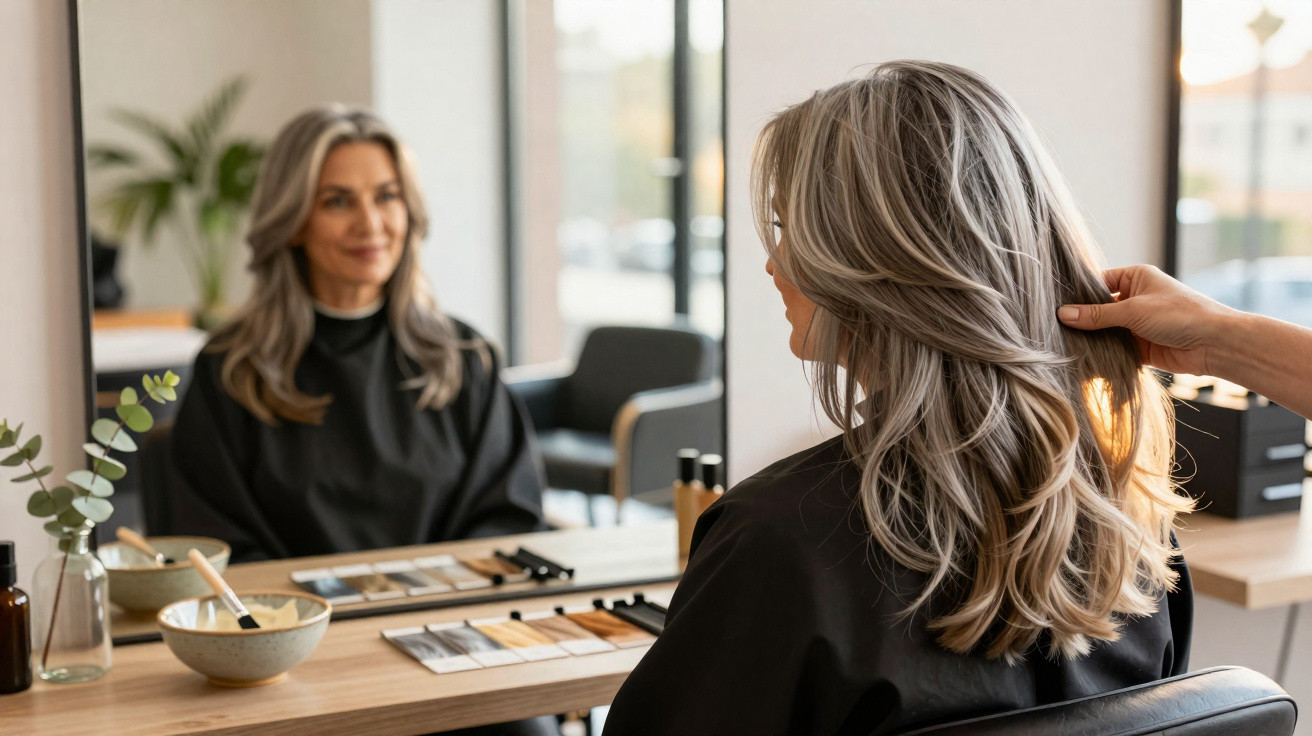
There is a different way to manage grey hair after 60, one that does not turn care into a chemical battlefield. The first step is strikingly simple: extend the gap between permanent colour treatments rather than reducing it. Aim for four to six weeks, then perhaps eight. Roots may not look flawless, but the cycle is kinder.
Some patients choose partial approaches, colouring only the front hairline or using soft lowlights rather than covering the whole head. Others try semi-permanent colours with milder formulas, or plant-based colourants that fade gradually without irritating the scalp.
Everyday care also matters more than it may seem. Moisturising shampoos, silicone-free conditioners and light-oil scalp massages before washing can all help. These small acts tell the follicles, “You’re still worth protecting.”
Many people over 60 feel caught between two stereotypes: being “totally gray and letting go” or “forever dyed and pretending”. In reality, there is much more room for a gentler middle ground. Natural white hair can be blended gradually with the existing colour, while some colour can be retained with less intensity and less frequent treatment.
When Laura discusses this with patients, some cry with relief. They are worn down by the unseen expectation to hide every grey hair. More deeply, they are tired of punishing a body that is simply ageing as it should.
Most of us have experienced a moment when the bathroom mirror feels like an adversary rather than an object. Treating your grey hair gently can also mean treating yourself more gently.
After dealing with yet another scalp allergy caused by a strong dye, Laura once found herself saying something she had not intended to say:
“Your gray hair is not the problem here. The way you fight it is.”
The words struck home. The woman sitting opposite her breathed out and almost laughed; she had spent years blaming the wrong thing.
Let us be honest: nobody really does this every day. No one follows every piece of hair-care advice with perfect discipline. Life is busy, budgets are limited and habits are hard to change. Even so, many of Laura’s patients began following a few simple principles:
- Leave at least 4–6 weeks between permanent dye treatments whenever possible.
- Do not sleep with dye, hairspray or heavy styling products left on the scalp.
- Avoid extremely tight hairstyles, including buns, rollers and extensions, that continually pull on fragile roots.
- Try gentler formulas or partial colouring rather than full-head permanent dye every time.
- Care for the scalp as you would facial skin: moisturise it, protect it and pay attention when it reacts.
Grey hair, self-image and the choice you make each month
Beneath all the discussion of chemicals lies something more personal. Grey hair at 60 is not only about pigment; it is about identity - who you are at work, with your partner and in family photographs. The mirror reflects more than hair; it reflects time.
This is why the harmful habit can be so difficult to break. Many people would rather chance scalp irritation than face the surprise of seeing themselves entirely grey. It is not simply vanity, but disorientation: they do not fully recognise themselves with white hair. It can feel as if they have jumped forward 10 years overnight.
Once that is understood, the question changes. Rather than asking, “How do I kill the gray?”, it becomes, “How do I age without hurting myself to look younger?”
Some patients who pause aggressive colouring for several months describe an unusual adjustment period. Initially, they feel exposed, almost bare. Then something shifts. Friends tell them they look “softer”, “lighter”, “like themselves again”. Their hair often appears healthier, shinier and less “fried”.
One woman in her late sixties told Laura that she finally stopped colouring after an allergic reaction led to an emergency hospital visit. She spent six months growing out her natural white hair. At first, she disliked every photograph of herself. Later, looking back, she said: “I wasted years attacking my own hair for a battle I could never win.”
A complete transition is not necessary or desirable for everyone. The important thing is the freedom to decide, rather than colouring automatically because of fear.
After 60, living with grey hair becomes a quiet negotiation with reality. You may choose to conceal it, blend it or embrace it. Medically, the important issue is not the colour itself, but whether the methods used are harsh or kind.
That “bad habit to avoid at all costs”, which the intern repeatedly sees, is assuming that a scalp at 65 can endure the same treatment it did at 25. Repeated strong dyes, no recovery time, tight hairstyles, sleeping in product and ignoring early signs such as burning or itching create the risky combination.
Once you identify it, you can begin to make adjustments. Not perfectly or all at once, but just enough to safeguard the hair you hope to keep and the person you are becoming in the mirror.
| Key point | Detail | Why it matters to the reader |
|---|---|---|
| Grey hair itself is not the enemy | Ageing reduces pigment, but healthy grey hair can remain strong | Helps you stop blaming grey hair and focus on the real risks |
| The real bad habit | Frequent, harsh chemical dyes and tight hairstyles on an ageing scalp | Identifies what genuinely damages hair after 60 |
| A gentler routine is possible | Extend intervals between dyes, choose milder methods and care for the scalp | Provides practical options without giving up on appearance |









Comments
No comments yet. Be the first to comment!
Leave a Comment